What Is an Influencer Score? How InfScore Builds One
What is an influencer score? InfScore's is a 0–100 versioned composite of four public signals, with visible weights, coverage, and dashes for gaps.
This versioned composite uses only available public signals. Missing factors stay unavailable and their weight is rebalanced across observed factors. It is not a percentile, price estimate, or guarantee of campaign results. Model 2026-08-18.1.
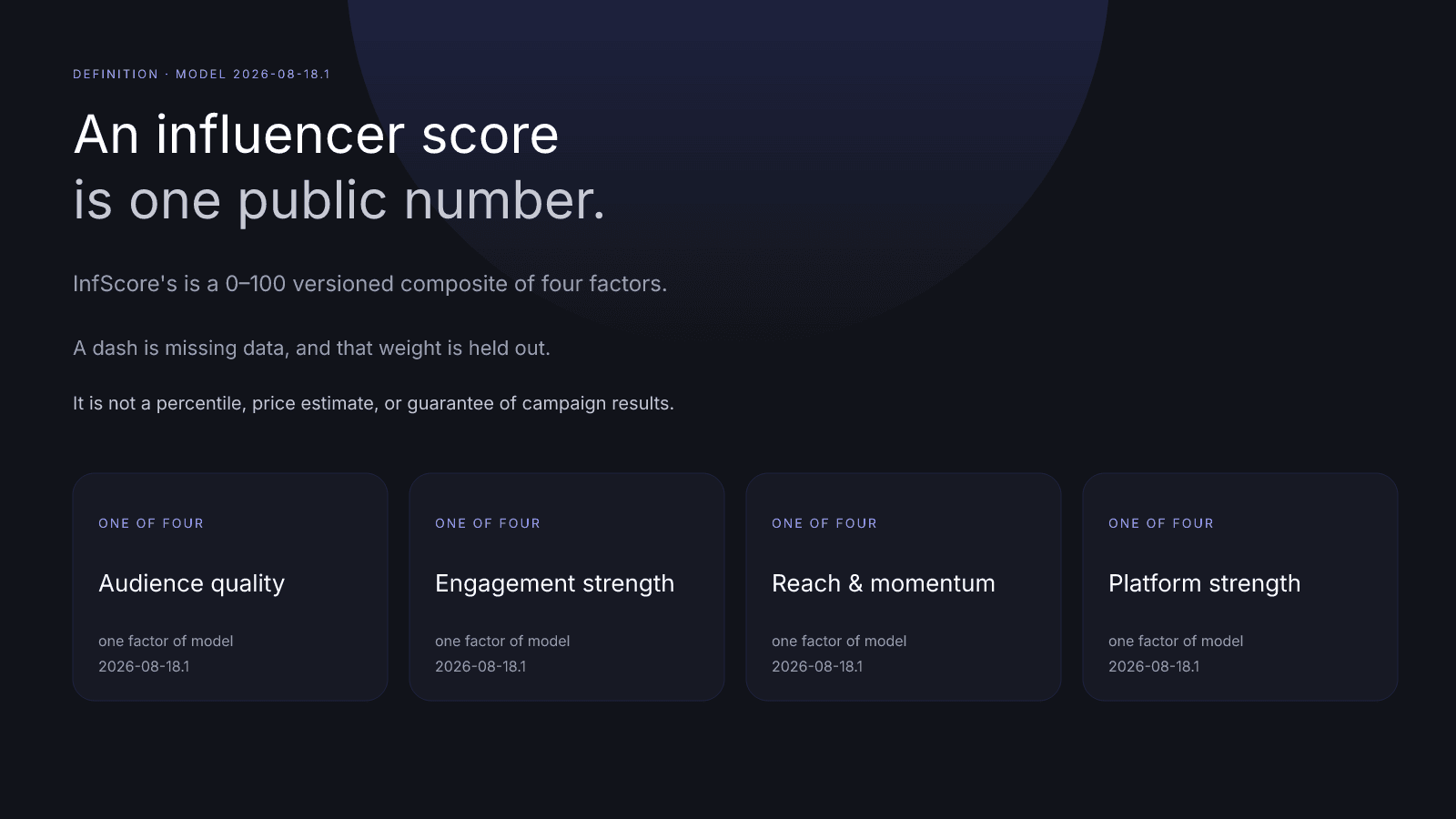
An influencer score is a single number that summarizes a creator's public signals. InfScore's is a 0–100 versioned composite of four factors. On model 2026-08-18.1 the weights are 32/27/23/18: audience quality 32%, engagement strength 27%, reach and momentum 23%, and platform strength 18%. A dash is missing data, and that factor's weight is held out. It is not a percentile, price estimate, or guarantee of campaign results.
What an influencer score is
The public card shows that composite for the profile you looked up, with the model id printed on the card. The same handle can show a different 0–100 under a different model id, which is why the model belongs in the definition. The factor tour, the reading order, and the coverage arithmetic each have their own guide, linked below.
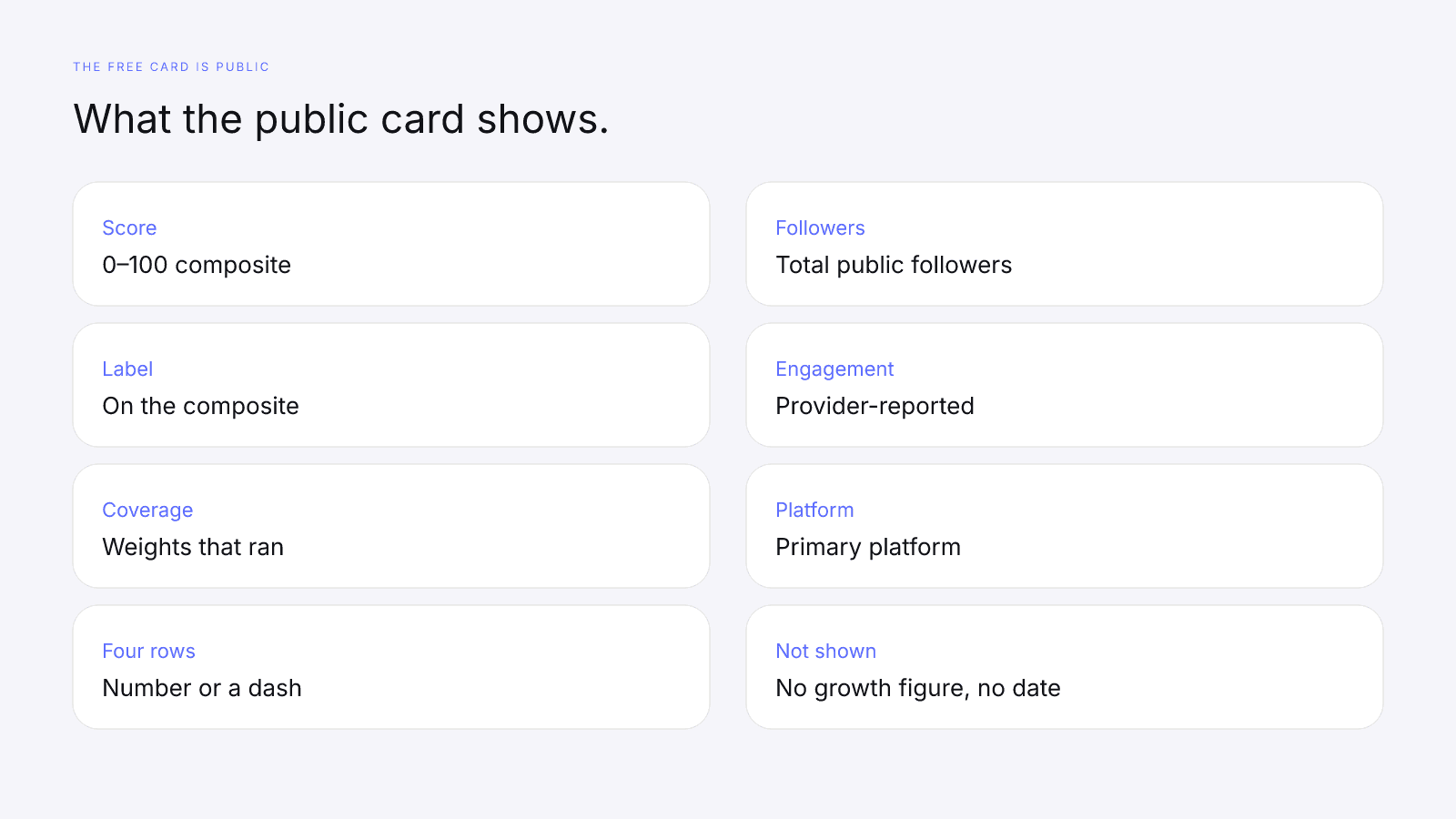
The free card shows the score, the label on the composite, the coverage line, the four factor rows, Total public followers, Avg. engagement, and Primary platform. Avg. engagement is provider-reported. There's no growth figure on the free card and no printed date. It's public, and you don't need to sign up to see it.
Cite that card by its public URL, its model id, and its coverage line, and name any dash as missing. The 0–100 on its own isn't the whole reading. Two lookups can print different composites when different factors ran or when the model ids differ. Coverage tells you which weights were in the divisor, and the model id tells you which published weights those were. Copy both, along with the date you viewed the card, before you repeat the number.
The four factors behind InfScore
How to Measure Influencer Performance walks through these factors in full. Each line below names one factor on model 2026-08-18.1, and the terms are defined one by one in the influencer marketing glossary. The weights are the ones in the opening paragraph.
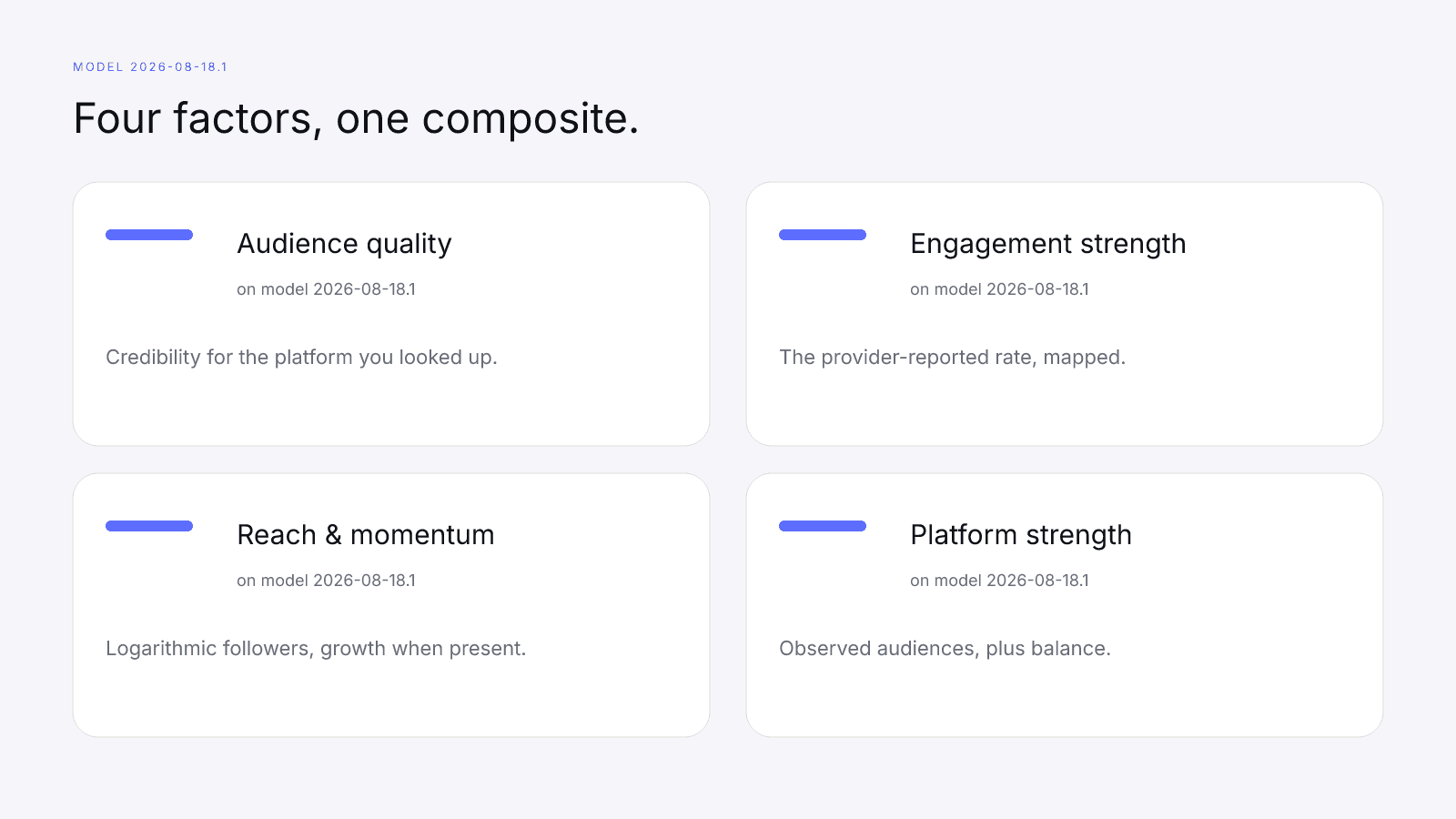
Audience quality is the first factor on model 2026-08-18.1. It's a credibility signal for the platform you looked up, which makes it a different measure from the follower count. Audience Quality vs Follower Count explains the difference.
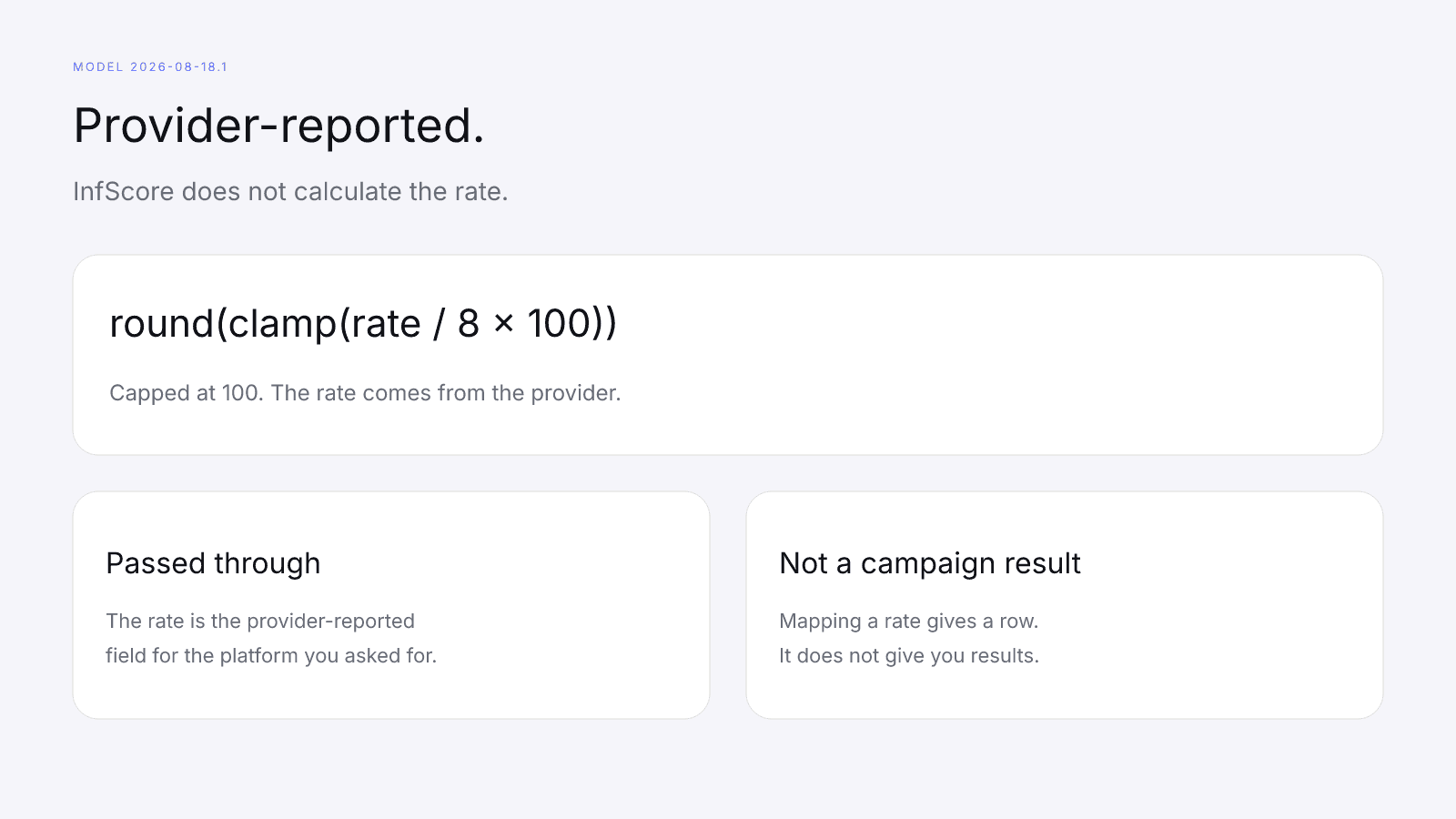
Engagement strength is the second factor on model 2026-08-18.1. InfScore doesn't calculate the rate. It maps the provider-reported rate with round(clamp(rate / 8 × 100)), so the result tops out at 100. What a Good Engagement Rate Actually Looks Like in 2026 covers the rate itself.
Reach and momentum is the third factor on model 2026-08-18.1. Reach is a logarithmic reading of total public followers, which is the sum of Instagram, TikTok, and YouTube; X isn't counted. The row shows a dash when that total is missing or not above zero, and with no growth figure it's simply the rounded reach. Nano Influencers: What a Small Account's Score Can and Can't Tell You covers the reach floor.
When a growth figure is present, it's the requested app's 12-month follower growth, from the provider's data. Reach and momentum then blends reach at 70% with momentum at 30%, where momentum is clamp(50 + 2 × the growth percentage). Missing growth isn't read as 0% growth. The row just stays reach-only.
Platform strength is the fourth factor on model 2026-08-18.1. The floors are 45, 70, and 90 for one, two, and three observed audiences, plus a balance bonus from 0 to 10 when two or more are observed. An empty profile doesn't count as an observed audience. Cross-Platform Creators: Does Being Everywhere Raise Your Score? has the longer explanation.
The methodology on the home page publishes the same weights for model 2026-08-18.1.
How the composite and coverage work
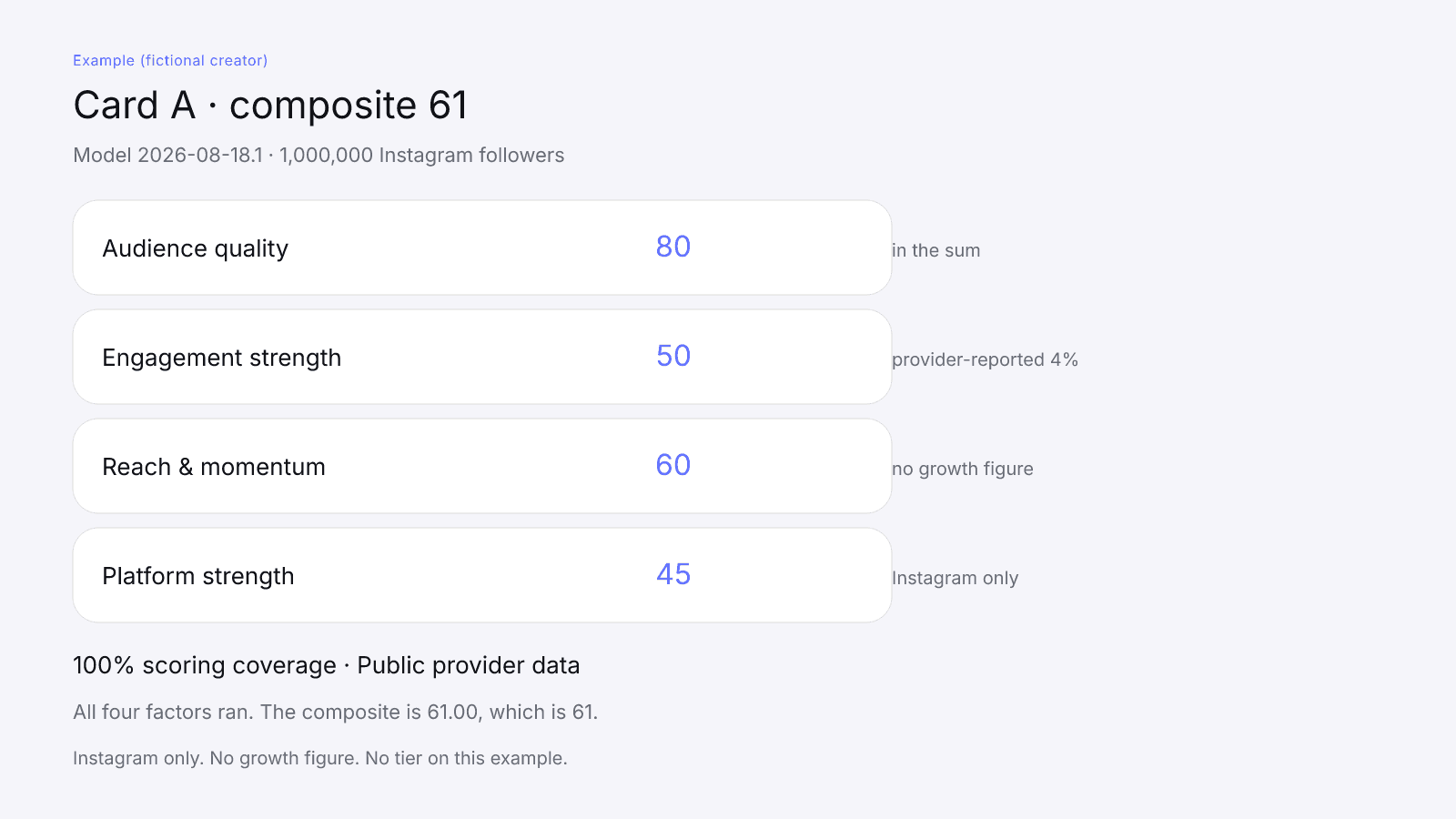
The composite divides the weighted sum of the factors that ran by the sum of their weights, and that sum is the coverage. The card prints it as "{n}% scoring coverage · Public provider data", with n filled in, so a complete card reads "100% scoring coverage · Public provider data".
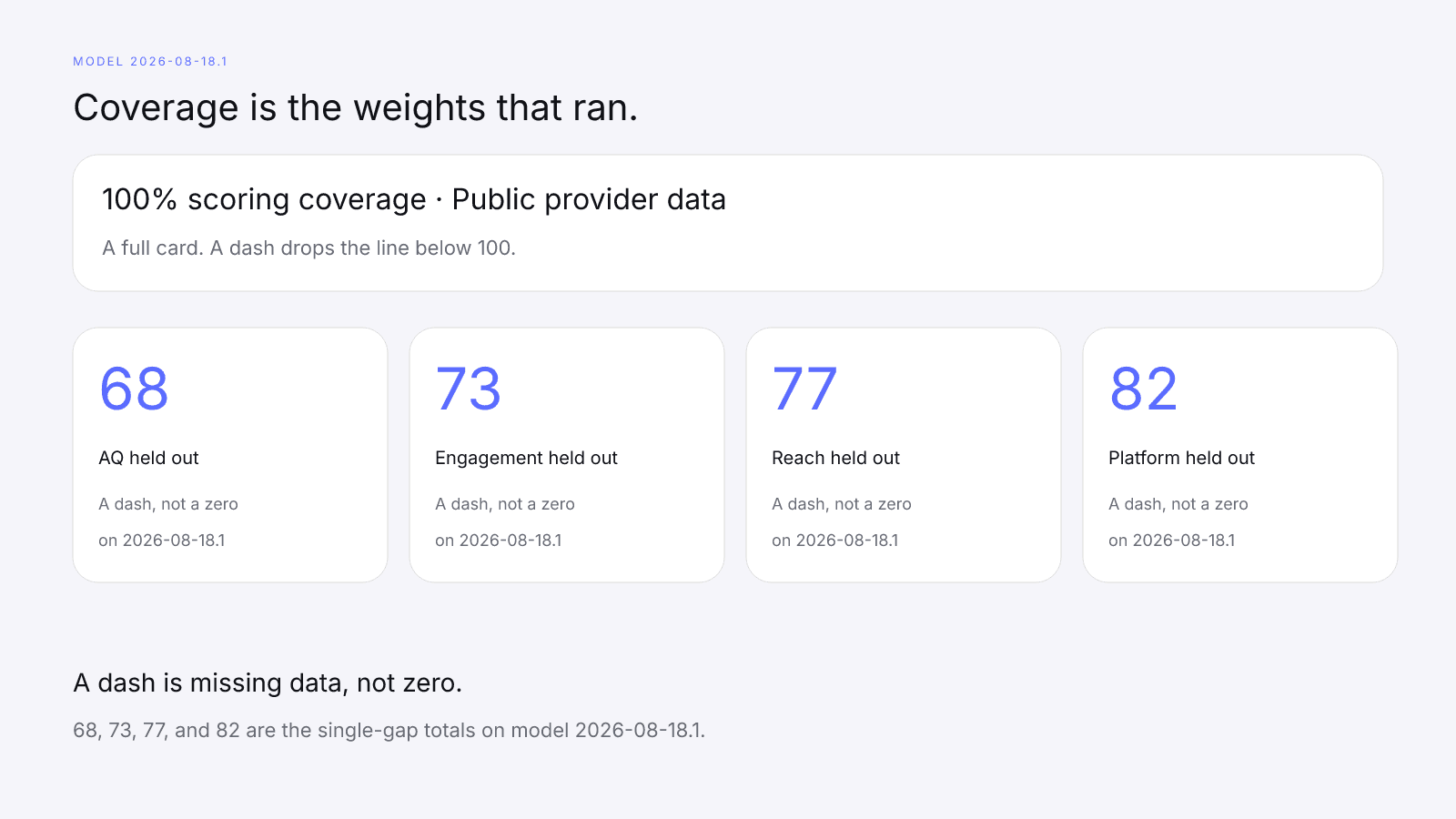
A dash is missing data, not zero. The missing factor's weight is held out, and coverage drops. On model 2026-08-18.1, one missing factor leaves coverage at 68, 73, 77, or 82, depending on which factor is missing.
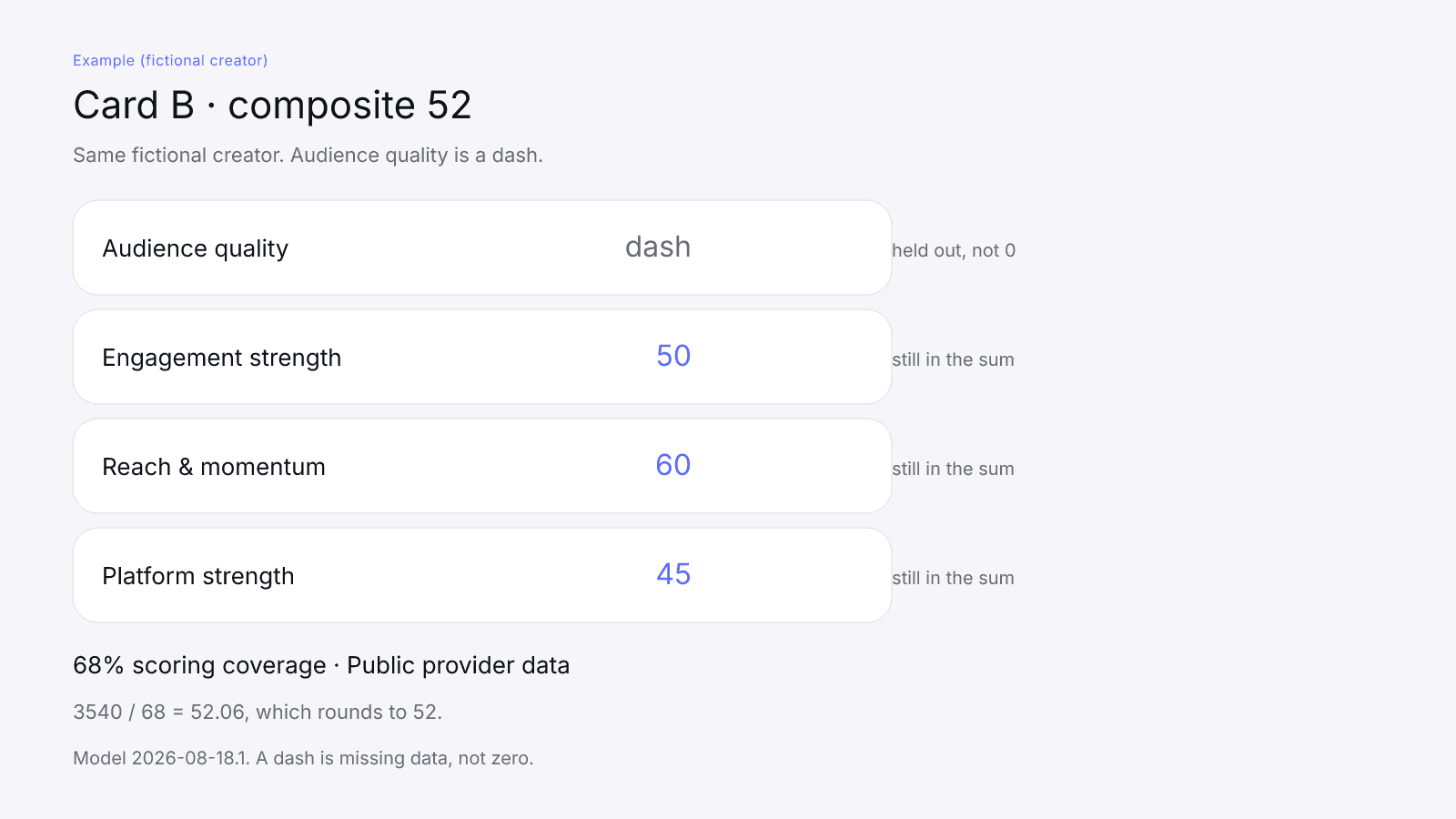
Holding a factor out isn't the same as giving it a low number, because the divisor shrinks along with the numerator. That's why the second fictional card below, which is missing only audience quality, doesn't fall the way a zero in that row would. Both worked cards use the published weights on model 2026-08-18.1, and neither one is a reading of a real profile.
Missing Data on Creator Metrics has the full arithmetic. How to Read an Influencer Scorecard Without Getting Fooled shows how coverage, dashes, and labels fit into one reading. What Brands Should Read First on an InfScore Card sets the reading order, with the model id and the coverage line ahead of the headline number.
Example (fictional creator). Card A is Instagram only: 1,000,000 Instagram followers, no growth figure, audience quality 80, and a provider-reported engagement rate of 4%. That rate maps to engagement strength 50. Reach and momentum is 60, and platform strength is 45. On model 2026-08-18.1, (80 × 32 + 50 × 27 + 60 × 23 + 45 × 18) / 100 = (2560 + 1350 + 1380 + 810) / 100 = 61.00, which is 61. The line reads "100% scoring coverage · Public provider data".
Card B is the same fictional creator, with audience quality as a dash. On model 2026-08-18.1, audience quality is held out, so coverage is 68. (1350 + 1380 + 810) / 68 = 3540 / 68 = 52.06, which rounds to 52. The line reads "68% scoring coverage · Public provider data". The dash took audience quality out of the divisor instead of entering it as zero.
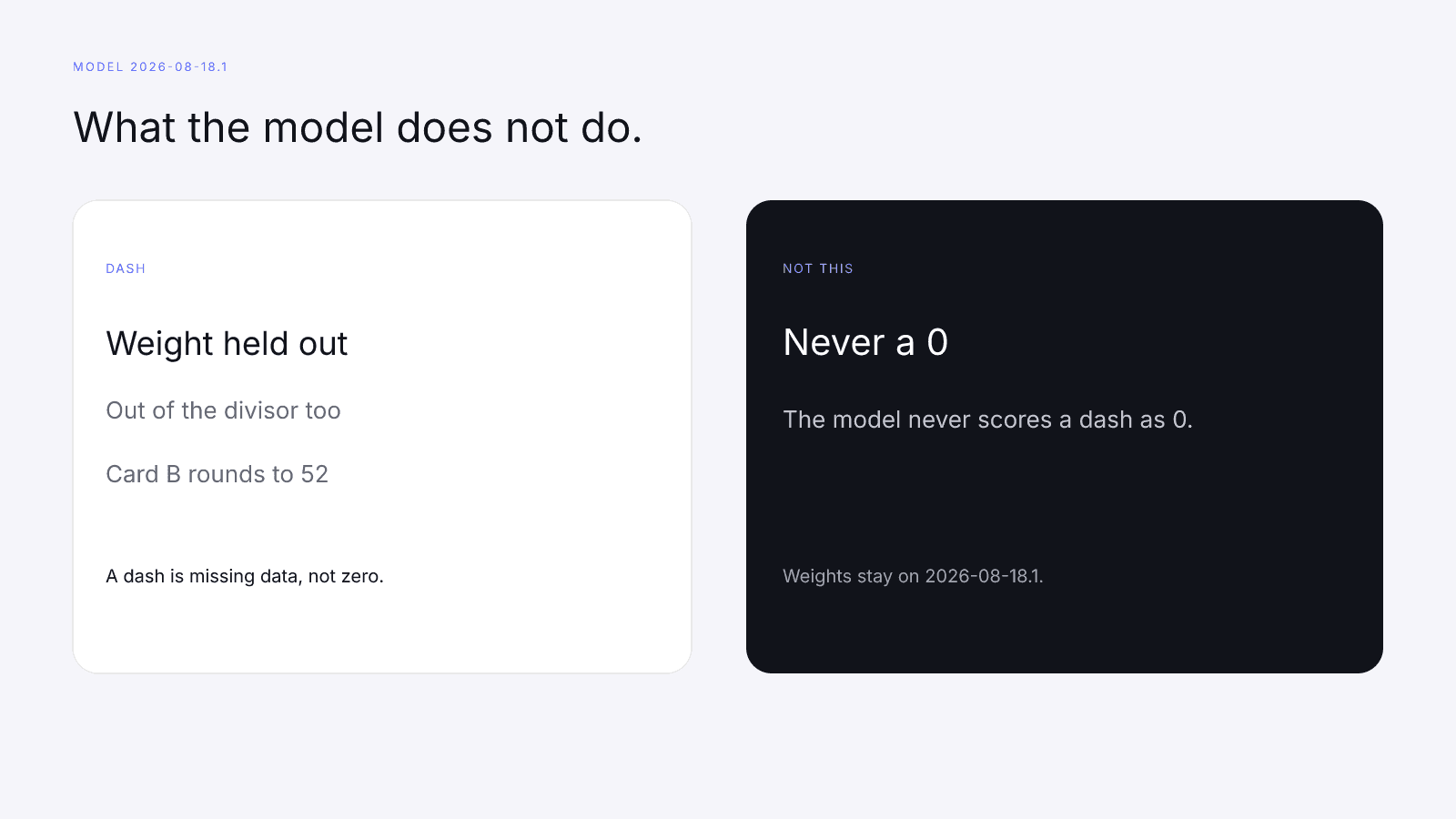
InfScore doesn't count the dash as 0. If it did, the result would be 35.4.
Tier labels on the card
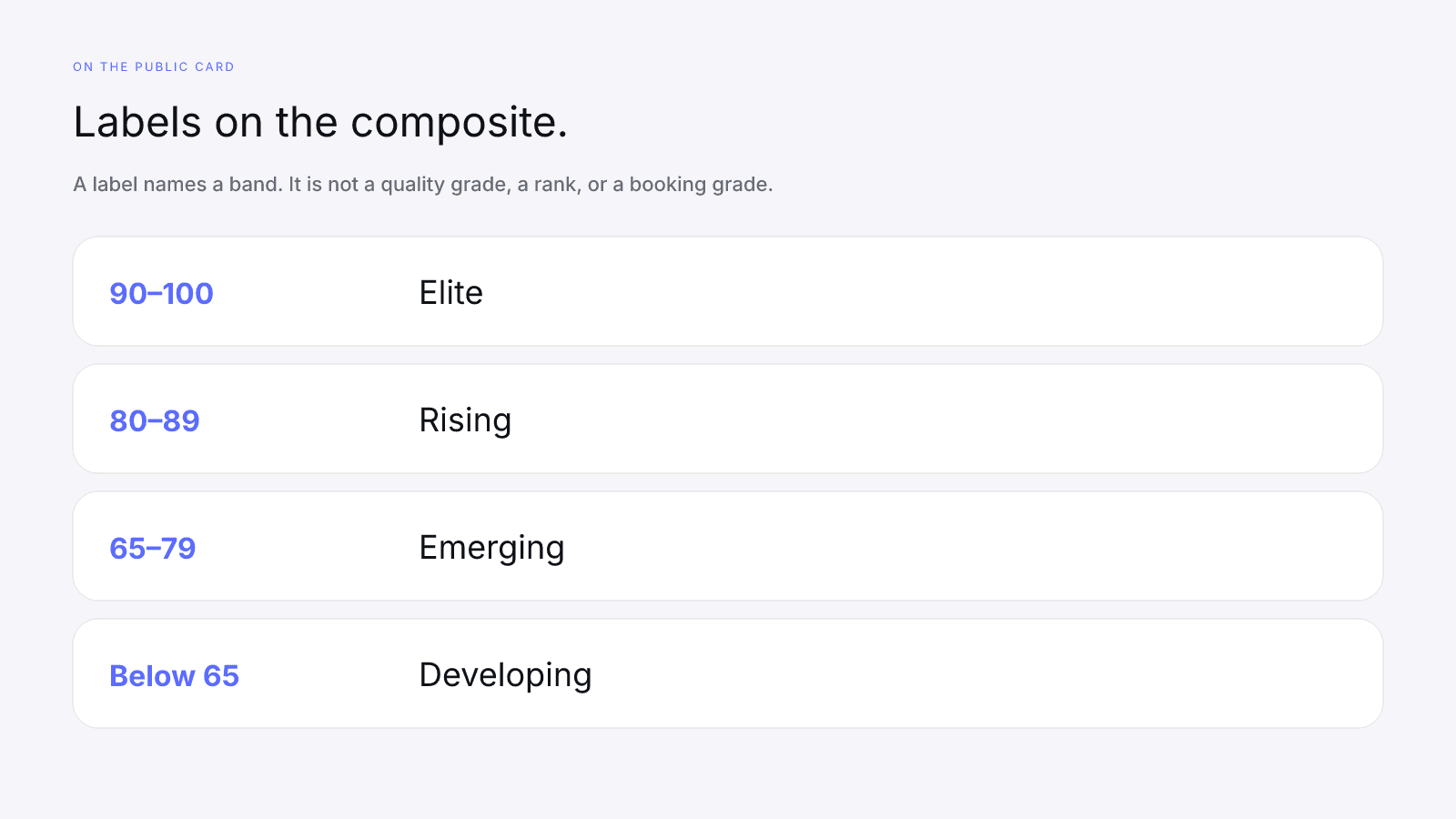
The public card prints four labels on the composite: 90–100 Elite / 80–89 Rising / 65–79 Emerging / Below 65 Developing. Each label names the band the 0–100 fell in. It isn't a quality grade, a rank, or a booking grade. If you note a label on a shortlist, copy the model id and the coverage line with it, since the label comes from the same composite. The fictional cards above leave the label off.
Not found and Unavailable
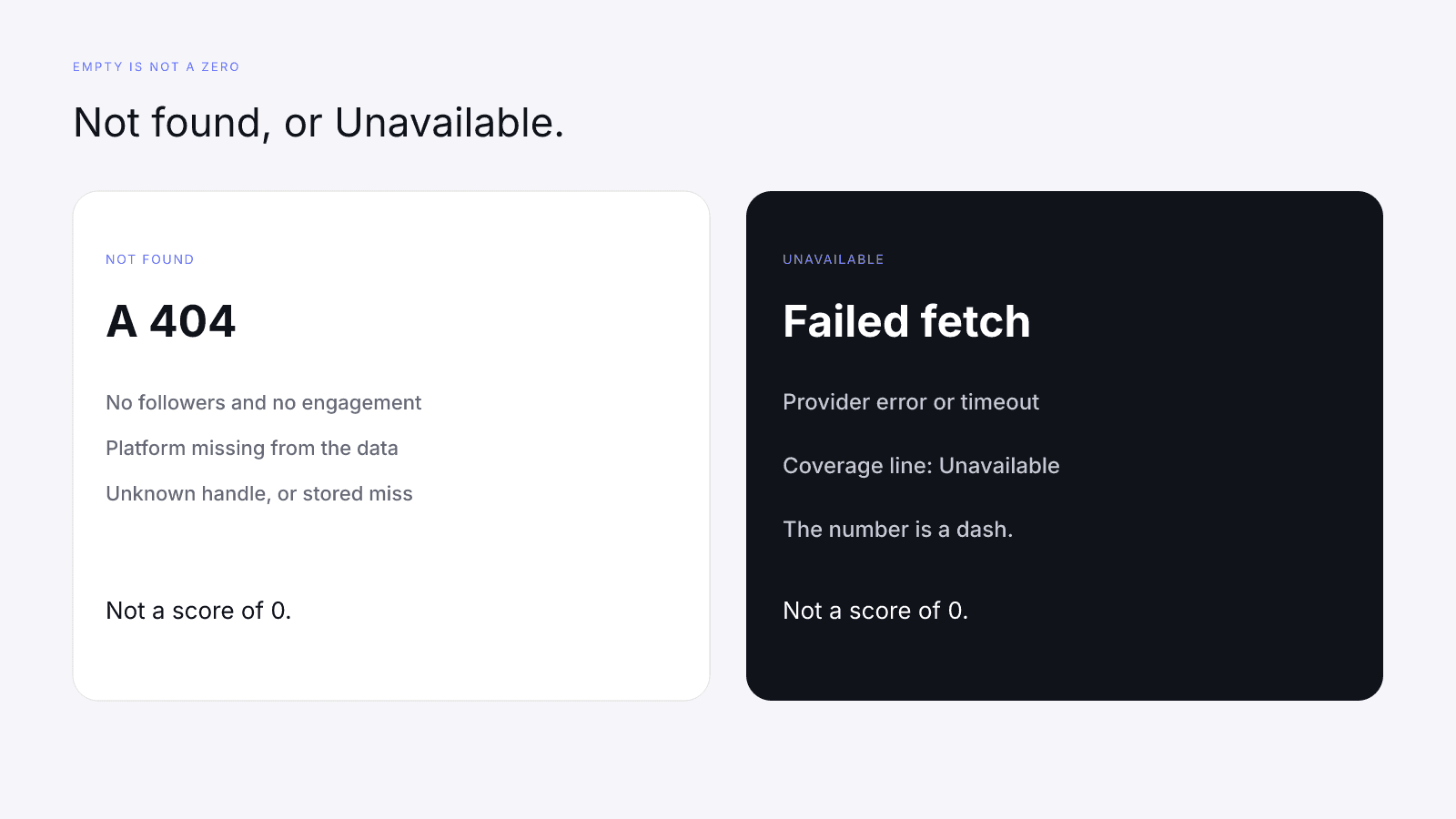
An empty result isn't a score of 0, so don't type 0 into a sheet to stand in for either state below. Not found is a 404. It applies when the requested platform has no followers and no engagement, when that platform is missing from the data, or when the handle is unknown or a not-found result was already stored. Unavailable is the card when the fetch fails, including a provider error or a timeout. The coverage line then reads "Unavailable", and the number shown is a dash, not 0.
Not found means there was no score to copy, and Unavailable means that fetch couldn't score the card. If a later fetch succeeds, treat it as a new reading rather than a fix for a zero the card never showed. In your sheet, write "Not found" or "Unavailable" in the score cell and add the date you viewed the card.
What changes the score, and what doesn't
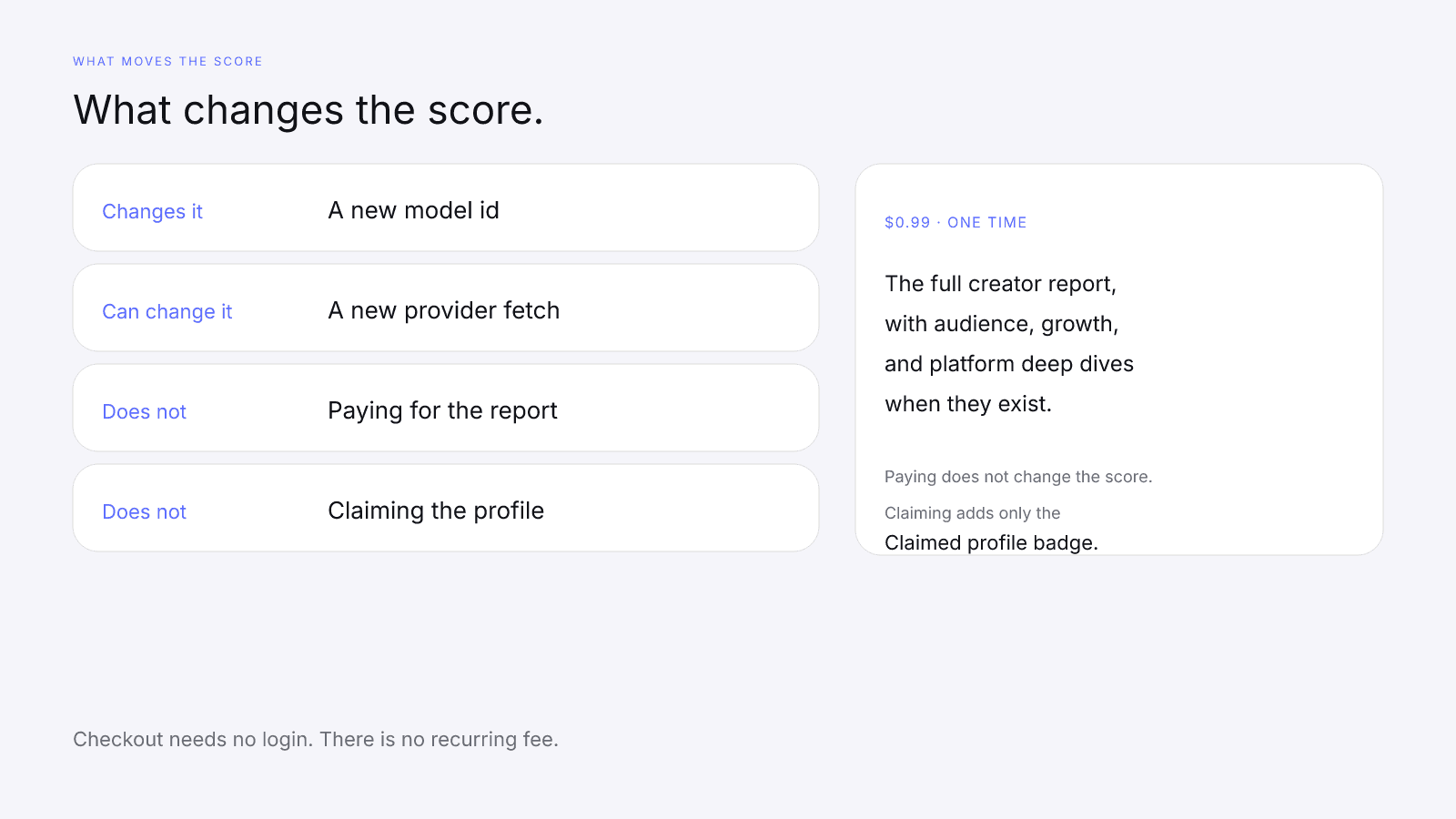
A new model id changes the score, because the composite is versioned. A new provider fetch can change it too, since the public signals behind the factors may differ. Comparing InfScore Across Model Versions Without Fooling Yourself explains how to set two readings side by side.
Paying doesn't change the score. The $0.99 purchase is the full creator report, with audience, growth, and platform deep dives when they exist. It's a one-time purchase with no recurring fee. Checkout needs no login, though an account keeps access to past purchases. The paid view keeps the free card's score, label, coverage, factors, and model id. Free InfScore vs the $0.99 Report: What Actually Changes lists what the report adds.
Claiming doesn't change the score either. The ownership step reads the public bio for the infscore code and sets only a verified status, so the card shows "Claimed profile" where it had shown "Claim this handle". On the card, that badge is the only addition.
What an influencer score can't tell you
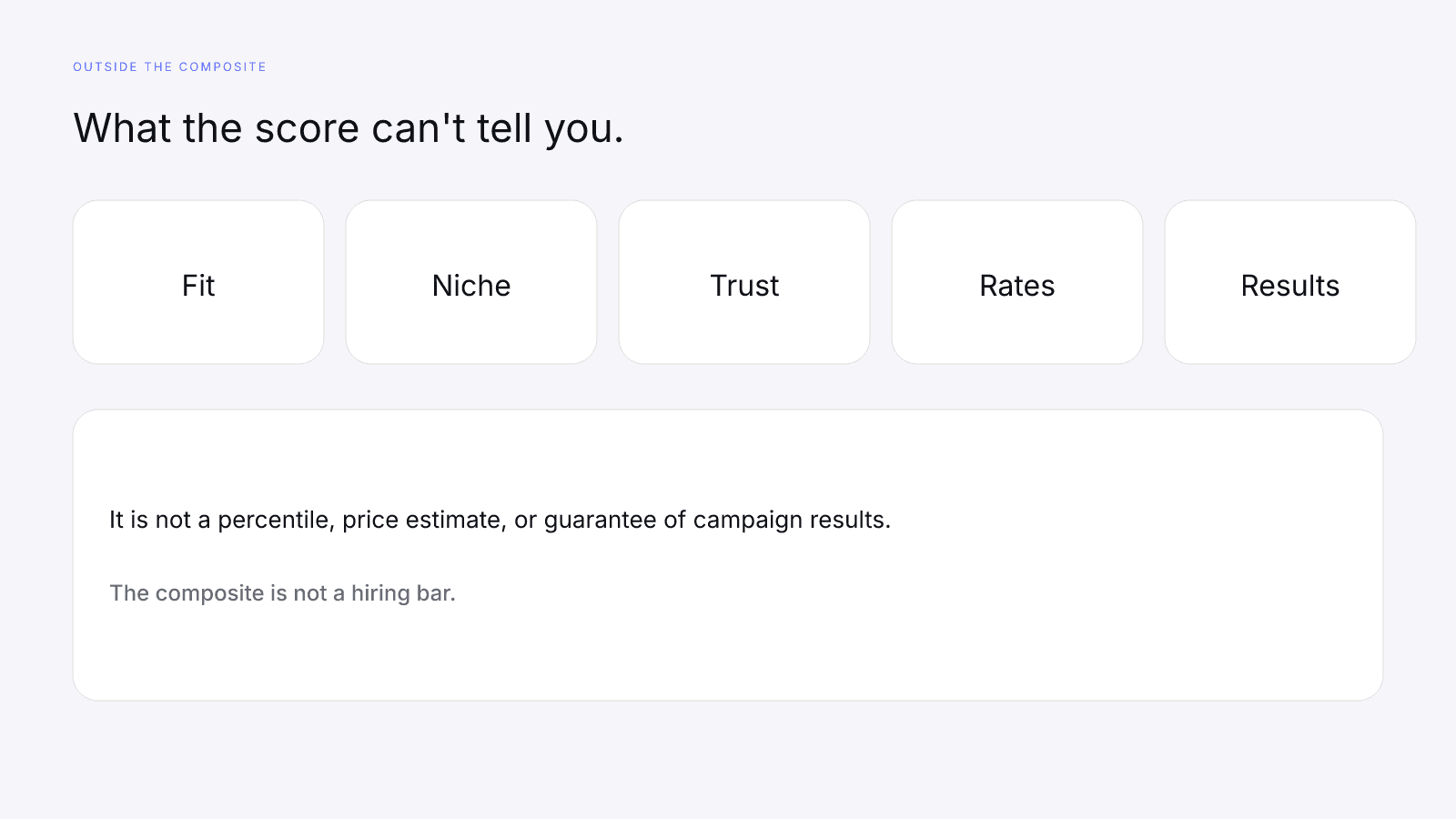
A score can't tell you fit, niche, trust, rates, or results. It is not a percentile, price estimate, or guarantee of campaign results. Fit is whether the creator's public work suits your brand, and niche is the subject people come to that profile for. Trust comes from the posts you actually open, so open several recent ones before you shortlist anyone. Rates and usage rights are whatever you agree in writing. Results are what you measure from your own records after the work. None of those is a row on the card, so those checks stay with you. The composite isn't a hiring bar either.
For each factor explained in depth, How to Measure Influencer Performance is the full tour.
FAQ and next steps
Search a public profile from infscore.com. The card is public and needs no sign-up.
For the $0.99 purchase, see Pricing. It's the full creator report, with audience, growth, and platform deep dives when they exist, and it's one-time.
What is an influencer score?
An influencer score is a single number that summarizes a creator's public signals. InfScore's is a 0–100 versioned composite of four factors. It is not a percentile, price estimate, or guarantee of campaign results.
How is InfScore calculated?
On model 2026-08-18.1 the four factors are audience quality, engagement strength, reach and momentum, and platform strength, each with a published weight. Engagement strength maps the provider-reported rate. The composite uses only the weights that ran, so a missing factor is held out of both the sum and the divisor.
What does a dash mean on an influencer score?
A dash is missing data, not zero. That factor's weight is held out, and scoring coverage drops. The card doesn't score the gap as 0.
What do Elite, Rising, Emerging and Developing mean?
They are labels on the composite. Each one names the band the 0–100 fell in on the public card. They are not quality grades, a rank, or a booking grade.
Does a higher influencer score mean a better partner?
No. It is not a percentile, price estimate, or guarantee of campaign results. Fit, niche, trust, rates, and results are checks you make yourself, because the card doesn't make them.
Does paying for the $0.99 report or claiming a profile change the score?
No. The $0.99 purchase is the full creator report, with audience, growth, and platform deep dives when they exist. It's one-time, and paying doesn't change the score. On the card, claiming adds only the "Claimed profile" badge.
Why might a creator show "not found" or "Unavailable"?
Not found is a 404 when the requested platform has no followers and no engagement, when that platform is missing, or when the handle is unknown. Unavailable is the card when the fetch fails, including a provider error or a timeout. Neither one is a score of 0.