Comparing InfScore Across Model Versions Without Fooling Yourself
A different InfScore on the same creator can be a new model id, not progress. Compare version, coverage, and dashes before you read the 0–100 as growth.
This versioned composite uses only available public signals. Missing factors stay unavailable and their weight is rebalanced across observed factors. It is not a percentile, price estimate, or guarantee of campaign results. Model 2026-08-18.1.
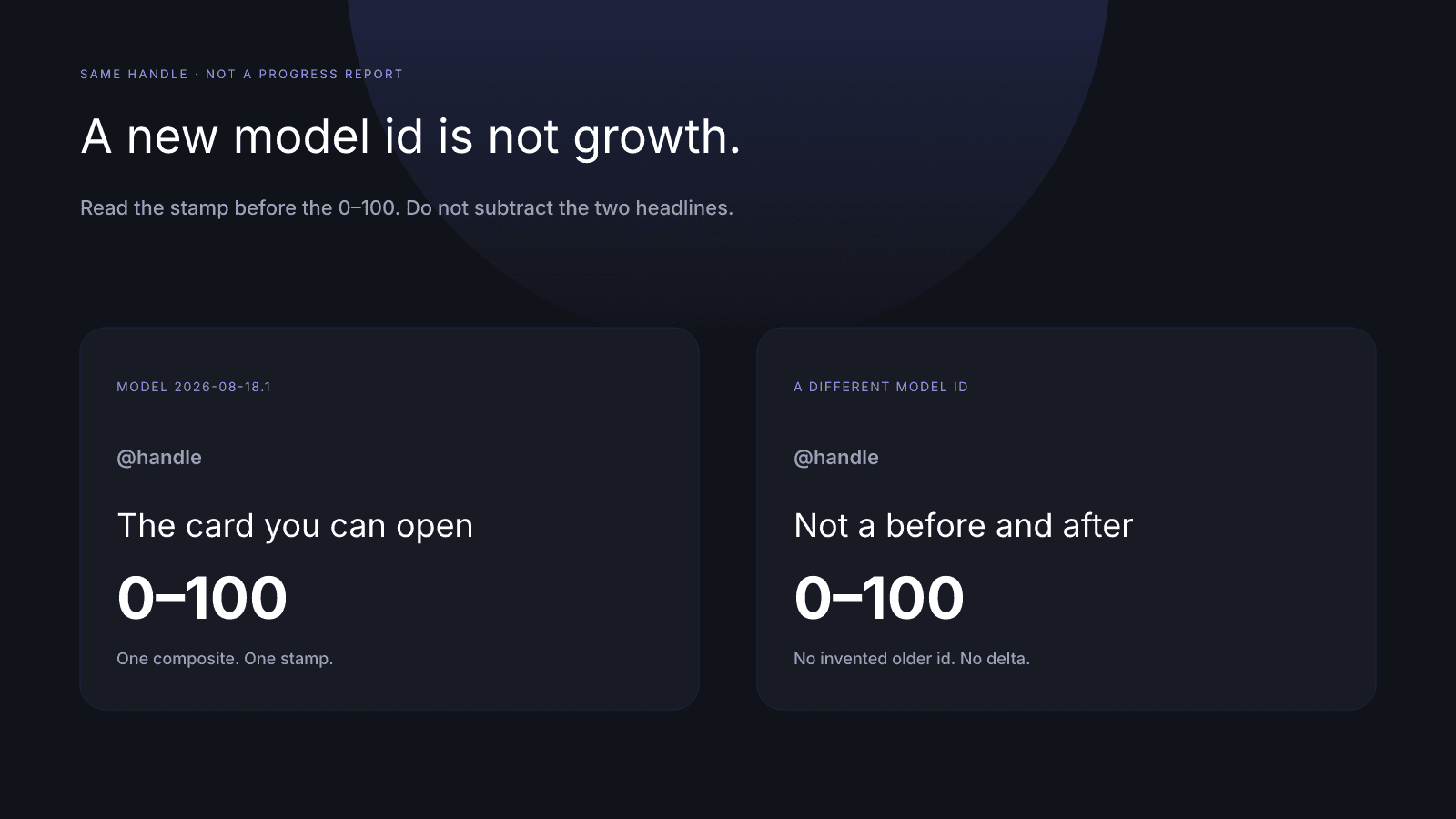
Comparing InfScore across model versions means reading the model id before the number. The same public handle can show a different 0–100 because the versioned composite changed, not because the creator grew. InfScore is one formula: audience quality 32%, engagement 27%, reach & momentum 23%, and platform strength 18%. It is stamped with a model id. Live scorecards opened on 2026-10-03 still print 2026-08-18.1. A rescore under a new id is not a progress report. There is no score-history feature and no model-changelog feature. You compare the stamp on the card you are looking at. Instagram, TikTok, and YouTube are lookup surfaces of that one model, not three formulas. Coverage and dashes are what stop a false before-and-after.
What the model id is for
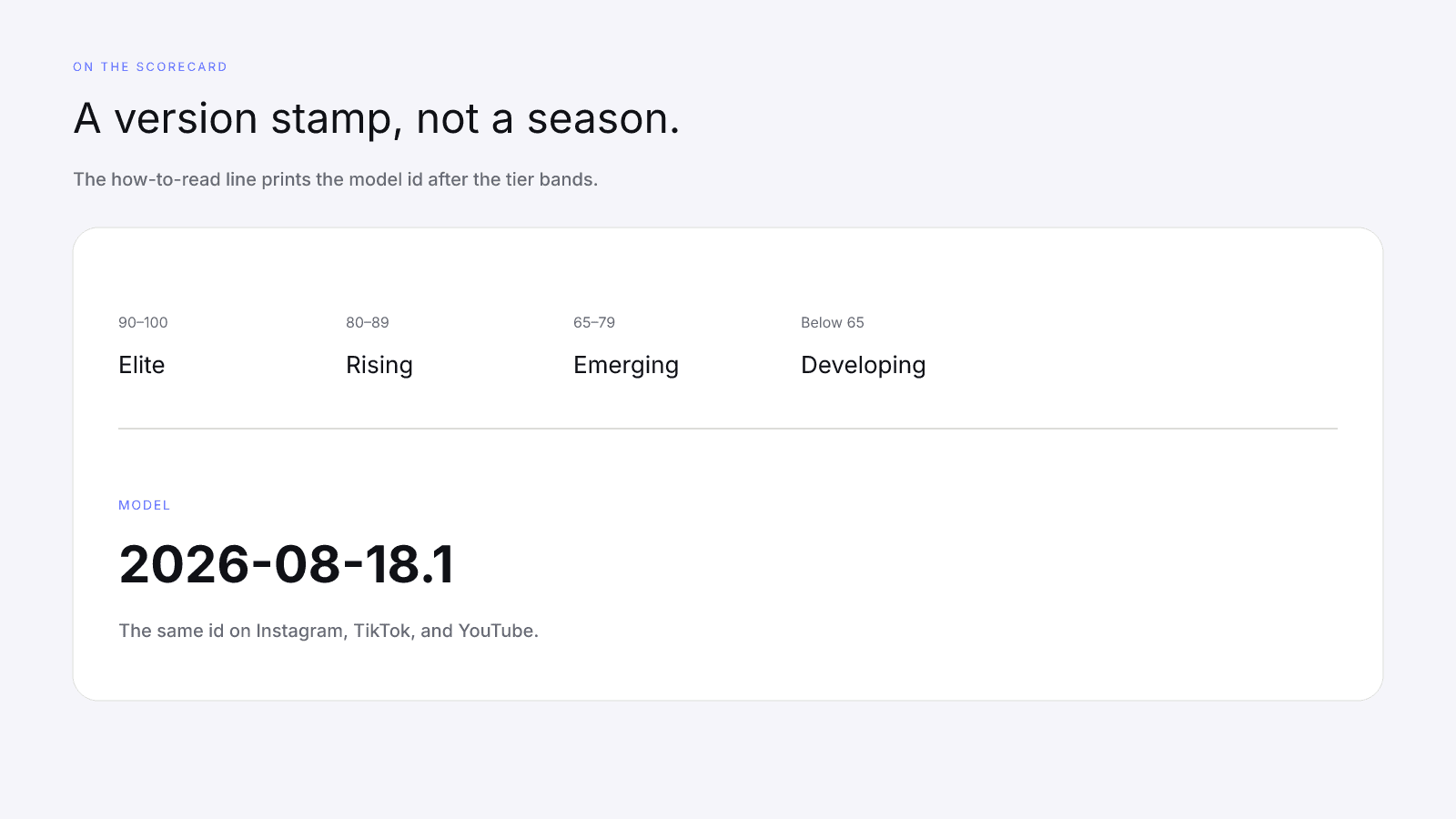
The model id is a version stamp on one composite. It is not a leaderboard season. The date inside the id is not a scoring month, and the stamp is not a grade of how hard someone worked. On the public scorecard it sits in the how-to-read line, after the tier bands: Model 2026-08-18.1. That string is the same on every lookup surface. Search infscore.com and open a card. The stamp is on that card. There is no menu of older stamps beside it.
What that stamp means, on the id the live cards still show:
- Audience quality, 32%. Provider-measured audience credibility when that public signal exists. Otherwise a dash. The split between size and credibility is Audience Quality vs Follower Count.
- Engagement, 27%. A public engagement rate mapped onto a fixed 0–8% scale, capped at 100. A 4% rate maps to 50. Values above 8% stay at 100. The scale is What a Good Engagement Rate Looks Like in 2026.
- Reach & momentum, 23%. Logarithmic public audience size, blended 70/30 with growth when a growth signal exists. No growth signal means the row is the log reach alone.
- Platform strength, 18%. How many public audiences were observed. On this model the floors are 45 for one, 70 for two, and 90 for three or more, plus a small balance bonus when follower counts are not concentrated on a single network. Empty profiles do not get those floors.
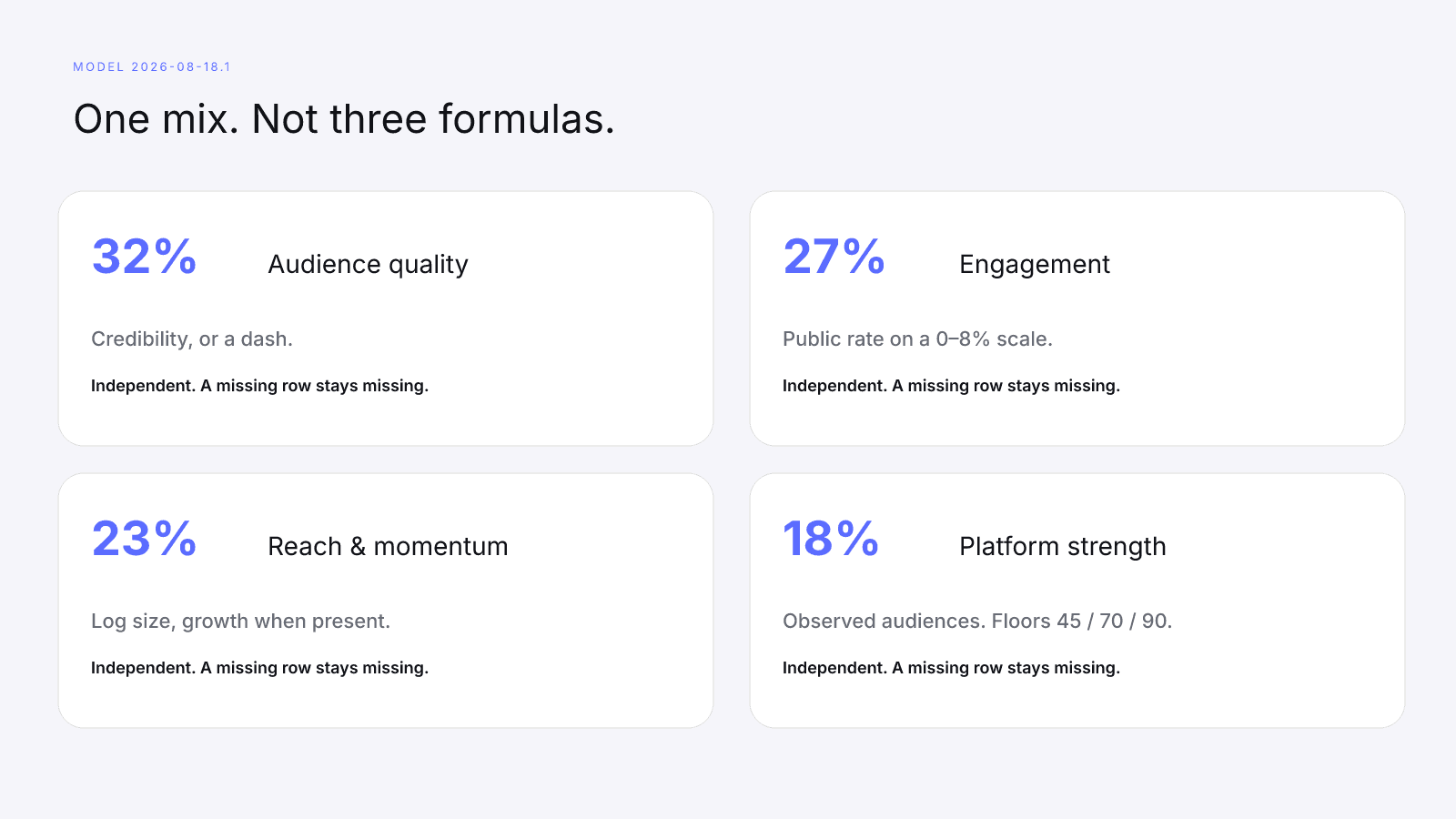
Those four factors are calculated independently. A strong reach row cannot lend points to a missing audience-quality row. When a factor is missing, its weight is held out and the observed weights are rebalanced in their published proportions. The methodology states that in one line: available factor weights are normalized when provider data is missing. The full tour of the mix is How to Measure Influencer Performance.
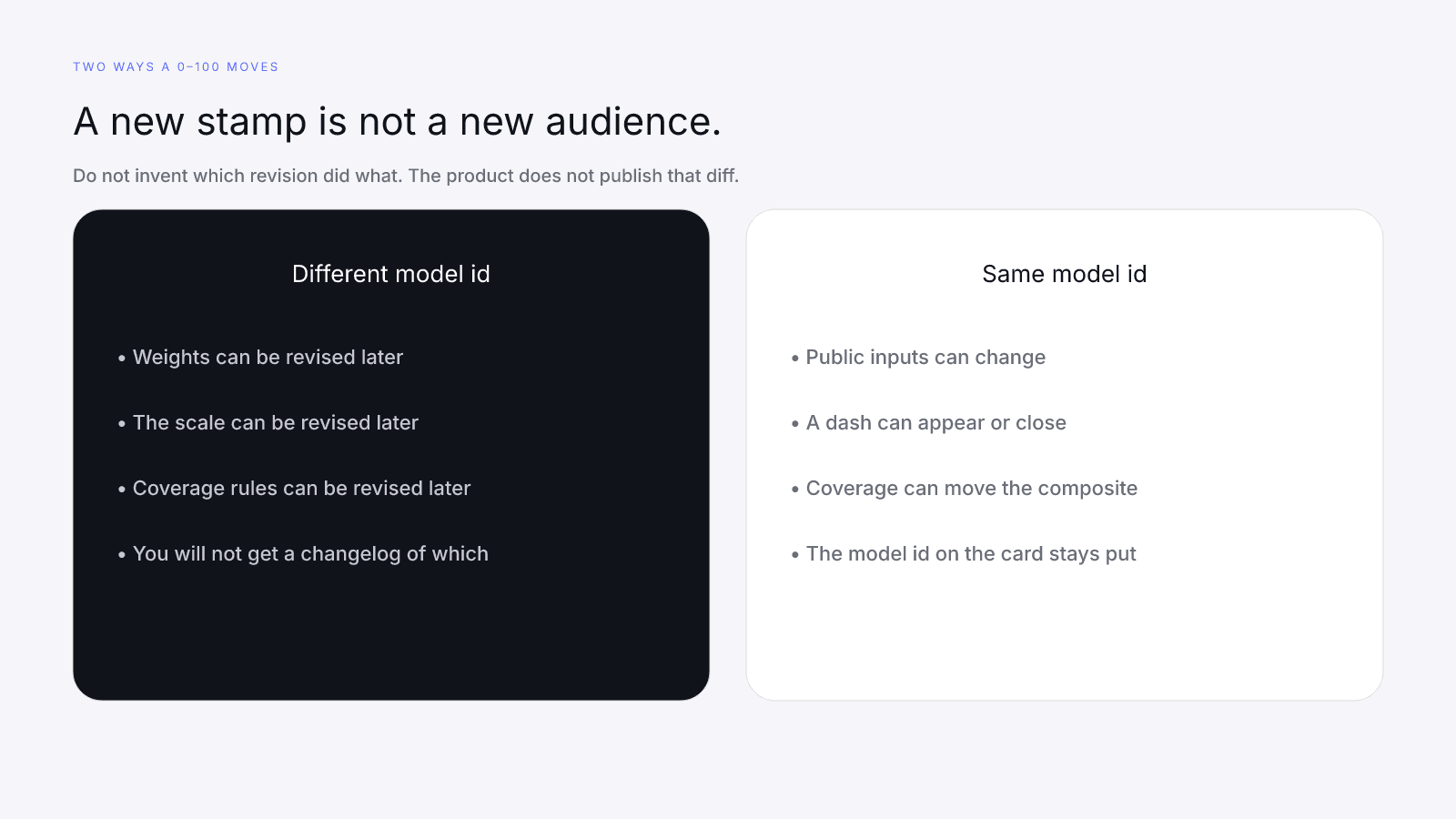
A different model id means the stamp changed. That does not, by itself, mean the creator's public work changed. This guide does not say what an unpublished id changed inside the formula. InfScore does not publish a changelog, and there is no list of older ids you can still open. If a note in your files shows some other id, that note is not a page on the site today. Cite 2026-08-18.1 only when the card in front of you still prints it.
Why the number can move without the creator changing
Two different things move a 0–100. Only one of them is the creator.
The first is the stamp. Weights, the engagement scale, and the coverage rules are decisions in the model. A later id could revise any of them. You would see a new model id on the card. No published sentence says which line moved. Do not fill that gap. "The score rose because the model improved" is not a reading. It is a guess, and the direction is just as unusable if the number fell. A rescore under a new id is not evidence the creator improved, declined, or gamed anything.
The second is the inputs under a stamp that did not change. Public followers, a public engagement rate, a credibility signal, and which rows came back can all change between two fetches of the same URL while the model id stays 2026-08-18.1. That can move a factor, the coverage percentage, and the composite. It is still not a model-version story. It is a new reading of the same formula. Write down which row moved. If you cannot, you do not have a progress report. You have two headlines.
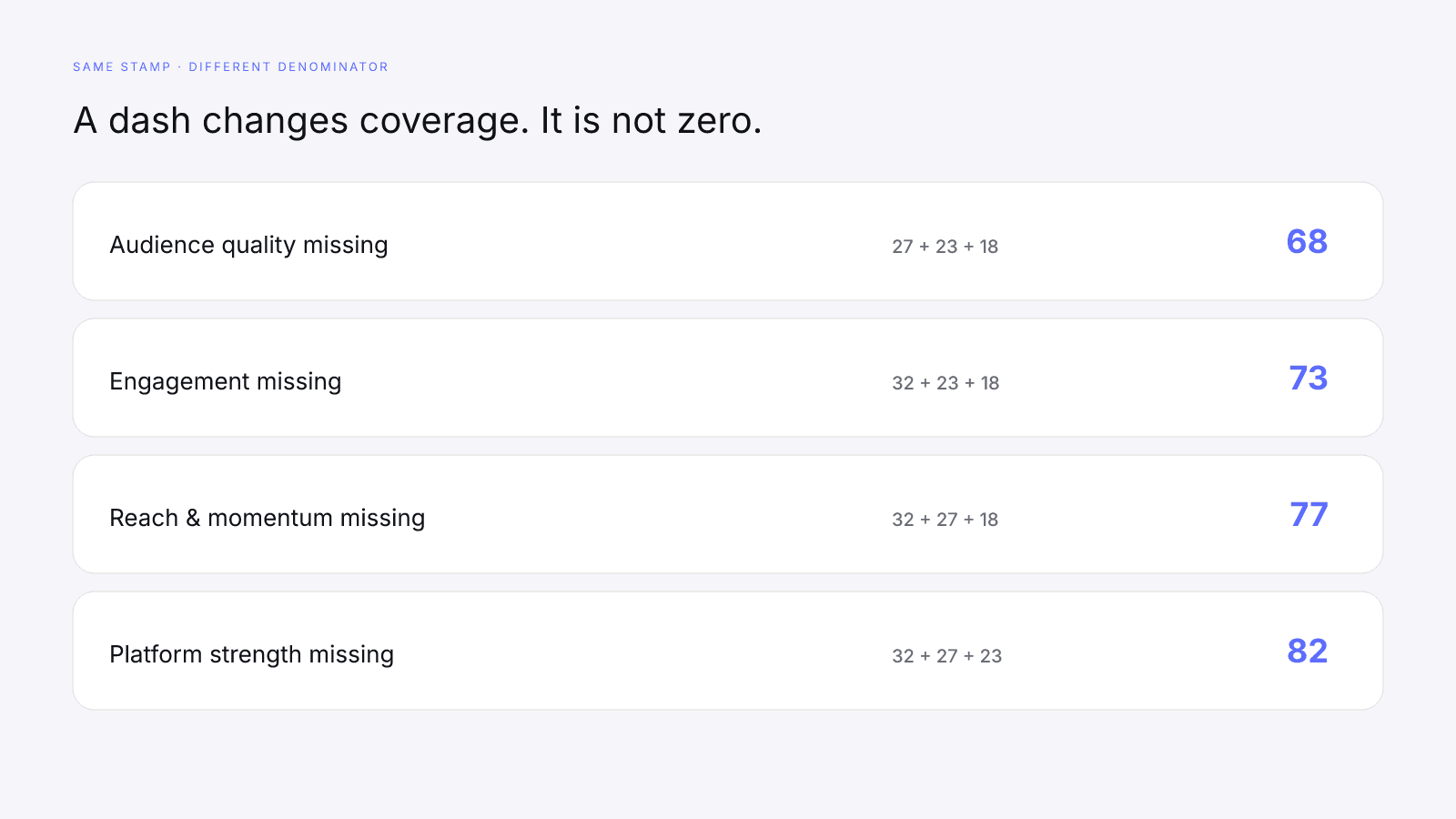
Coverage is the part people skip when they want a trend. Full coverage is 100, and the 32/27/23/18 mix applies in full. One missing factor changes the denominator:
- Audience quality dashed: coverage 68 (27+23+18).
- Engagement dashed: coverage 73 (32+23+18).
- Reach & momentum dashed: coverage 77 (32+27+18).
- Platform strength dashed: coverage 82 (32+27+23).
The composite is the weighted average of the rows that exist, divided by that coverage. A row appearing or disappearing changes the result even when the other factors sit still. A dash is a gap, not a zero and not a silent pass. Missing Data on Creator Metrics is that arithmetic. Paying does not fill a dash.
A separate case from the model tests, not from a live card and not from two model ids, uses round numbers. Audience quality is missing, engagement sits at a 4% public rate (50 on the factor), reach & momentum is 40, and platform strength is 45. Coverage is 68. The composite is (50 × 27 + 40 × 23 + 45 × 18) ÷ 68, which is 3080 ÷ 68, which rounds to 45. The engagement factor of 50 is not the InfScore. The 45 is not a "before" waiting for an "after" under a new model id. It is the rebalance rule on this stamp.
Same-stamp movement is still easy to misread as a version change, because the headline is the number people screenshot. A higher composite the week after a busy month can be a public rate, a credibility signal, or a dash that closed because a row came back. None of those is a new model id. The id on the card either matches your last note or it does not. Start there.
What a fair comparison requires
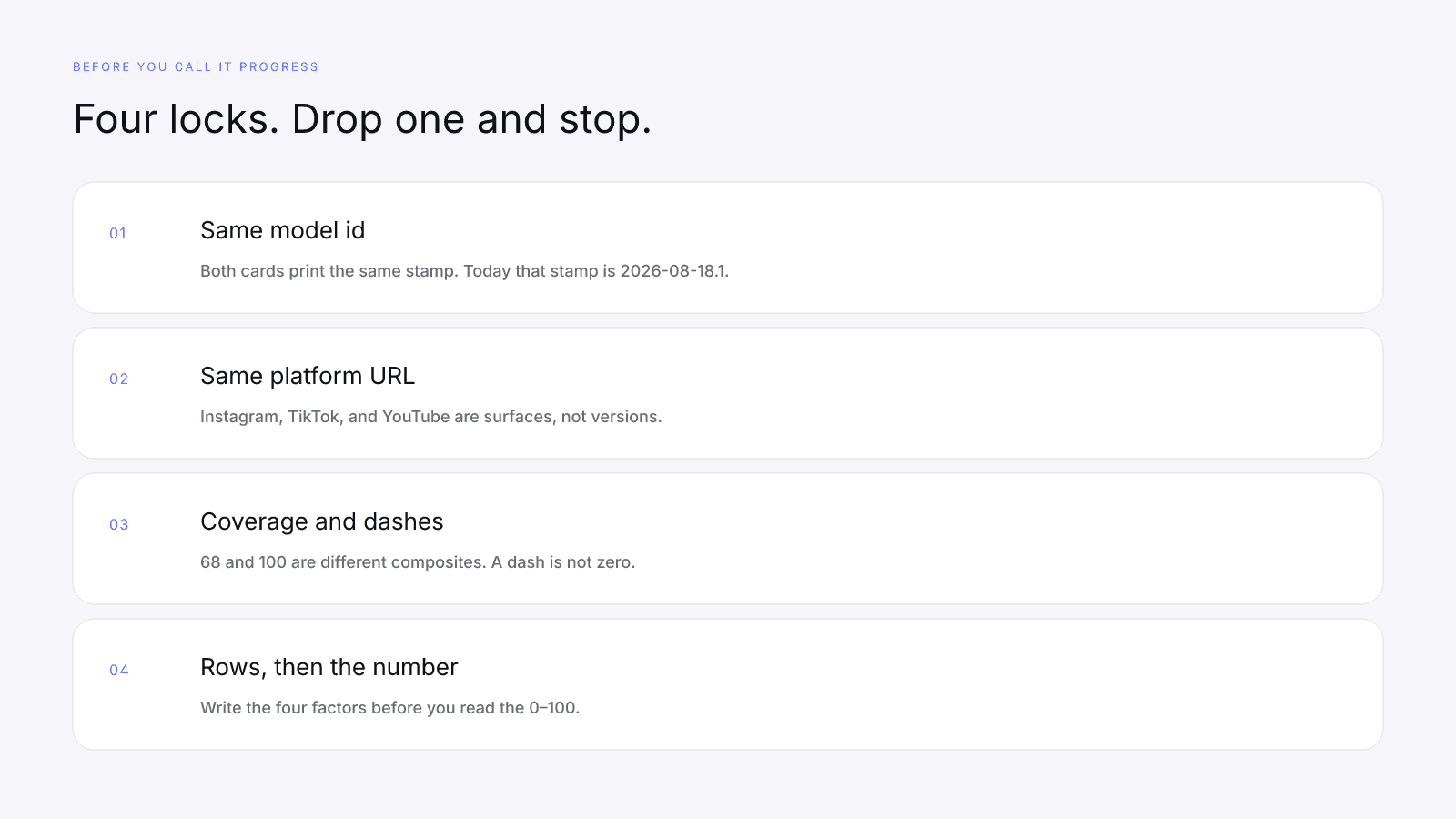
A fair comparison has four locks. Drop any one of them and the gap is not evidence.
- The same model id. Both cards must print the same stamp. On 2026-10-03 the live cards checked for this guide print
2026-08-18.1. If one note says a different id, stop. You are not holding two readings of one formula. - The same platform surface. The URL's platform is the lookup. Instagram, TikTok, and YouTube do not get their own models. Do not stack them as if the higher composite were the newer version.
- Coverage and dashes, written down. A dash held out of the average is not a quiet zero. Coverage 68 and coverage 100 are different composites even when three of the rows look familiar.
- The factor rows, before the 0–100. Audience quality, then engagement, then reach & momentum, then platform strength. The headline is last.
The same handle is the comparison people mean. InfScore does not show that comparison for you. There is no toggle that reloads an older composite under an older id. You can keep your own notes. InfScore will not confirm those notes or show the older card again. If your notes disagree on the model id, treat them as two formulas, not as growth.
Tiers do not rescue a bad comparison. Elite is 90–100, Rising is 80–89, Emerging is 65–79, and Developing is below 65. Crossing a band means the rebalanced mix on the card you are holding crossed a line. It does not mean a new model season started. How to Read an Influencer Scorecard is the longer version of that order: coverage, dashes, factors, then the number.
What is not a trend
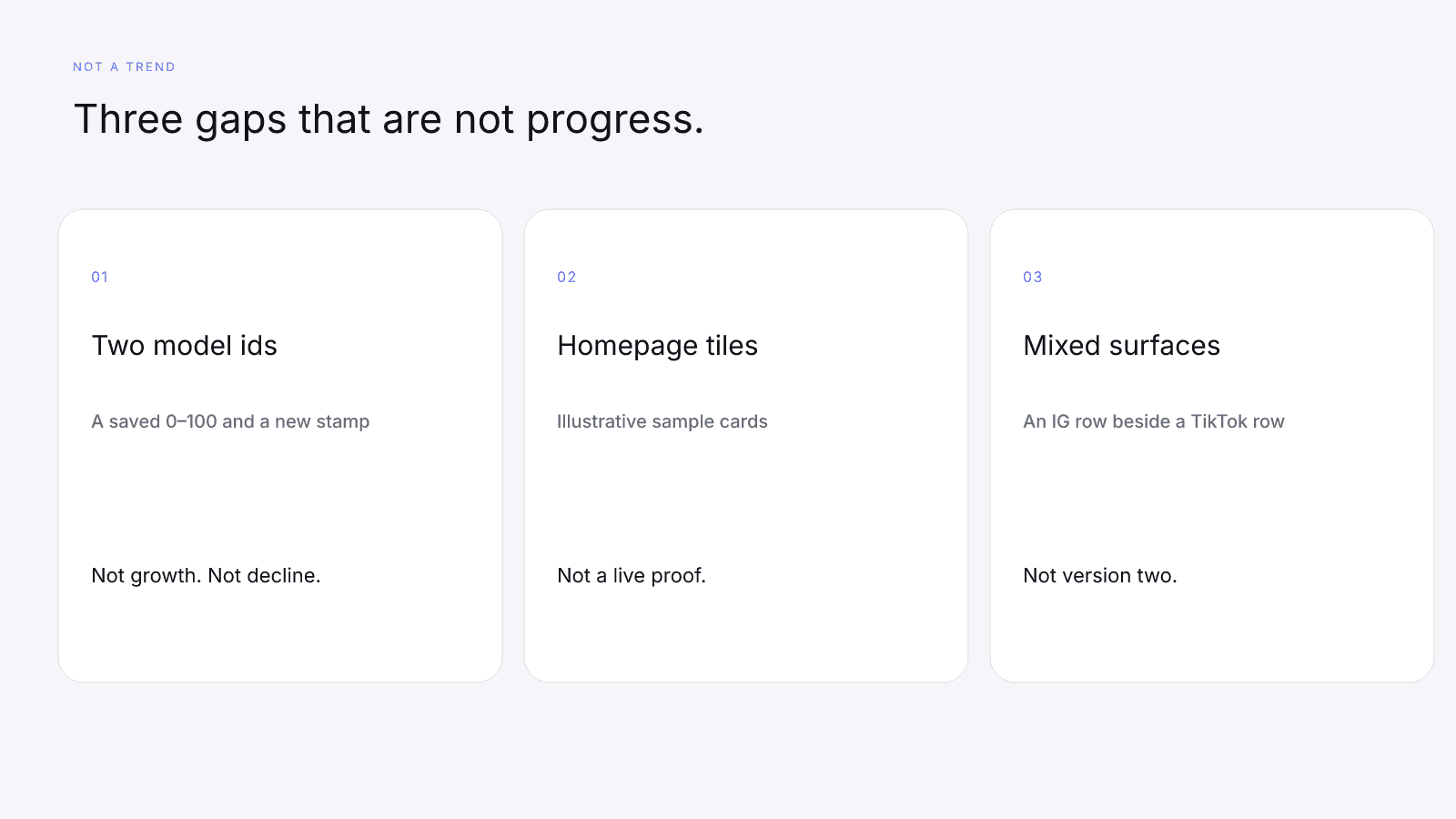
Three habits produce a fake trend. None of them require the creator to have changed.
Two fetches, two model ids. You saved a 0–100. You open the same handle later and the model id is different. The subtraction is not a result. It mixes two stamps. A higher number can be a rescaled factor, a different cap, or a coverage rule, and you do not have a changelog that says which. A lower number has the same problem. Do not call that gap an improvement, a decline, or someone gaming the score. The id changed. That is the whole published fact.
Homepage sample cards. Tiles on the marketing page are illustrative. They are not live model-version proof, and they are not a cohort you can difference against a score URL. Open the score URL. Read the stamp on that page. Leave the tile where it is.
A TikTok row beside an Instagram row. Those are two lookup surfaces of one model, or two creators. The gap between them is not version two versus version one. Instagram InfScore Factors, TikTok Reach vs Engagement, and YouTube Momentum Signals describe the same four weights facing different public inputs. Cross-Platform Creators is the platform-strength piece, including why an empty second profile does not raise the floors. None of those pages is a second formula, and none of them is a second version line.
Subtracting two different people is the same mistake with a cleaner spreadsheet. A gap between two handles is not an uplift, and it is not a model effect. The composite is not a percentile or a price, and it does not guarantee campaign results.
How to read a live card
Read in this order: model id, scoring coverage, dashes, the four factors, then the 0–100. Three live lookups, opened on 2026-10-03, are a stamp check. Each card prints model 2026-08-18.1. They are three people on one composite, not a before-and-after or a version delta, and the table does not show that anyone moved.
| Live lookup | Model id | Coverage | Audience quality | Engagement | Reach & momentum | Platform strength | Composite |
|---|---|---|---|---|---|---|---|
| Emma Chamberlain, Instagram | 2026-08-18.1 | 100 | 84 | 49 | 83 | 45 | 67, Emerging |
| Khaby Lame, TikTok | 2026-08-18.1 | 68 | dash | 100 | 85 | 70 | 87, Rising |
| MrBeast, YouTube | 2026-08-18.1 | 68 | dash | 24 | 100 | 95 | 69, Emerging |
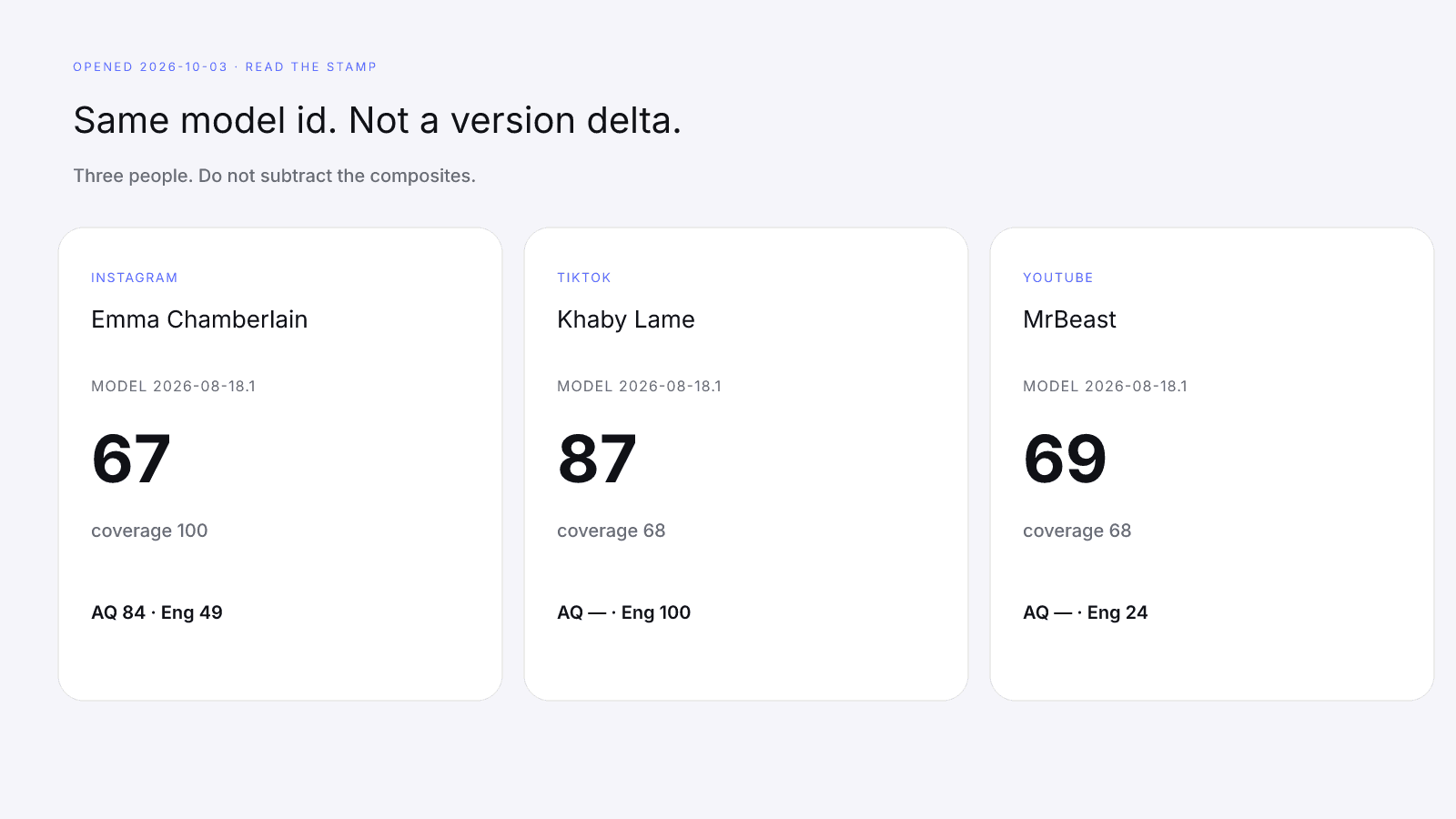
The model id is the point of the table. The rows are what sit under that stamp on the day the card was opened, so you can check the mix without subtracting. Do not compute 87 minus 67, or 87 minus 69, or 69 minus 67, and call the gap a version effect. The ids match. The people do not. The TikTok handle on that URL is khaby.lame.
Emma is the full-coverage card. Check the mix under this one id: (84 × 32 + 49 × 27 + 83 × 23 + 45 × 18) ÷ 100 = 67.3, which rounds to 67. The public engagement rate on that card is 3.9%, and 3.9 ÷ 8 × 100 rounds to 49. Audience quality is 84. Both rows are present. 49 is not the InfScore, and 67 is not a comparison with an older model. The card displays about 14 million public followers. That total feeds reach. It is not a second score.
Khaby and MrBeast are the partial cards. Audience quality is a dash, not a zero, so coverage is 68 (27 + 23 + 18). Khaby's public rate is 8.99%, which is past 8%, so engagement is capped at 100. The composite is (100 × 27 + 85 × 23 + 70 × 18) ÷ 68 = 86.985, which rounds to 87. MrBeast's public rate is 1.95%, so engagement is 1.95 ÷ 8 × 100, which rounds to 24. The composite is (24 × 27 + 100 × 23 + 95 × 18) ÷ 68 = 68.5, which rounds to 69. Those cards display about 163 million and about 745.3 million public followers. The missing 32% is not inside the engagement factor. A dash stays a dash. The 0–8% scale is the same one when a rate is higher, and the model id is the same whether the surface is TikTok or YouTube.
Use the same order on a card you care about:
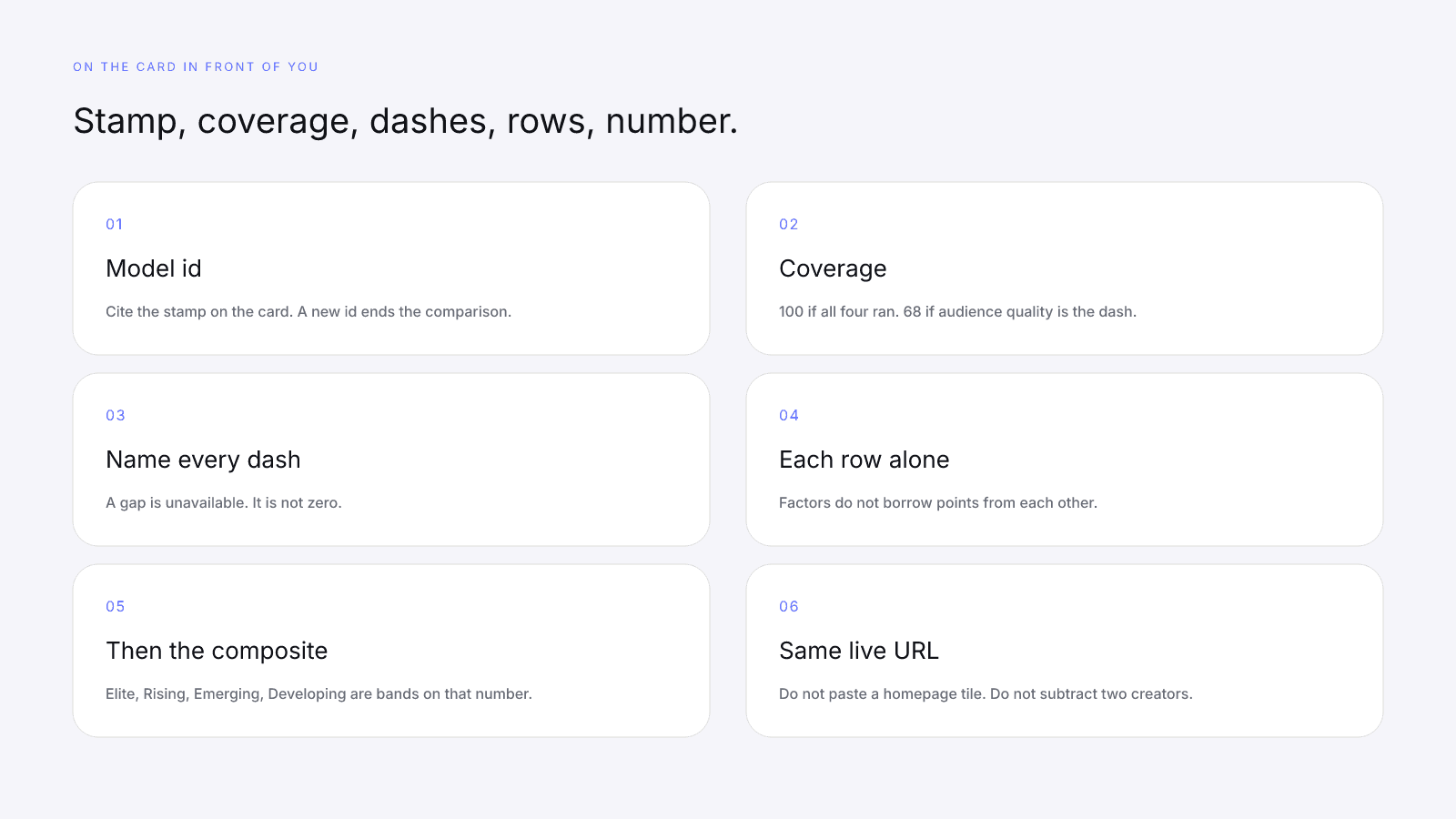
- Model id. If it is not
2026-08-18.1, you are not lining that card up against the three above, and you are not lining it up against an older note that carried a different id. Cite the stamp you actually see. - Scoring coverage. 100, or 68, 73, 77, or 82 when one published weight is the one that is missing.
- Dashes. Name the missing factor. Do not type a zero in its place.
- Each factor on its own. Audience quality, engagement, reach & momentum, platform strength. They do not borrow.
- The composite and the tier, last. Then decide whether anything you would call progress actually moved a row under the same stamp.
If you fetch the same URL again later, repeat the list before you compare headlines. A row can move while the 0–100 stays put. The headline can move because coverage changed. Neither event is a new model id. A new model id is a different event, and it ends the comparison.
Locked historical signals are not past scores
On the public scorecard, under the four factors, a locked panel is titled Follower growth. Its subtitle reads "Locked historical signals." That line is the paid follower-growth module. It charts follower counts, not past InfScores, and it is not a history of model versions.
When the $0.99 report is unlocked, and when a follower series is returned, the report charts follower counts over recent months. The heading on that block is creator growth. The points are audience size, not 0–100 scores, and they are not labeled with model ids. A series of follower totals does not say what InfScore was under an older stamp. Nothing in that chart is a changelog of a model revision.
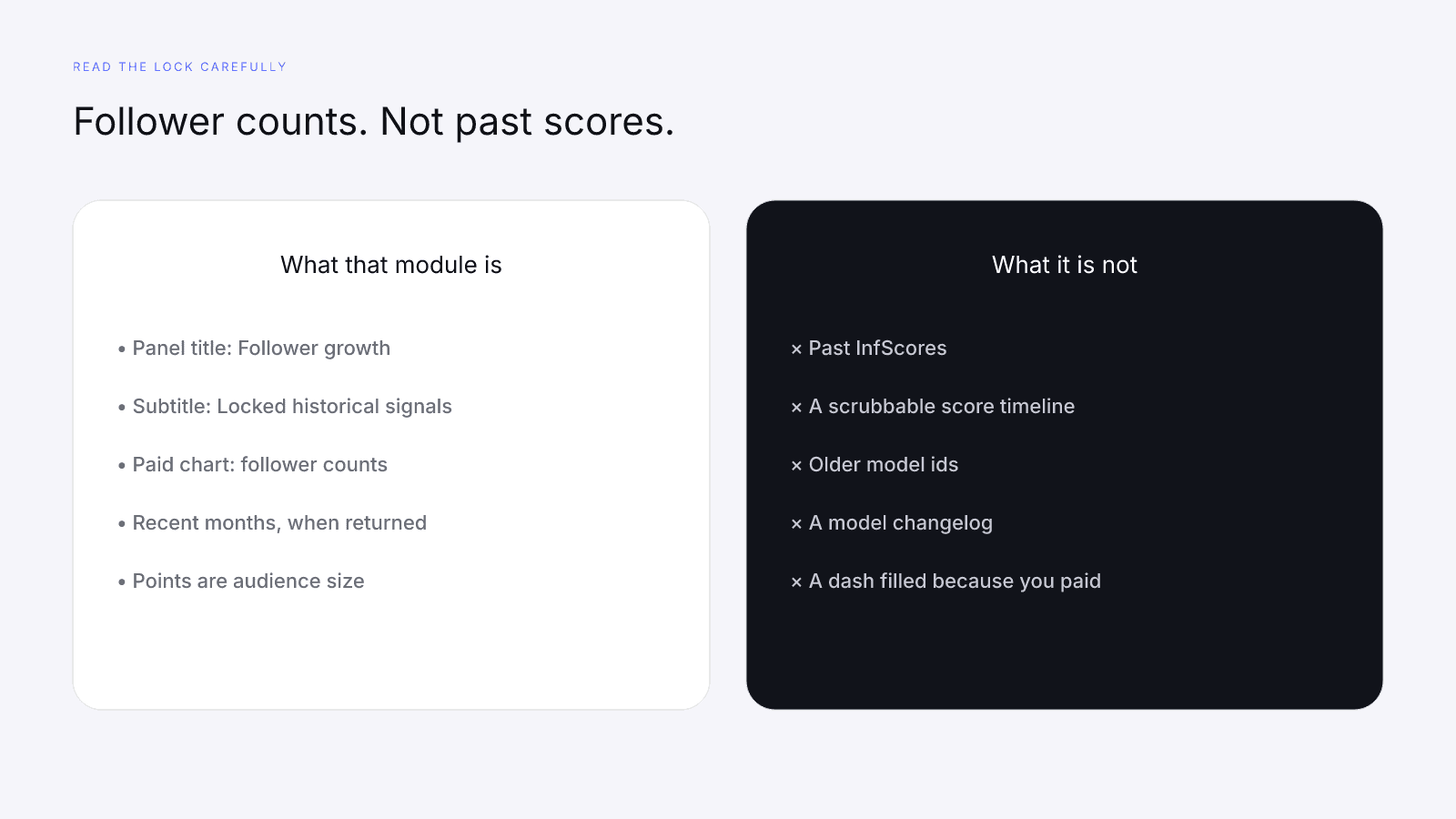
There is no score-history feature. The card you open shows one composite and one model id. There is no timeline to scrub and no version picker. There is no model-changelog feature. Paying does not unlock prior composites, show an older model id, or fill a dash.
The free InfScore needs no signup. Pricing is one report for $0.99, once, with no subscription. The report unlocks denser provider modules when they exist. Same weights. Paying does not change the 32/27/23/18 mix, and it does not turn the follower chart into a list of old scores.
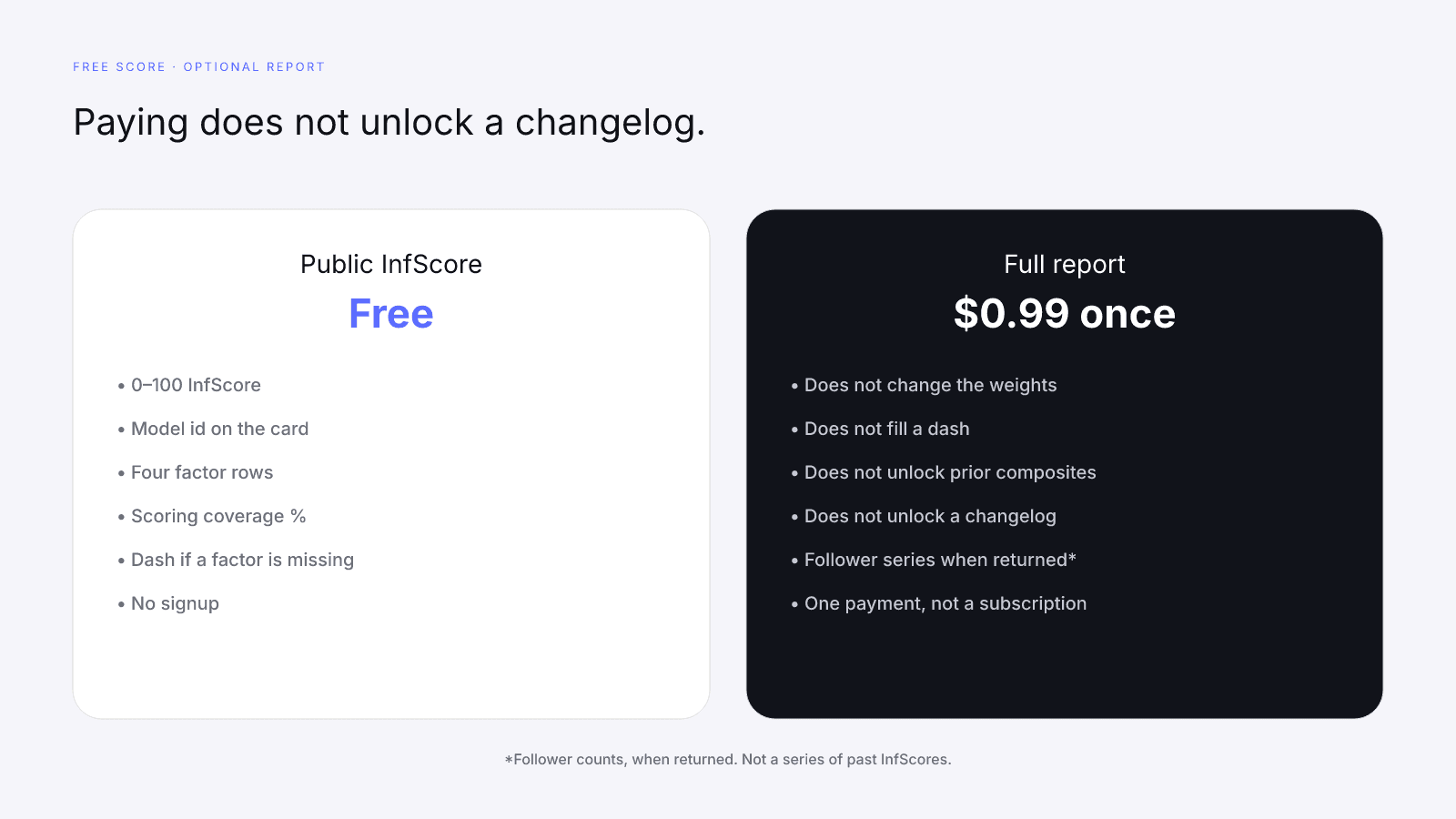
If follower counts rose across those months, that is a follower series. It can sit behind the reach & momentum row on a later fetch, when a growth signal is part of the public inputs. It is still not a list of old InfScores. Do not read the lock, or the paid series behind it, as proof the model was revised.
One model, three lookup surfaces
Instagram, TikTok, and YouTube are lookup surfaces of the same InfScore. One formula, one version line. Changing the platform query does not change the model id or the weights. A dashed audience-quality row on TikTok follows the same missing-data rule as a dashed audience-quality row on YouTube: the 32% is held out, coverage falls, and the other rows do not fill that gap.
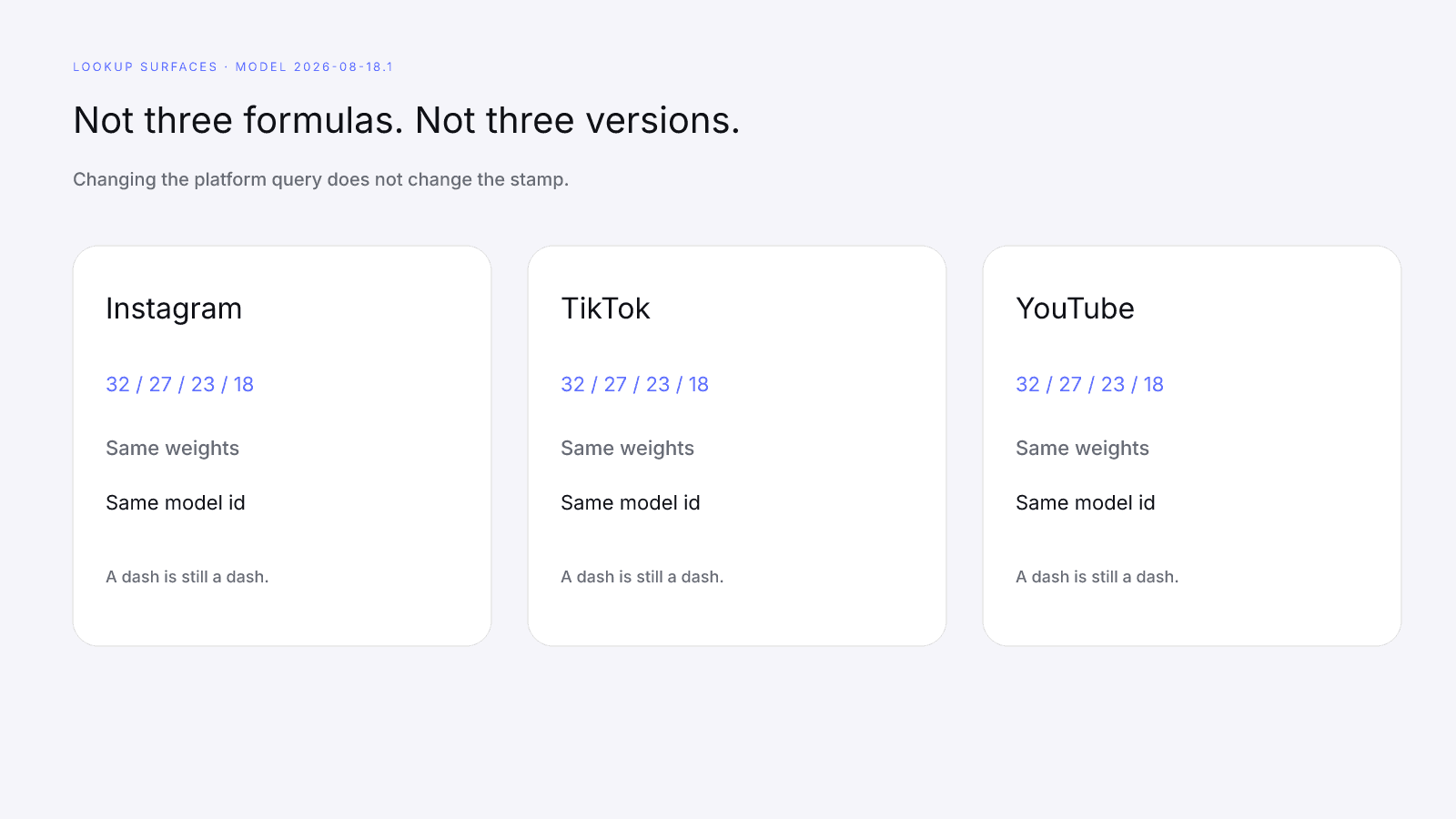
That is why a cross-platform creator is not "on three models." Platform strength scores how many public audiences were observed. Reserved usernames and empty profiles do not count as a second or third audience. The public work that can move a later fetch under the same stamp (a credible audience, real engagement, real reach, and platforms that actually have an audience) is Ethical Ways to Improve Your InfScore. Manufactured comment volume is not one of those levers. That limit is Why Engagement Pods Usually Hurt Public Influence Scores. Neither page changes the model id, and neither one publishes a point reward for a rescore.
The public InfScore stays free. Search a public profile on infscore.com. Read the model id before you read the 0–100. If the stamp matches the other card you are holding, compare coverage, dashes, and each factor. If the stamp does not match, you have two versions, not a progress report. InfScore does not publish the difference between them.
This versioned composite uses only available public creator signals. Missing factors stay unavailable and their weight is rebalanced across observed factors. It is not a percentile, a price estimate, or a guarantee of campaign results.
FAQ
If my InfScore changed, did I get better?
Not from the headline alone. A different 0–100 on the same handle can be a new model id, a coverage change, or a dash that appeared or disappeared. On model 2026-08-18.1 the mix is audience quality 32%, engagement 27%, reach and momentum 23%, and platform strength 18%. Compare that stamp, the coverage percentage, and each factor row before you read the composite as growth. There is no score-history feature that will do the subtraction for you.
What is the model id on an InfScore?
It is the version stamp on one composite, not a leaderboard season. Live scorecards opened on 2026-10-03 print 2026-08-18.1 in the how-to-read line, after the tier bands. That id marks the published weights and rules on the card you are looking at. It is not a changelog or a list of older scores.
Can I compare a score from an older model to today's?
Only as two different stamps, not as progress. If the model ids differ, the gap between the two 0–100 figures is not evidence the creator improved or declined. InfScore does not publish a changelog of what an older id changed, and the score page does not keep prior composites for you to reopen. Cite the id printed on the card in front of you.
Do Instagram, TikTok, and YouTube use different models?
No. They are lookup surfaces of the same InfScore. One formula, one version line. Audience quality is 32%, engagement is 27%, reach and momentum is 23%, and platform strength is 18% on model 2026-08-18.1, whichever public surface you opened. A higher composite on one surface is not a newer model.
Does paying $0.99 show score history or fill a dash?
No. The free InfScore needs no signup. The $0.99 report is a one-time unlock of denser modules when they exist, not a subscription. Paying does not change the 32/27/23/18 weights, fill a dash, or unlock prior composites or a model changelog. The scorecard line "Locked historical signals" is the paid follower-growth module. It charts follower counts when that series is returned. It is not past InfScores.
What should I check before calling a rescore progress?
The model id, then scoring coverage, then every dash, then the four factor rows, then the 0–100. Same stamp, same platform URL, notes on coverage. A row can move while the headline stays put. A new model id ends the comparison. Do not subtract two creators, and do not paste a homepage tile.
Where do I see the current model id?
On the live scorecard, in the how-to-read line, after the tier bands. Cards opened on 2026-10-03 show Model 2026-08-18.1 there. The free score shows that stamp. Paying does not add a second id or a version picker.