Cross-Platform Creators: Does Being Everywhere Raise Your Score?
Platform strength is 18% of InfScore. See the 45 / 70 / 90 coverage floors — and why empty second profiles do not raise the score.
This versioned composite uses only available public signals. Missing factors stay unavailable and their weight is rebalanced across observed factors. It is not a percentile, price estimate, or guarantee of campaign results. Model 2026-08-18.1.
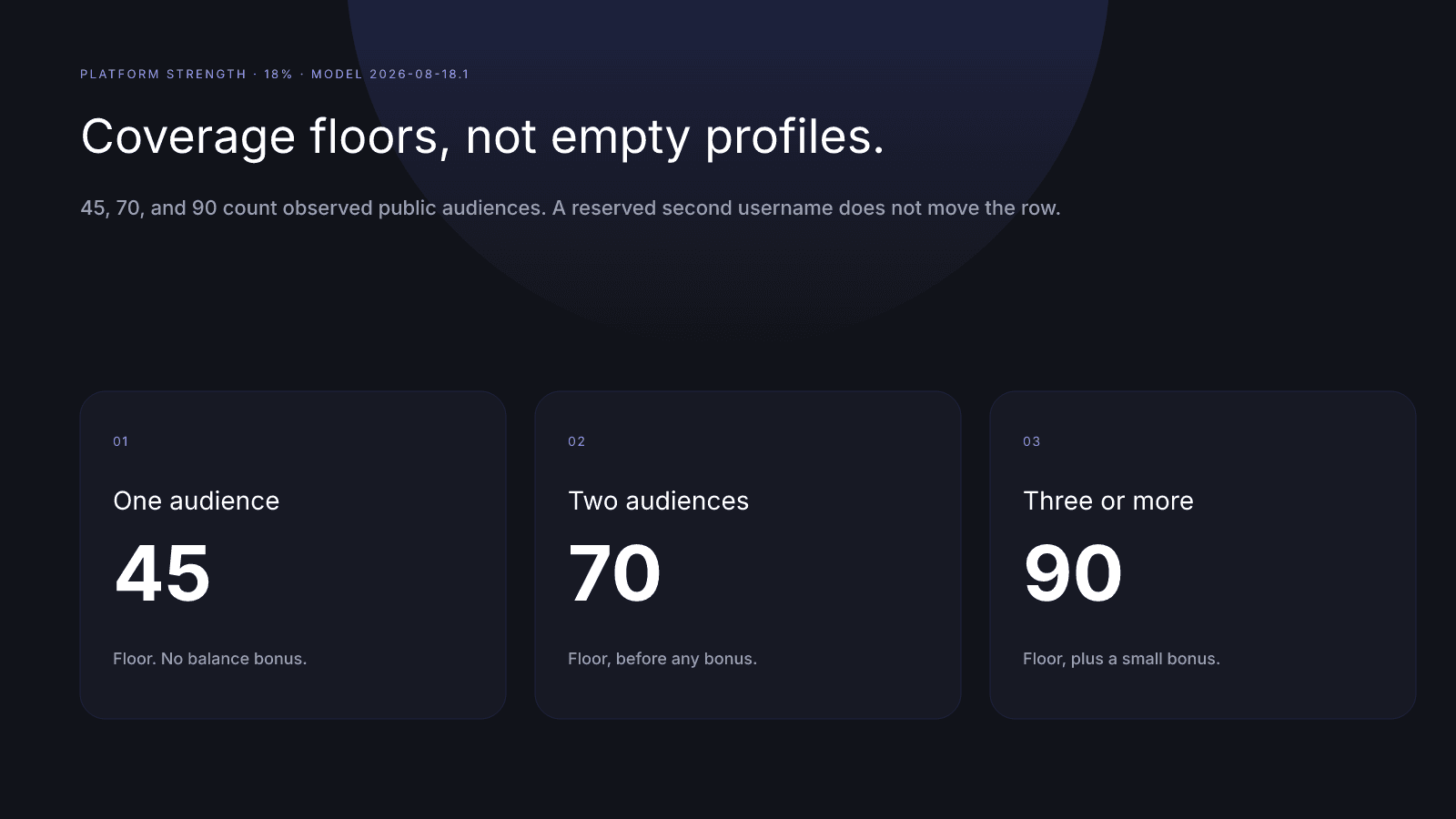
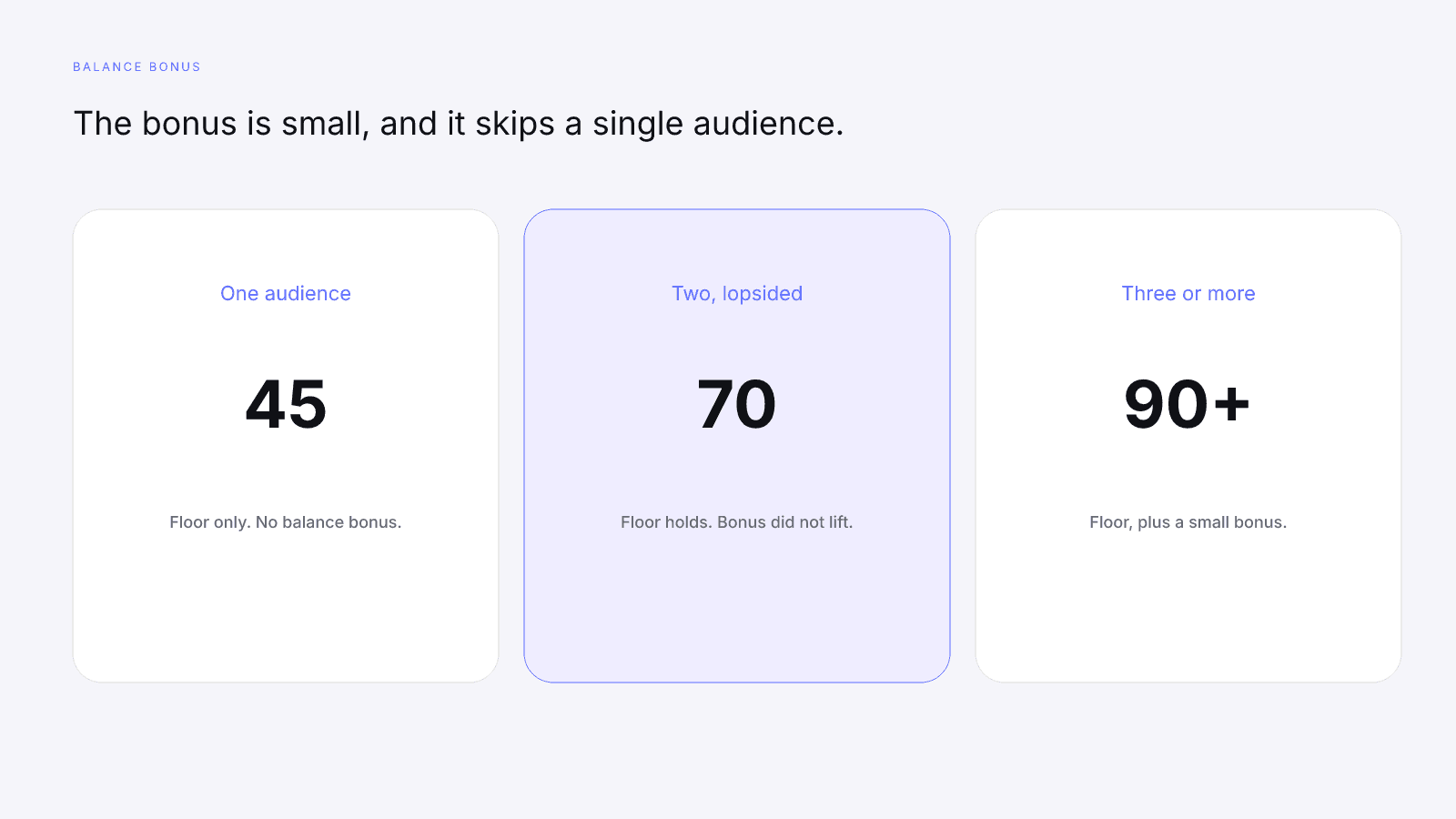
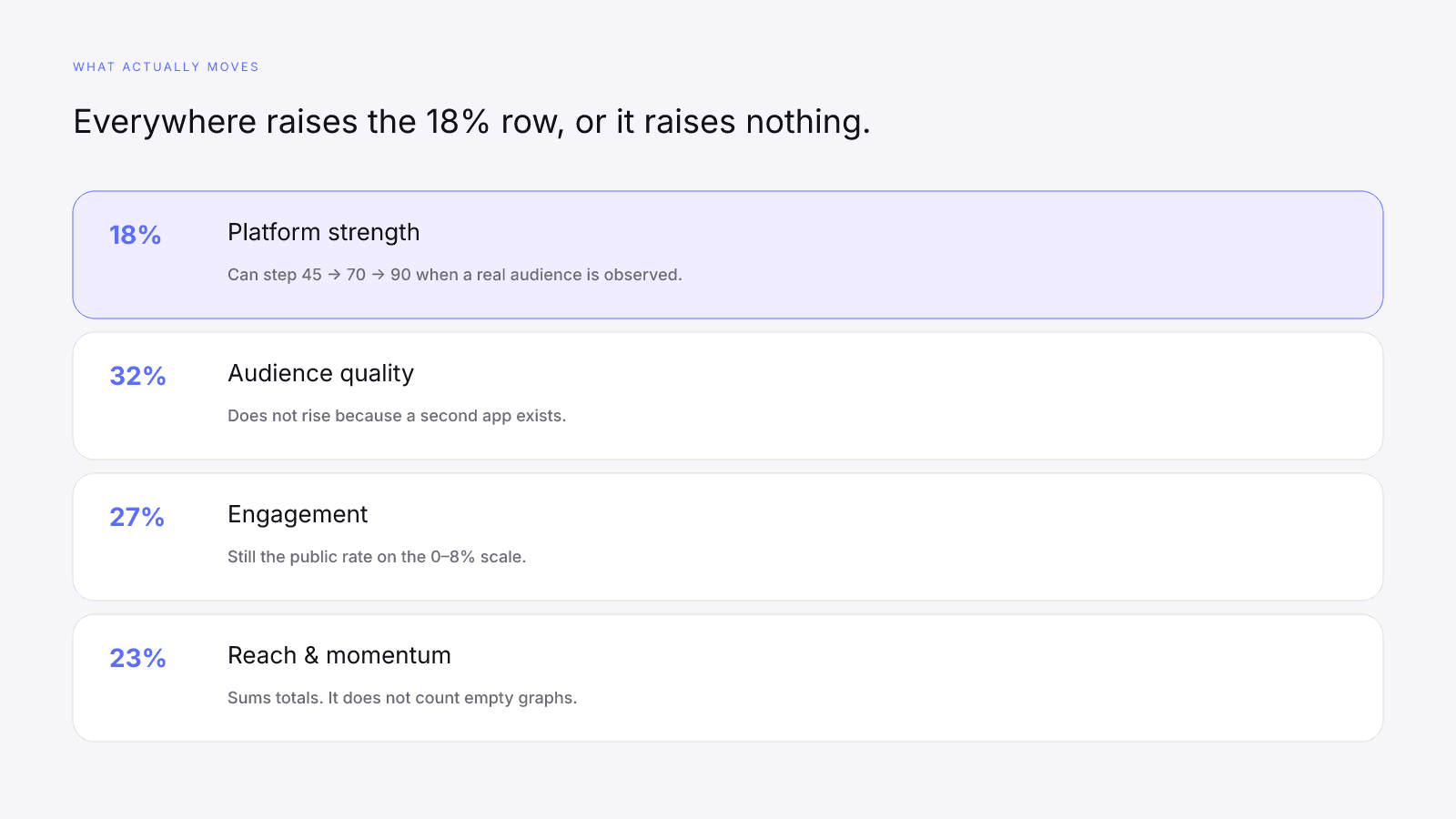
Being on more networks can raise InfScore only through platform strength, and only when those public audiences are actually observed. Empty or reserved second profiles do not raise the score. On model 2026-08-18.1, platform strength is 18% of the composite. The coverage floors are 45 for one observed platform, 70 for two, and 90 for three or more, plus a small balance bonus when counts are not lopsided. Audience quality at 32%, engagement at 27%, and reach & momentum at 23% still dominate. Instagram, TikTok, and YouTube are lookup surfaces of that same published model, not three formulas. This guide shows what "everywhere" means on the scorecard, and what does not count.
Same InfScore, three lookup surfaces
Search a public Instagram, TikTok, or YouTube profile on infscore.com and you get the same free 0–100 composite. No account is required. There is not a separate formula for the network you typed, and there is not a fork of the math. The four-factor tour is How to Measure Influencer Performance. The scorecard still shows four independently calculated rows, scoring coverage, and the model id. The platform in the URL is the lookup surface.
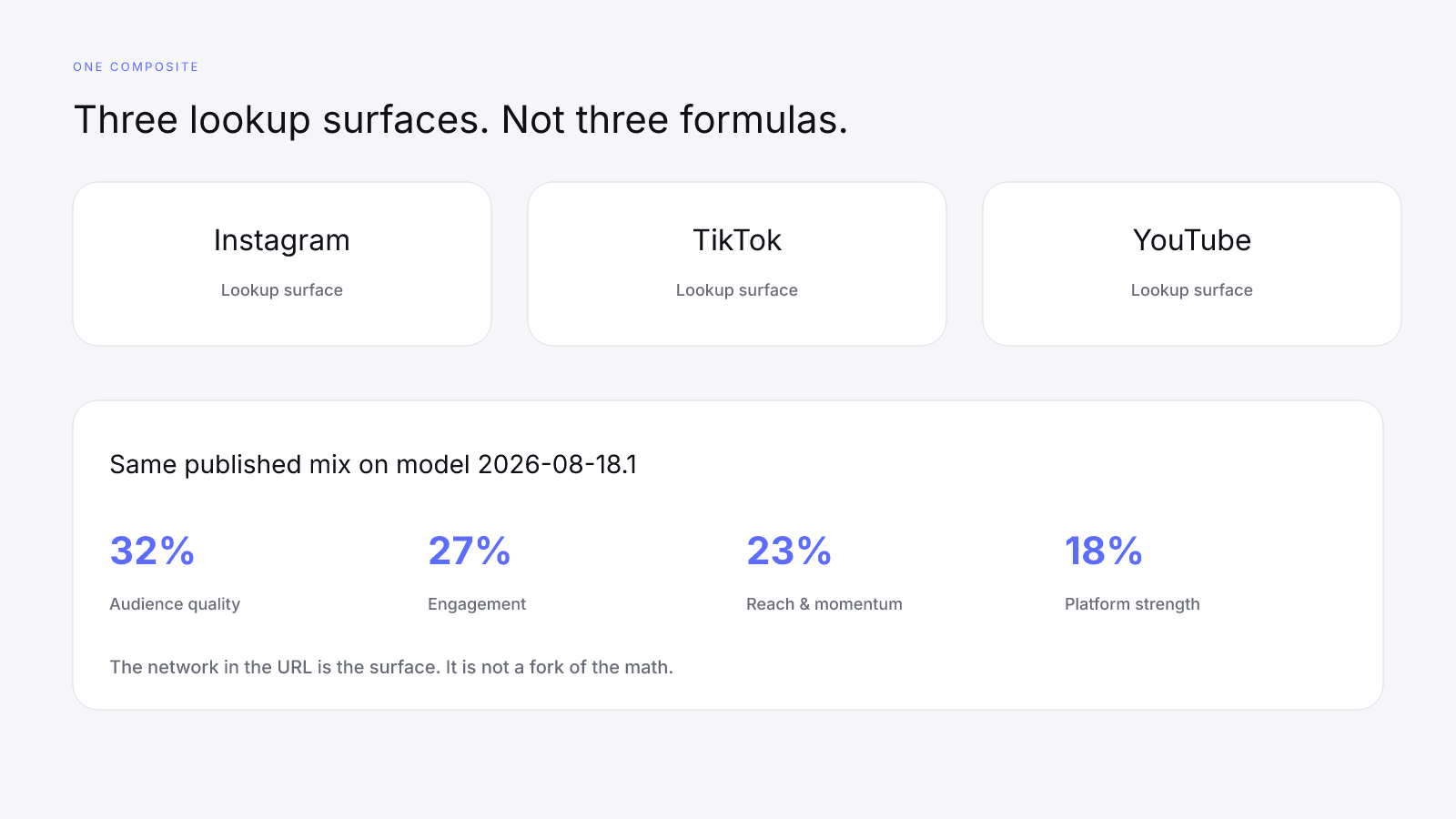
Brands still ask which app "counts more," as if each network kept its own weights. It does not. The displayed mix is the mix the current model uses: audience quality 32%, engagement 27%, reach & momentum 23%, platform strength 18%. Independently calculated still applies. A second observed audience cannot lend points to a dashed audience-quality row, and a huge follower total on one network cannot invent engagement on another.
What does change is which public creator signals sit behind those rows, and how many public audiences the provider actually returned for that creator:
| Factor | Weight | What cross-platform coverage changes |
|---|---|---|
| Audience quality | 32% | Credibility when the provider returns it. A second network does not fill this row. |
| Engagement | 27% | The public engagement rate on a fixed 0–8% scale. Not a count of apps. |
| Reach & momentum | 23% | The sum of observed public audience totals, scored on a log scale. |
| Platform strength | 18% | How many of those public audiences were observed, and whether they are badly lopsided. |
Those inputs are public provider data. They are not a dump of private analytics, and they are not a creator-uploaded media kit. If a field is missing, the factor is a dash. The missing weight is held out. Remaining observed weights are rebalanced in their published proportions. See Missing Data on Creator Metrics for the coverage arithmetic.
The three live cards in this guide are surface siblings of that one model, checked on 2026-09-22. Emma Chamberlain on Instagram, Khaby Lame on TikTok, and MrBeast on YouTube are not three formulas and not a study of "creators on more apps score X% higher." Example cards on the homepage are illustrative. A score URL is the product. The network-facing maps are Instagram InfScore Factors, TikTok Reach vs Engagement, and YouTube Momentum Signals.
What platform strength actually scores
Platform strength is the smallest published weight, and it is the row people treat as a growth plan. It is not. It scores observed platform coverage and balance across public audiences. The weight is 18%.
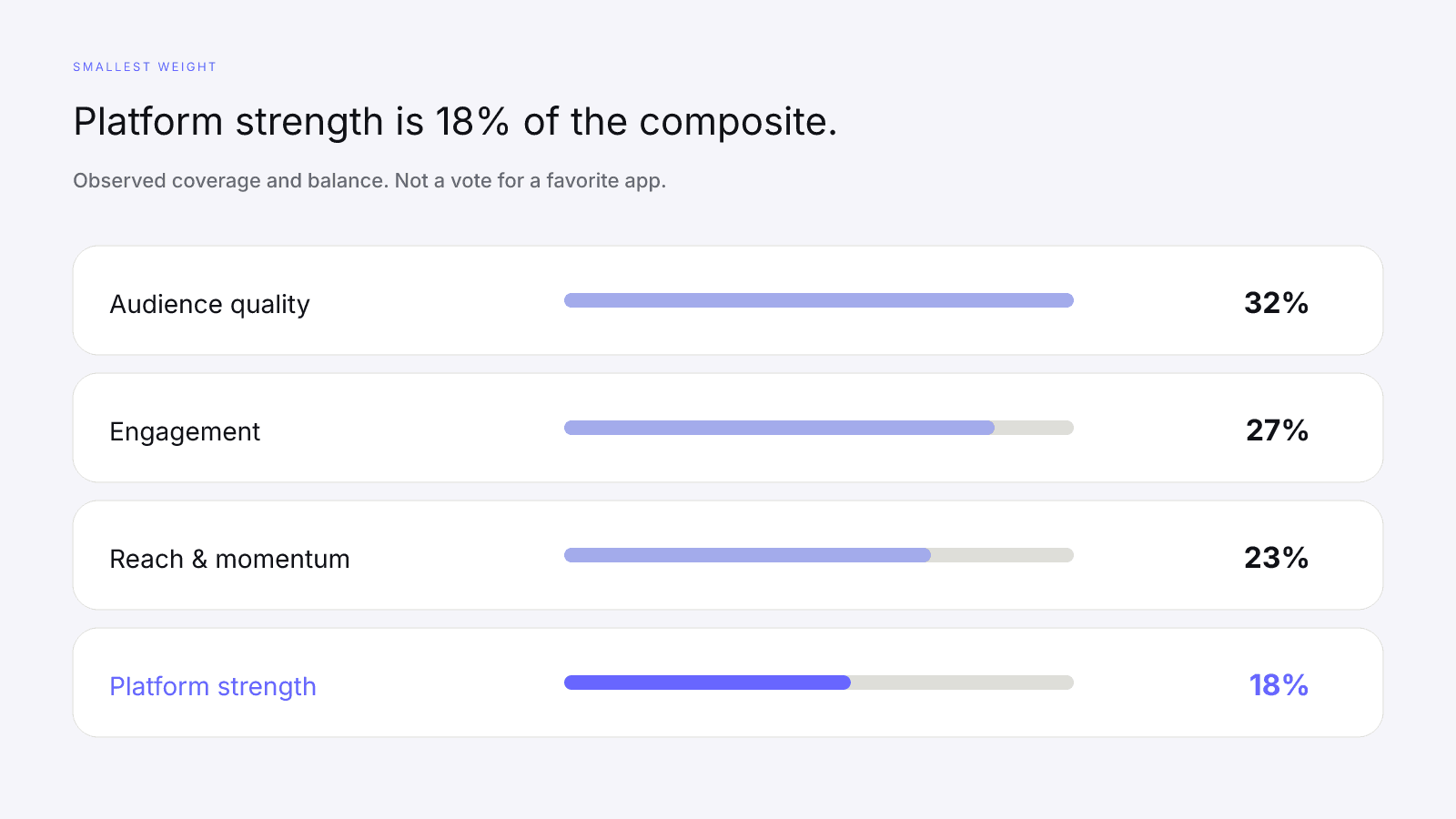
Two questions decide the row:
- How many public audiences were observed? A platform counts when the provider returns a public audience greater than zero. A reserved username, a zero, or a graph that never came back does not count.
- Are those audiences badly lopsided? When two or more audiences were observed, a small balance bonus can lift the row above the floor if the counts are not concentrated on a single network. One observed audience gets the floor and no bonus.
The factor is calculated on its own. It does not borrow audience quality's 32%, engagement's 27%, or reach & momentum's 23%. A strong platform-strength number is still only 18% of the mix when the row exists. Cropping the card to that line is not a reading. How to Read an Influencer Scorecard is the order: coverage, dashes, independent rows, then the composite.
If no usable public audience was observed, the row is a dash. You cannot call coverage strong or weak. You can only say the row did not run. Coverage then falls by 18. When the other three factors are present, coverage is 82, because 32 + 27 + 23 = 82.
The 45 / 70 / 90 floors
On model 2026-08-18.1 the coverage floors are fixed:
- 1 observed platform → 45
- 2 observed platforms → 70
- 3 or more → 90, plus a small balance bonus when follower counts are not concentrated on a single network
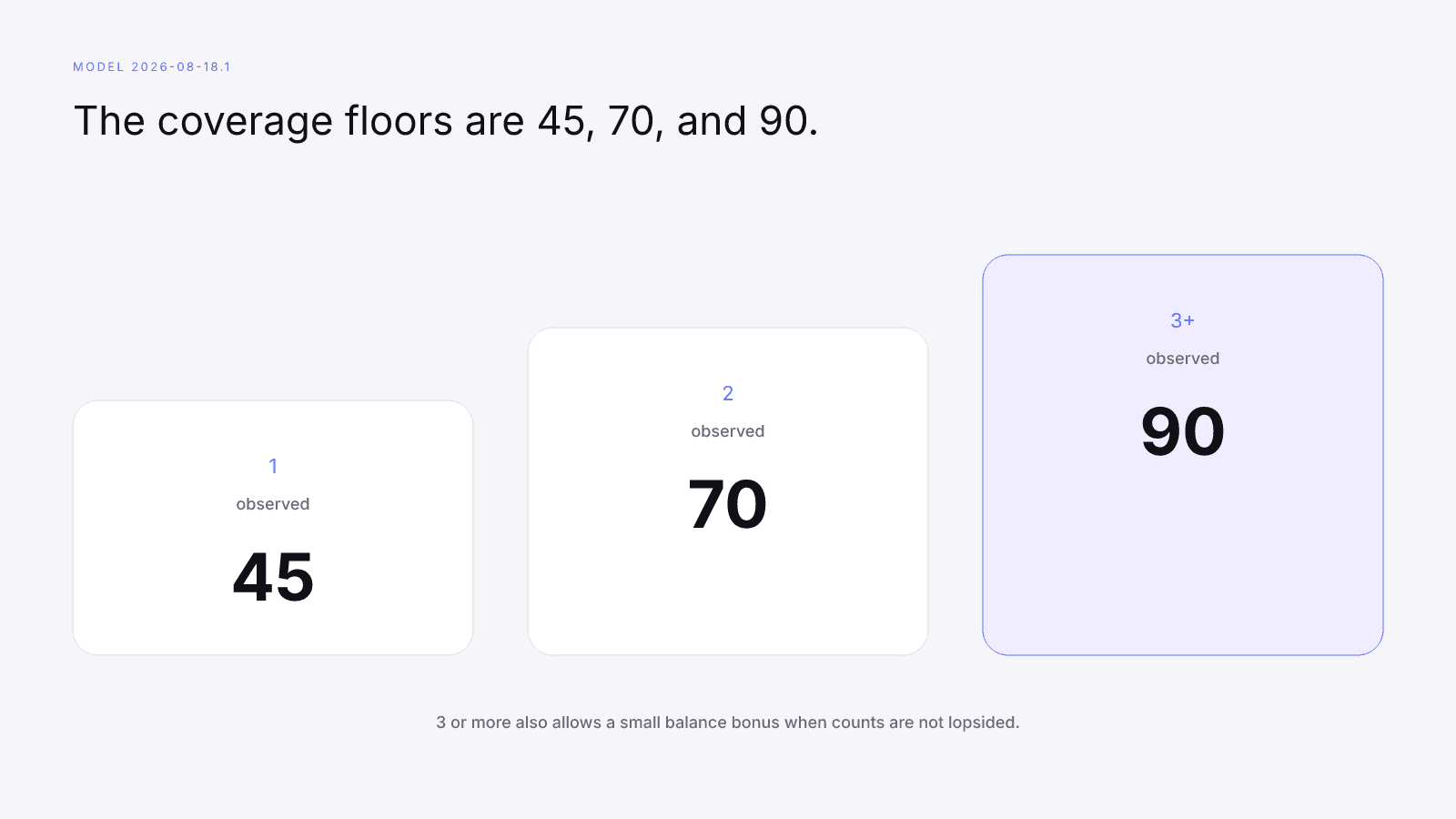
The floor is the base. It is not a promise that the composite moves by the same gap. Going from one observed audience to two moves this factor from 45 toward 70 before any balance bonus. Going from two to three or more moves the floor from 70 to 90. The other three factors do not automatically step with it.
The balance bonus is small, and it only runs when at least two audiences were observed. A creator whose public counts sit almost entirely on one network can remain on the floor even with a second graph present. A spread that is less lopsided can sit a little above the floor. One observed audience stays at 45. There is no bonus to negotiate.
Live cards, re-opened 2026-09-22, show the ladder without turning it into an uplift study. These are three lookups of the same composite. They are not one creator measured three times, and they are not a percentage claim about "being everywhere."
| Live lookup | Platform strength | Floor reading | Composite | Coverage |
|---|---|---|---|---|
| Emma Chamberlain, Instagram | 45 | One observed public audience | 67, Emerging | 100% |
| Khaby Lame, TikTok | 70 | Two observed audiences; the balance bonus did not lift the row | 87, Rising | 68% |
| MrBeast, YouTube | 94 | Three or more; the 90 floor plus a small balance bonus | 69, Emerging | 68% |
Emma's 45 is the one-platform floor, not a verdict that Instagram is a weak network. The rest of that card still ran: audience quality 84.4, engagement 48, reach & momentum 83, coverage 100%. Platform strength is one row on a complete mix. It is not the InfScore.
Khaby's 70 is the two-platform floor. The balance bonus did not add. Audience quality on that card is a dash, so coverage is 68 (27 + 23 + 18). Engagement is 100 and reach & momentum is 84. The composite is 87 because those observed rows were rebalanced. It is not 87 because a second network "added 17 points," and it is not comparable to Emma's 67 as a multi-platform prize. The handle on that URL is khaby.lame.
MrBeast's 94 sits above the three-or-more floor of 90. The gap is the small balance bonus, not a different YouTube formula. Audience quality is a dash there too, so coverage is also 68. Engagement is 27 and reach & momentum is 100. The composite on the card is 69. A platform-strength row of 94 did not become an InfScore of 94.
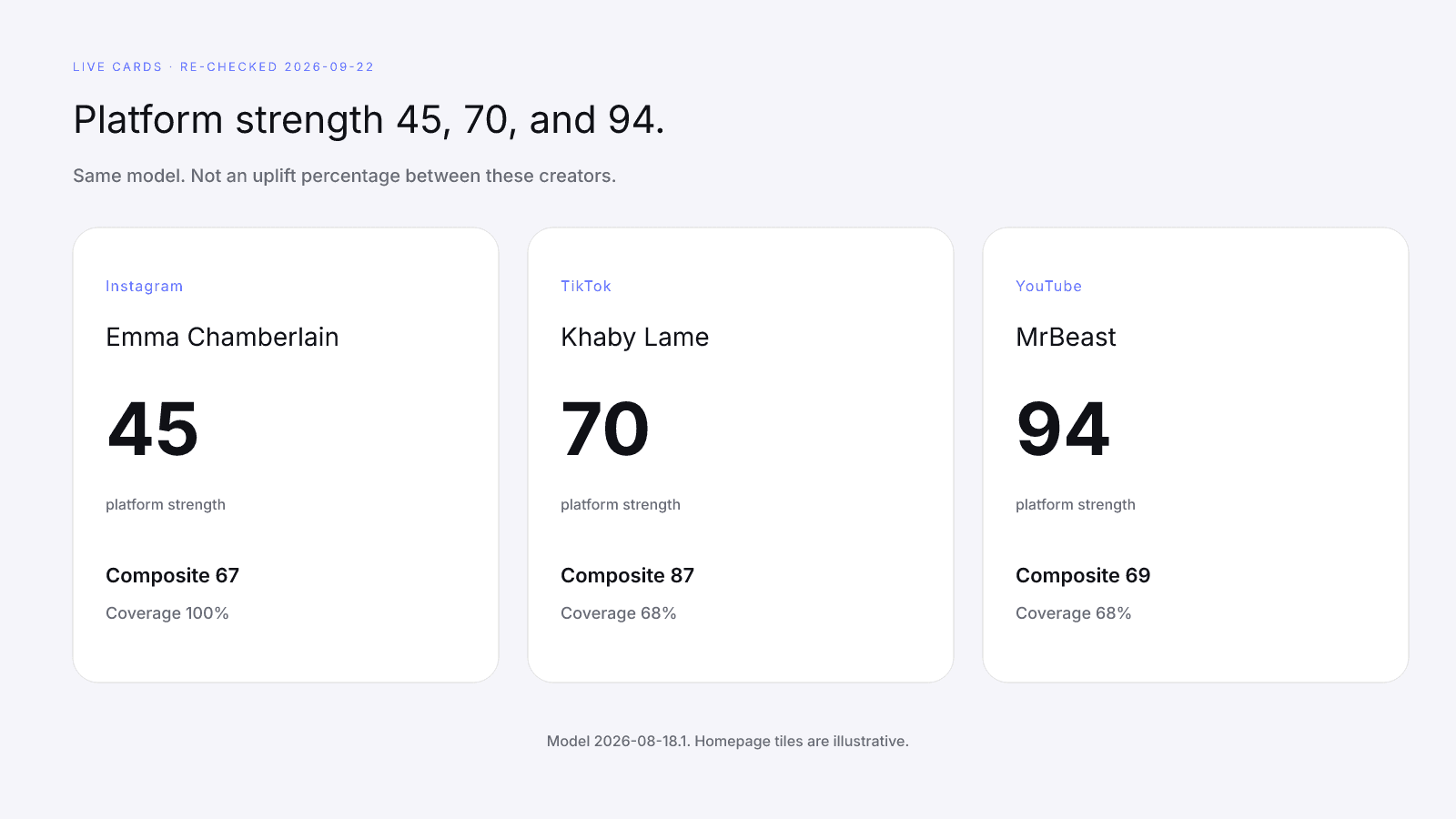
Do not subtract those composites and call the difference a cross-platform uplift. Coverage differs. Dashed rows differ. The creators differ. The only number this section is willing to treat as a floor reading is the platform-strength row itself: 45, 70, and 94.
Does "everywhere" raise the composite?
Sometimes the platform-strength row moves. The composite moves only to the extent that 18% weight, after rebalancing, actually changes the mix. The other factors can swamp it.
A checkable case from the model tests, using round numbers so the arithmetic is checkable, is not one of the live cards above. Audience quality missing, engagement at 4% public rate (50 on the factor), reach & momentum 40, platform strength 45. Coverage is 68. The remaining mix is 27/68, 23/68, and 18/68. The composite is (50 × 27 + 40 × 23 + 45 × 18) ÷ 68, which rounds to 45. On that card, platform strength is the one-platform floor. It is not the InfScore. Paying does not fill the audience-quality dash, and it does not turn 45 into a reward for opening another empty account.
Read the same limit on the live YouTube card. MrBeast's observed rows are engagement 27, reach & momentum 100, and platform strength 94, with audience quality dashed. Coverage is 68. The composite is (27 × 27 + 100 × 23 + 94 × 18) ÷ 68, which rounds to 69. That is the number on the YouTube score. The 94 did real work inside an 18% weight. It did not set the headline.
Khaby's observed rows make the same point from the two-platform floor. Engagement 100, reach & momentum 84, platform strength 70, audience quality dashed. (100 × 27 + 84 × 23 + 70 × 18) ÷ 68 rounds to 87, which matches the TikTok score. Swap the 70 for a fictional 45 and you would be inventing a card. This article will not publish that counterfactual as a "raise by X" result.
Audience quality remains the heavy row when it exists. Emma's Instagram card has 100% coverage and an audience-quality score of 84.4. That 32% weight is why a one-platform floor of 45 can still sit inside a composite of 67. Engagement at 48 is the public rate mapped onto the fixed 0–8% scale, not a grade of how many apps she uses. The longer split between size and credibility is Audience Quality vs Follower Count. The engagement scale is What a Good Engagement Rate Looks Like in 2026.
So "everywhere" raises InfScore only in this narrow sense: another observed public audience can lift platform strength off 45 toward 70, or off 70 toward 90 and a small balance bonus, and that new factor score then takes its 18% place in the mix. It does not raise audience quality. It does not raise engagement. It does not replace a dash. Empty profiles do not start the sentence.
Reach sums observed audiences
Reach & momentum is a different question wearing a similar coat. Platform strength counts graphs. Reach uses totals.
When a public audience total exists, reach scores that total on a log scale from about 1,000 (0 on that piece) through 100 million (100). If the provider returned more than one public graph, those counts are summed first. A platform the provider did not return does not add to the total. When a public growth or consistency signal also exists, the factor becomes a blend: 70% logarithmic reach and 30% momentum. If growth is missing, reach still scores on its own.
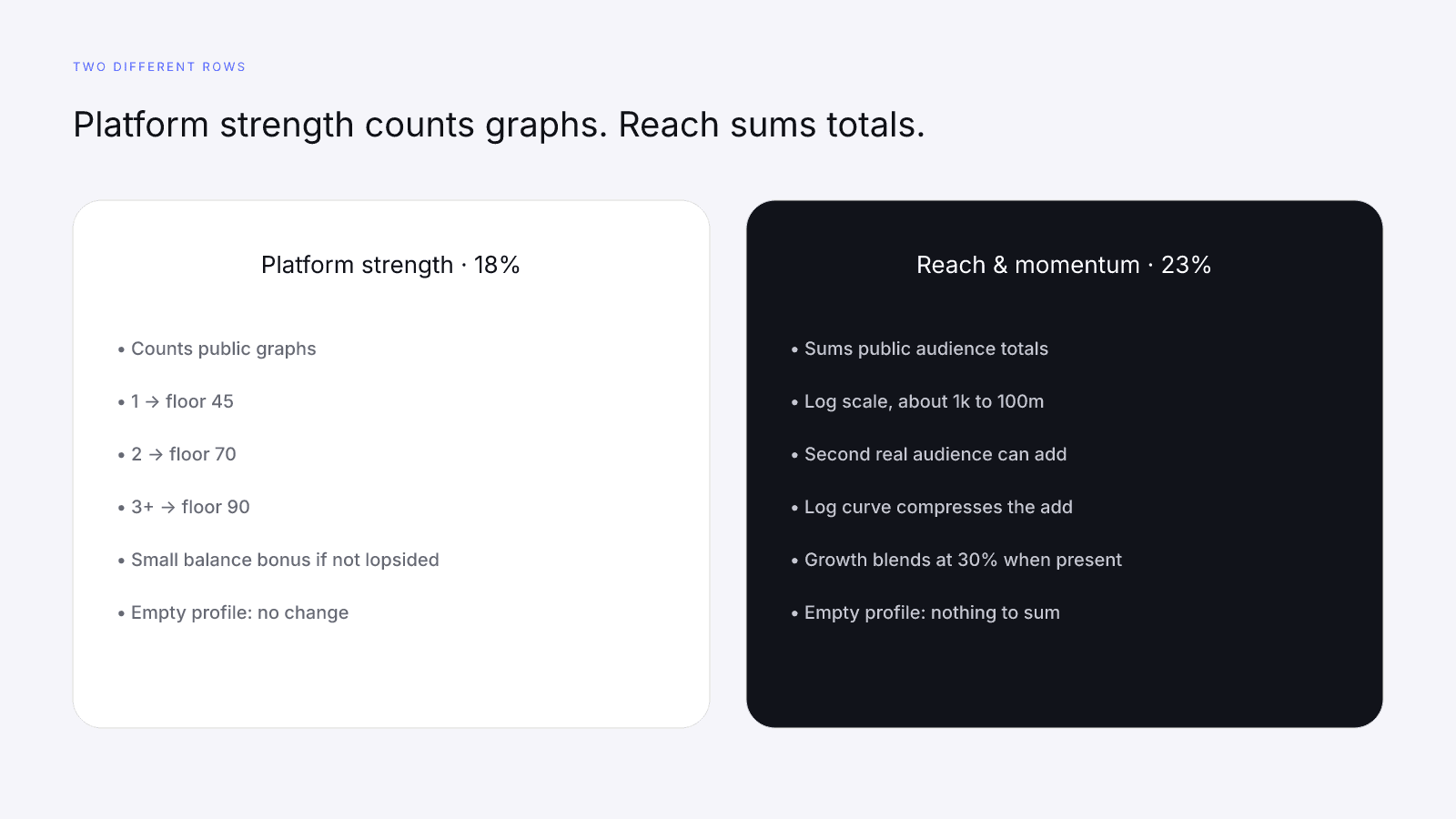
That is why a second real audience can move both rows and still move them differently:
- Platform strength steps by floors: 45, then 70, then 90, plus a small balance bonus when the split is not lopsided.
- Reach moves only by the added public count, and the log scale compresses that addition. A modest second audience does not double the reach score.
- A second empty profile moves neither. Nothing was observed, so nothing was summed.
The YouTube-facing version of the reach row, including the growth blend creators underuse, is YouTube Momentum Signals. The TikTok comparison of that row against engagement is TikTok Reach vs Engagement. Neither article treats platform strength as a substitute for logarithmic size.
If the public audience total is missing or not usable, reach & momentum is a dash even if you can name three networks from memory. Coverage then falls by 23, to 77, when the other factors ran (32 + 27 + 18). Naming the apps does not fill the row.
What does not count
A lot of "everywhere" behavior feels like it should count. Most of it never enters this row.
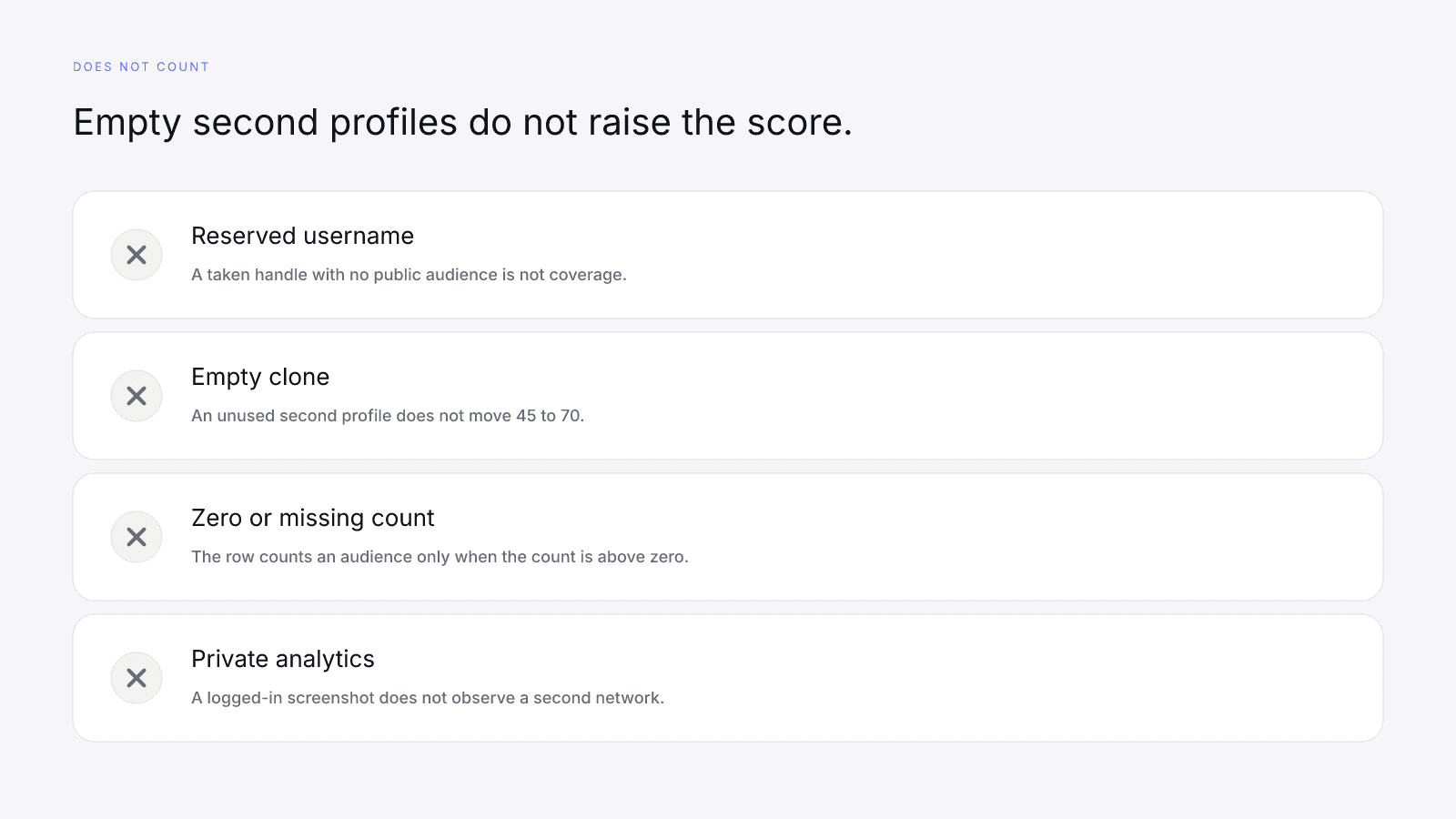
Reserved usernames and empty clones. A handle that exists so the name is taken, with no observed public audience, is not coverage. The floor stays on the graphs that actually returned a count. Opening three empty accounts does not move 45 to 70 to 90.
Unused second profiles. A profile you never post on, that the provider returns as empty or does not return, does not help. Matching a real public identity across networks where you do publish is a different act. The hub guide already says the ethical move is to connect the identities you use, not to stand up a placeholder.
Private analytics as proof of a second network. The free InfScore uses public creator signals. A screenshot from a logged-in app, a media kit, or unpaid access to non-public fields is not a free-score input. Paying $0.99 does not purchase a pipe into that app, and it does not fill a dash with a screenshot you pasted.
Picking a "best" platform. Platform strength does not rank Instagram against TikTok against YouTube as products. A YouTube-only lookup can still return a number at the 45 floor. That is information: one public audience was observed. It is not a verdict that the network is weak, and it is not a request to spam two empty handles so the floor can move.
Bought followers, pods, and manufactured ratios. Those usually work against you on other rows. Hollow followings tend to weaken audience quality. Pods can inflate a raw engagement ratio for a moment and still leave a weaker credibility row. They do not purchase a higher platform-strength floor. InfScore will not publish a recovery score for people who did those things.
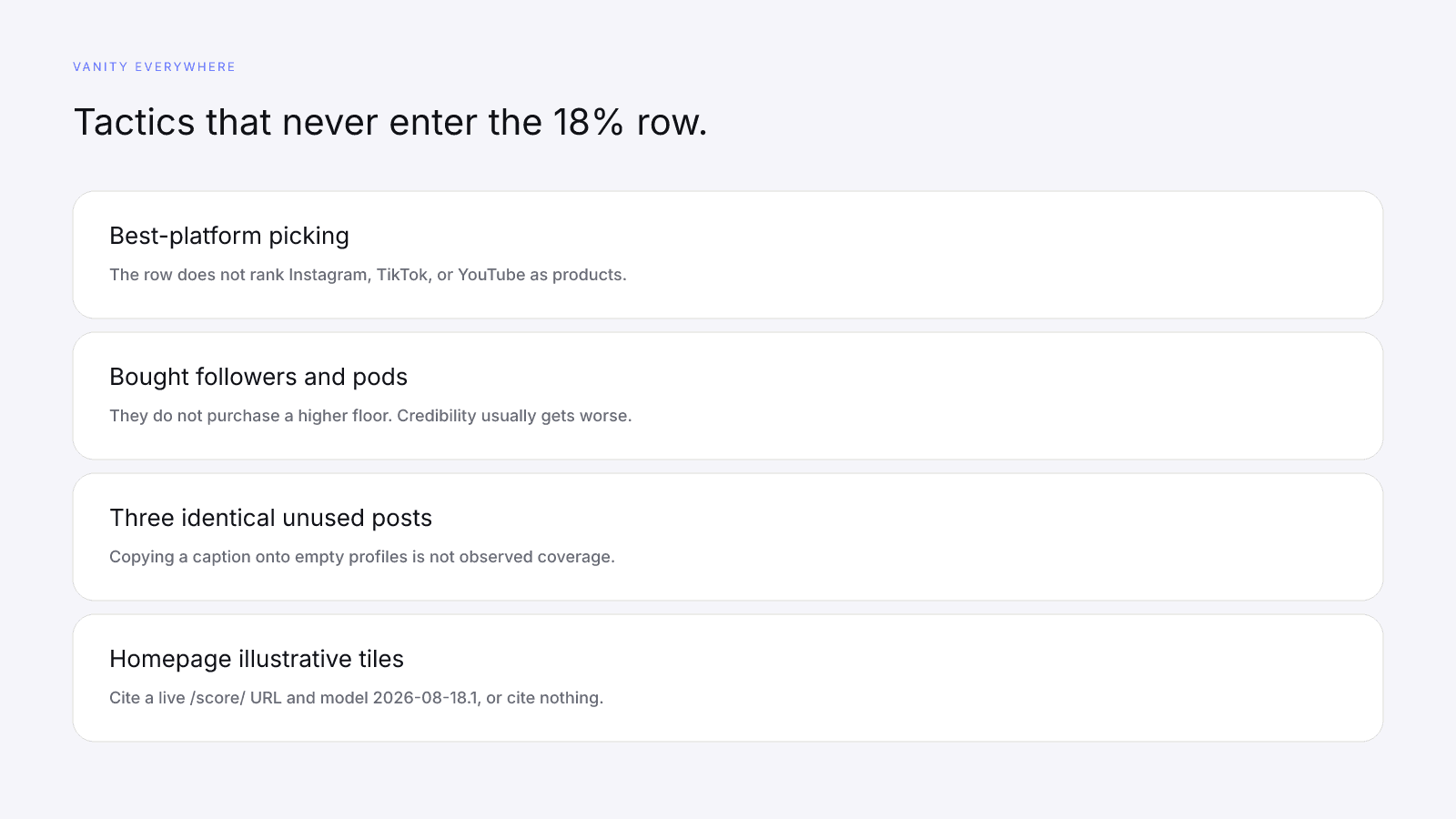
A homepage tile. Example cards on the homepage are illustrative. Cite a live /score/ URL and the model id, or do not cite a number.
One green row. A platform-strength score of 90 or 94 is still 18% of the model when the row exists. The composite is the rebalanced mix of the rows that returned a number.
How to read a live multi-surface card
Read a cross-platform card the same way you read any other public InfScore: coverage first, then dashes, then the four rows, then the 0–100 number and the model id. When the job is "everywhere," read the platform-strength floor before you read the headline.
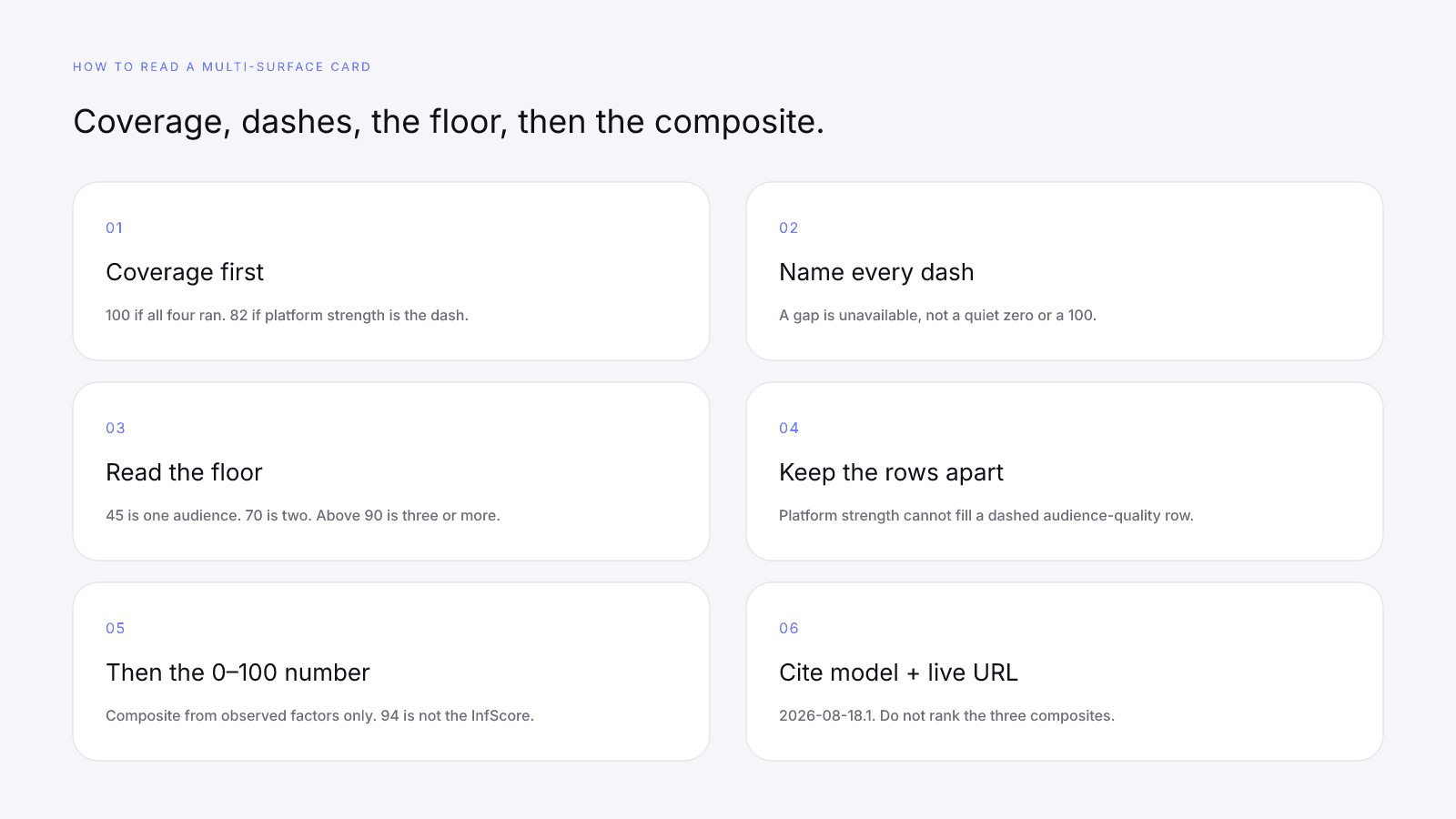
- Scoring coverage. If every factor is present, coverage is 100 and the 32/27/23/18 mix applies in full. If audience quality is dashed, coverage is 68. Engagement dashed, 73. Reach & momentum dashed, 77. Platform strength dashed, 82.
- Dashes. A dash is a gap in public provider data. Treating it as zero punishes a blind spot. Treating it as 100 invents a perfect row. Missing signals stay missing. Weights rebalance across the factors that actually ran.
- The platform-strength row, only if it exists. 45 means one observed public audience. 70 means two, with no balance lift. A number above 90 means three or more, plus however much of the small balance bonus the split earned. MrBeast's live 94 is that last case. Emma's live 45 is the first. Khaby's live 70 is the middle.
- Independence. Each factor uses its own inputs. Platform strength cannot stand in for a dashed audience-quality row. Reach cannot stand in for a missing engagement rate. The rows do not borrow.
- The 0–100 composite, after the rows. Cite model
2026-08-18.1. A 69 on this version is this mix. A 69 on a later version might mean something else. - A live URL. Open Emma Chamberlain on Instagram, Khaby Lame on TikTok, or MrBeast on YouTube. Do not paste a homepage tile, and do not treat the three composites as a ranking of networks.
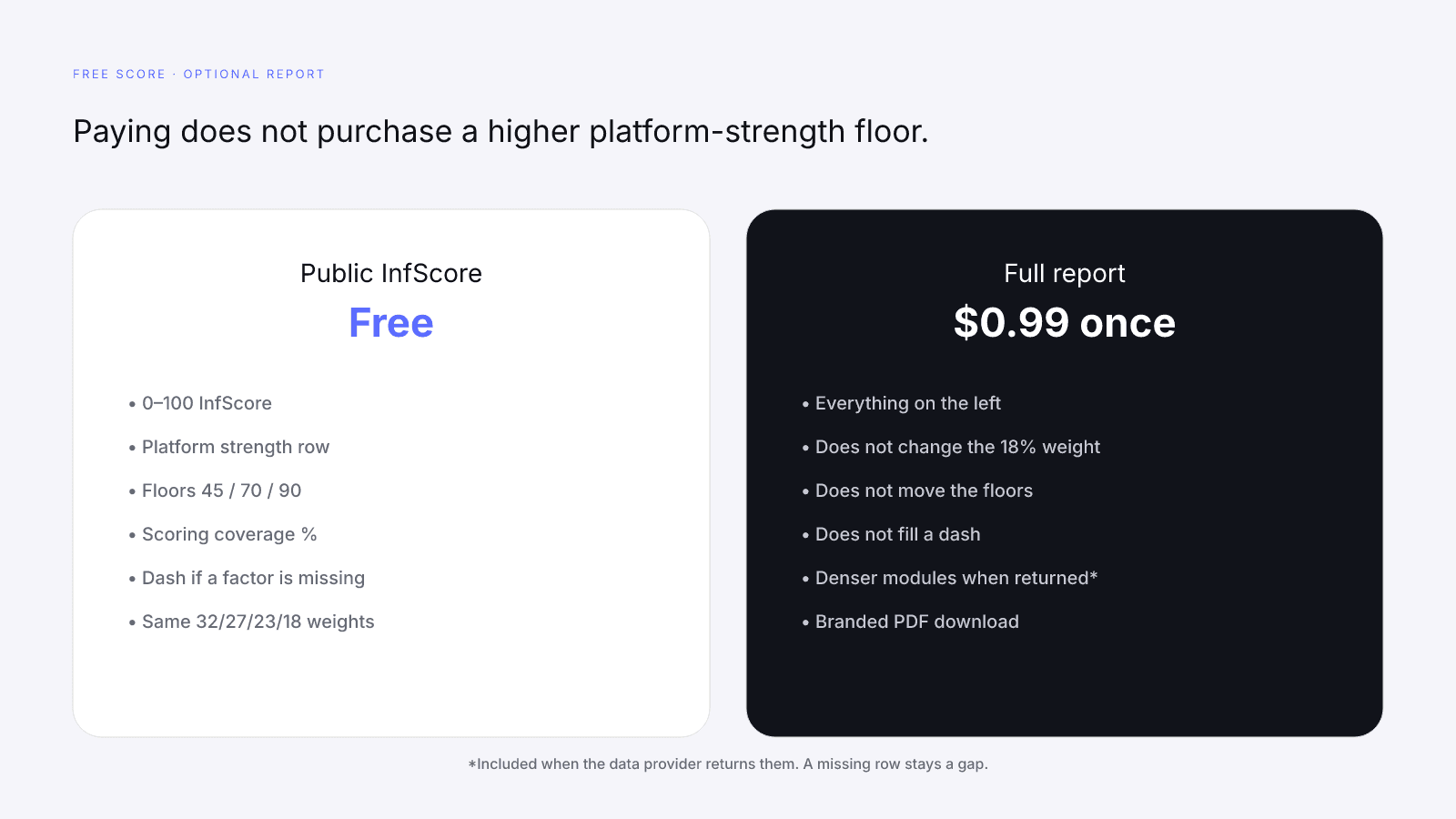
The public InfScore stays free. No signup. Pricing is one report, one dollar, no recurring fee. Use the paid report when you need the denser modules behind a specific scorecard. Use the free score when you need the comparable number. Both views use the same weights. Paying does not change platform strength, and it does not turn an empty second profile into an observed audience.
This versioned composite uses only available public creator signals. Missing factors stay unavailable and their weight is rebalanced across observed factors. It is not a percentile, price estimate, or guarantee of campaign results.
The cross-platform InfScore worth trusting is the one you can check: four published factors, public audiences that were actually observed, floors of 45 / 70 / 90, and a composite that still has room for the heavier rows. Search a public profile on infscore.com. If you want the modules behind a specific scorecard, the full report is there for $0.99, and only when you actually need it.
FAQ
Does being on Instagram, TikTok, and YouTube raise InfScore?
It can raise the platform strength row, and only when those public audiences are actually observed. On model 2026-08-18.1 the floors are 45 for one observed platform, 70 for two, and 90 for three or more, plus a small balance bonus when counts are not concentrated on one network. Platform strength is 18% of the composite. Audience quality is still 32%, engagement is still 27%, and reach and momentum is still 23%. Empty or reserved second profiles do not raise the score. There is no published "raise InfScore by opening Y accounts" table.
What are the platform strength floors (45 / 70 / 90)?
On model 2026-08-18.1, one observed public audience scores a platform strength floor of 45. Two observed audiences score a floor of 70. Three or more score a floor of 90, plus a small balance bonus when follower counts are not concentrated on a single network. A live check on 2026-09-22 shows Emma Chamberlain on Instagram at 45, Khaby Lame on TikTok at 70, and MrBeast on YouTube at 94. Those are the same composite on three lookup surfaces, not three formulas, and not an uplift percentage.
Is platform strength the same as picking a best platform?
No. Platform strength does not pick a best network. It scores how many public audiences were observed and whether those audiences are badly lopsided. The weight is 18%. Instagram, TikTok, and YouTube remain lookup surfaces of one model. Choosing the app you like does not rewrite audience quality, engagement, or reach.
Do empty or unused second profiles help?
No. Reserved usernames, empty clones, and profiles with no observed public audience do not count as coverage. The floor moves only when a provider returns another real public audience. Stuffing three networks with unused handles does not raise platform strength, and it is not a request this score will honor.
How does platform strength interact with reach and momentum?
They are independent rows. Platform strength counts how many public graphs were observed and is 18% of the mix when at least one audience exists. Reach and momentum is 23% and sums the observed public audience totals when those totals are returned, then scores that sum on a log scale. A second empty profile changes neither row. A second real audience can move both, and it will not move them by the same amount.
Is InfScore's formula different per platform?
No. Instagram, TikTok, and YouTube are lookup surfaces of the same versioned 0–100 composite, not a fork and not a separate formula. Searching any of them still runs audience quality 32%, engagement 27%, reach and momentum 23%, and platform strength 18% on model 2026-08-18.1. Private analytics do not move the free score.
Does paying $0.99 change platform strength weights?
No. The free InfScore is the same 0–100 composite, the same four factors, and the same coverage percentage. No signup is required. The one-time $0.99 report unlocks denser provider modules when they exist. Paying does not change the 18% platform strength weight, does not move the 45 / 70 / 90 floors, and does not fill a dash.