Audience Quality vs Follower Count: What Brands Quietly Check
Follower count is size. Audience quality is credibility. InfScore weights AQ at 32% of the 0–100 score—why brands look past vanity headcounts, and why bought followers hurt.
This versioned composite uses only available public signals. Missing factors stay unavailable and their weight is rebalanced across observed factors. It is not a percentile, price estimate, or guarantee of campaign results. Model 2026-08-18.1.
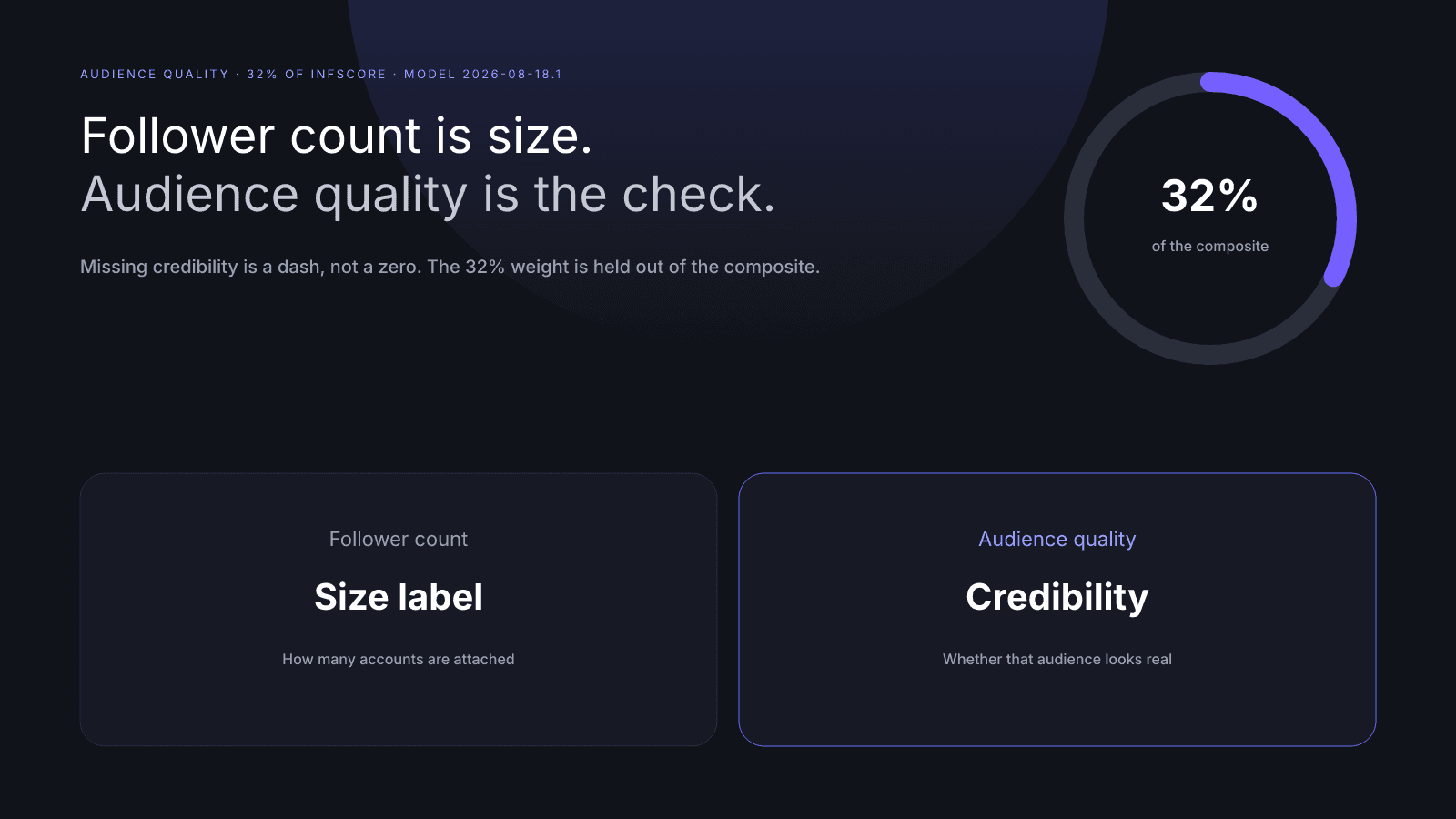
Follower count is a size label. Audience quality is a credibility check. A screenshot of 400,000 followers does not tell a brand whether those accounts look real, active, or even interested in the work.
InfScore treats that gap as the largest published factor. Audience quality is 32% of the versioned 0–100 composite, ahead of engagement 27%, reach & momentum 23%, and platform strength 18%. The factor uses provider-measured audience credibility when that public signal exists. If it does not, the row is a dash, not a zero.
This guide is how to read AQ on model 2026-08-18.1 without treating a headcount as a grade. For the four-factor tour, start with How to Measure Influencer Performance.
Follower count is a size label, not a quality grade
Follower count answers one question: how many public accounts are attached to this profile, on the platforms a provider returned. It does not say whether those accounts look credible, whether they watch the work, or whether a brand should pay more.
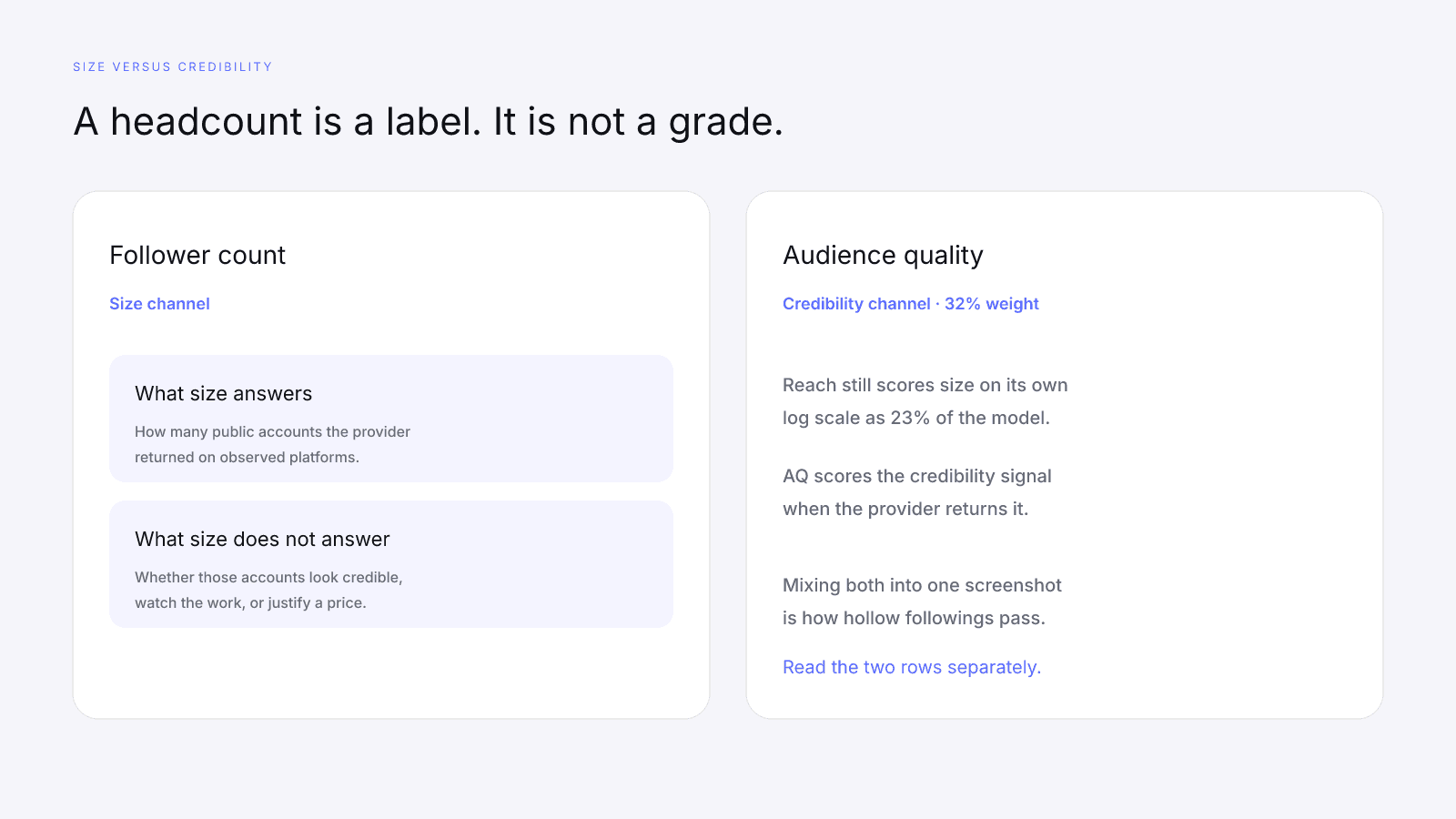
Reach still has its own row in InfScore. Logarithmic total reach is 23% of the model, blended with measured growth when that signal exists. That is the size channel. Audience quality is the credibility channel. Mixing the two into one vanity screenshot is how hollow followings pass a first glance.
A useful size reading has three parts:
- The count is a public provider total, not a private analytics export.
- You know reach is scored on a log scale, not as a richest-follower contest.
- You also read audience quality. Size without credibility is a noisy input.
Search any public creator on infscore.com. The free scorecard shows headline followers when they exist, then the audience-quality row when the credibility signal exists.
What audience quality means on public signals
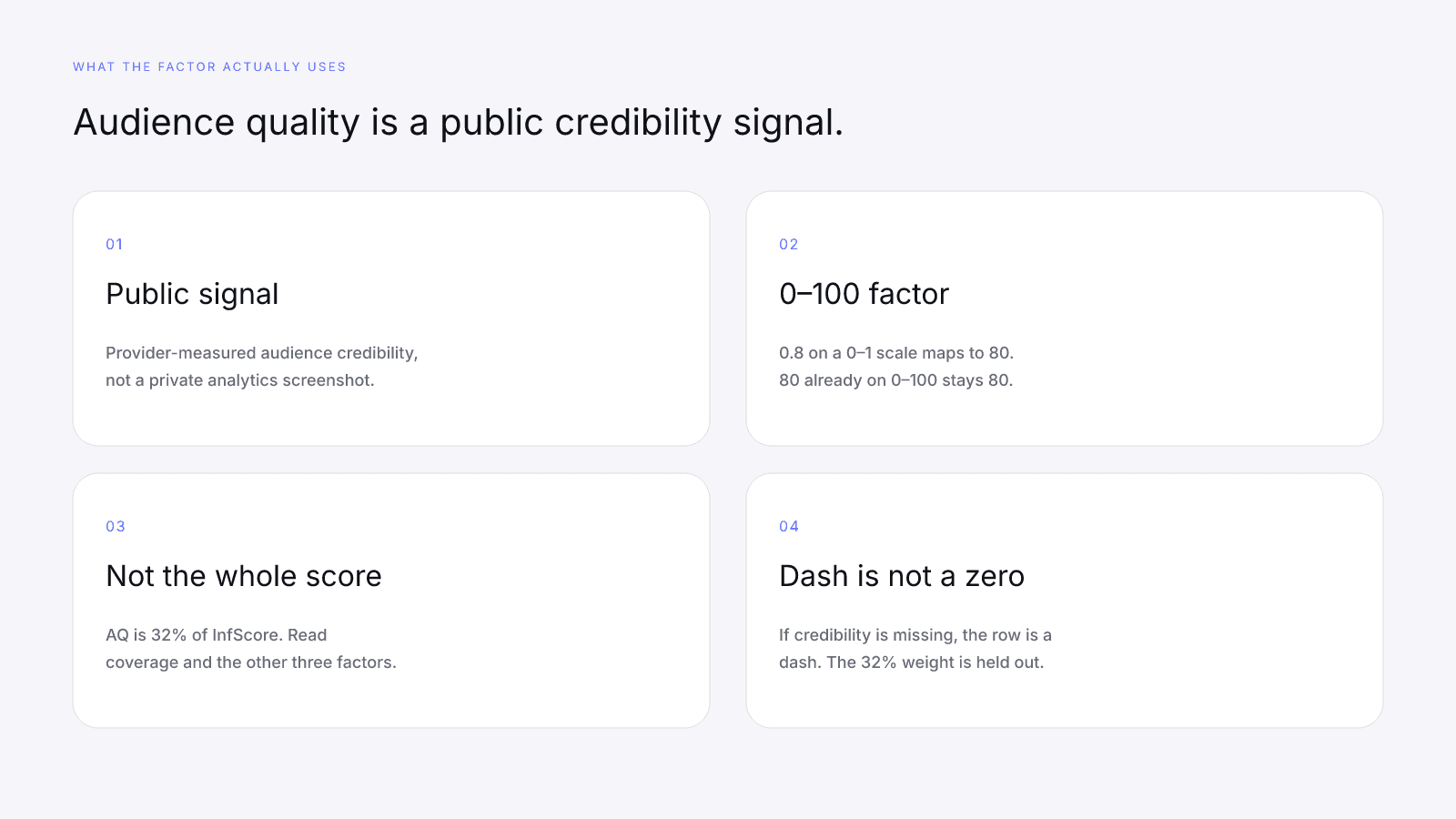
Audience quality is not a vibe. On InfScore it is a 0–100 factor built from provider-measured audience credibility, when the provider returns that field for the profile you searched.
That is narrower than "is this community nice," and it is more useful than a follower screenshot. A large audience can be inactive, mismatched, or assembled in ways that weaken the credibility signal. A smaller audience can look like people who would actually see the next post.
InfScore does not invent the credibility number. It does not let you type one in. It uses the public creator signal a provider actually sent, scaled onto the 0–100 factor. If the provider sends 0.8 on a 0–1 scale, the factor is 80. If the provider already sends 80, the factor is 80. Null or non-finite input returns no factor score at all.
A useful AQ reading has four parts:
- The credibility signal exists as public provider data, not as a creator's screenshot of "real followers."
- You know it maps onto a 0–100 factor row, or a dash.
- You also read scoring coverage and the other three factors. AQ is 32% of the model, not the InfScore.
- You treat a missing credibility field as missing. A dash is a gap, not a failed grade.
This factor is independently calculated. A strong engagement row cannot lend points to a missing audience-quality row. Each row is computed from its own inputs. The composite only mixes the rows that actually returned a number.
The scorecard copy is the same on every public profile: provider-measured audience credibility when available.
Why InfScore weights AQ at 32%
Audience quality is the heaviest factor because follower count without credibility is a noisy input. Brands already behave as if that is true. They screenshot the headcount, then they look for whether the audience looks real enough to bother with. InfScore publishes that check instead of leaving it as a side conversation.
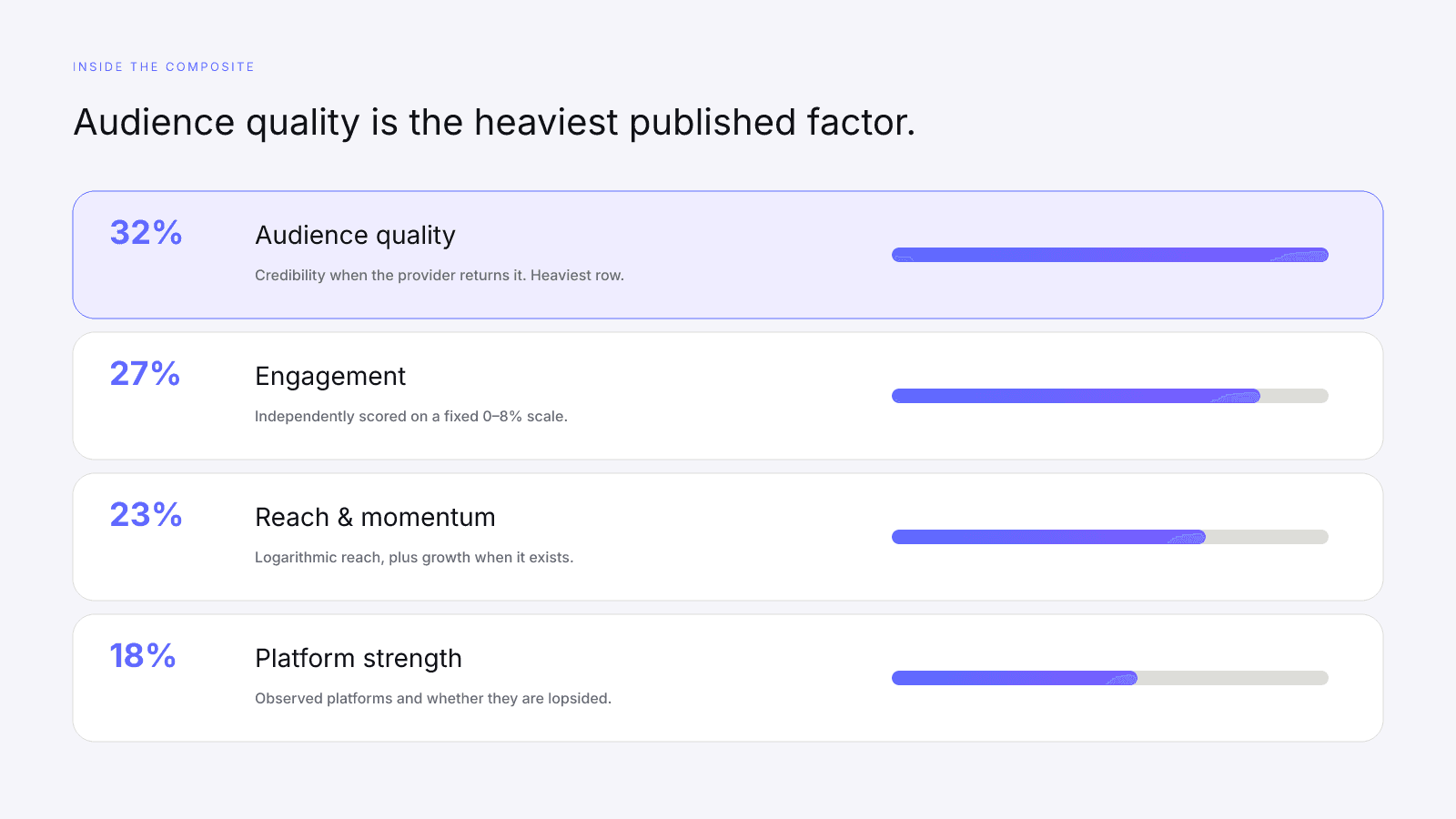
The displayed weights on the scorecard are the weights the current model uses: audience quality 32%, engagement 27%, reach & momentum 23%, platform strength 18%. Those four numbers add to 100. They are not a mood, a percentile, or a price.
32% is large enough that a weak credibility row moves the composite. It is not large enough to erase engagement, reach, or platform coverage. A creator can still sit in a respectable band with quieter AQ if the other observed factors are strong, and the reverse is also true. Read the four rows.
On model 2026-08-18.1, the factor is a clamped 0–100 conversion of the credibility signal. There is no niche slider. InfScore will not raise or lower the factor because a vertical "usually" has noisier or cleaner graphs. One conversion applies to every public Instagram, TikTok, and YouTube profile on this version.
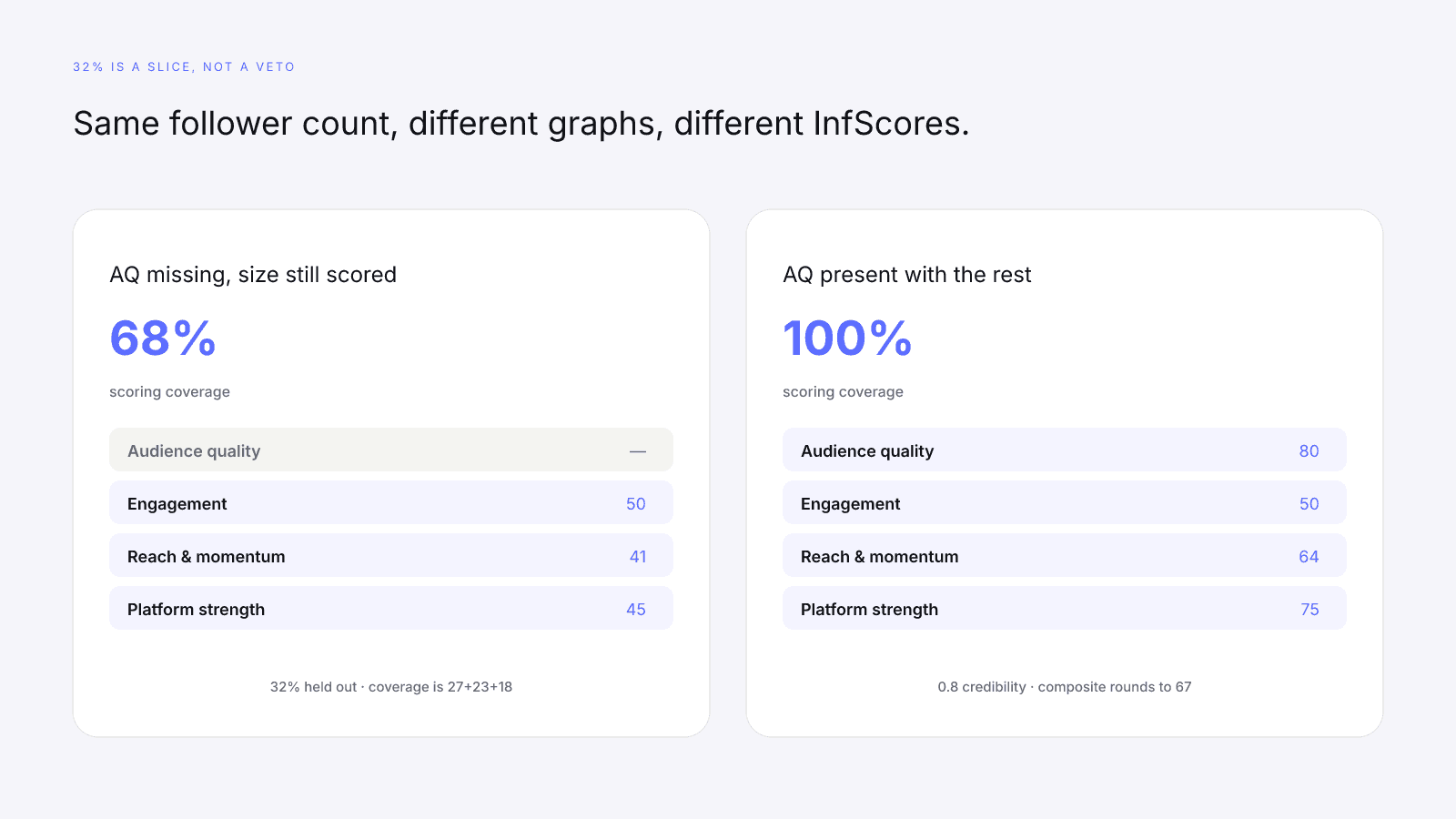
If AQ is present and the other three factors are present, coverage is 100 and the 32/27/23/18 mix applies in full. If AQ is the only gap, coverage is 68, because 27 + 23 + 18 = 68. The 32% weight is held out. It does not enter as a zero.
Compare two scores only when you also look at the model id. If the formula changes later, the version string on the scorecard changes with it. An 80 on 2026-08-18.1 is an 80 on this AQ factor. An 80 on a later version might mean something else.
What brands quietly check
The quiet part is not a secret formula. It is the sequence after the screenshot.
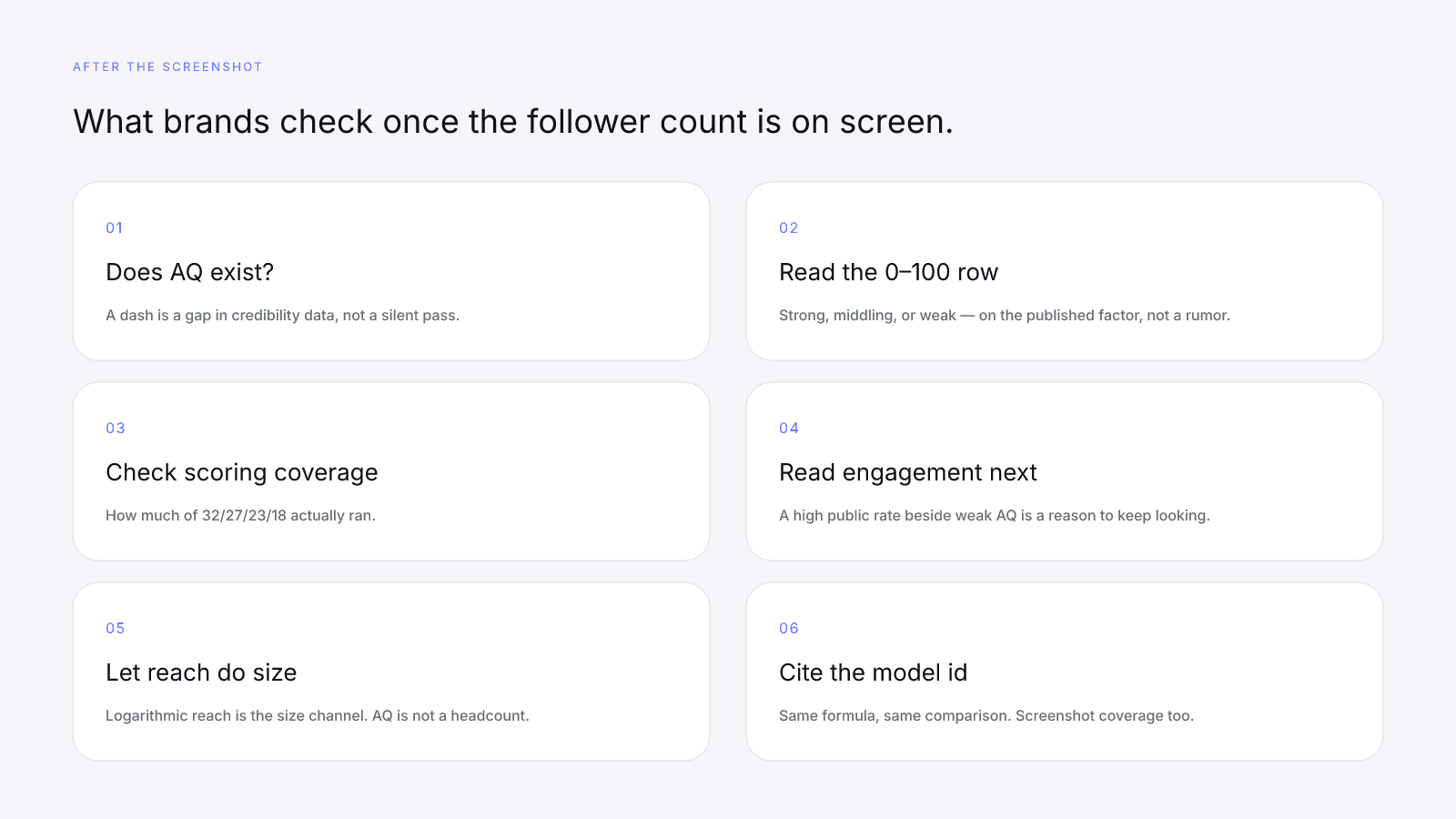
A brand that has been burned by a hollow following usually checks some version of this list, whether they use InfScore or not:
- Does a credibility signal exist at all, or is the row a dash?
- If it exists, is audience quality strong, middling, or weak on the 0–100 factor?
- How much of the 32/27/23/18 model actually ran? Scoring coverage is part of the reading.
- Does engagement agree with the audience? A high public rate next to a weak AQ row is a reason to keep reading, not a reason to stop.
- Is reach doing the size work on its own log scale, instead of pretending the headcount is a quality grade?
- What is the model version? Same formula, same comparison.
InfScore does not turn that list into a booking tool, estimate campaign ROI, or say what a post should cost. It holds still long enough to compare the public graph.
Open a live score and read the AQ row rather than quoting a homepage card. The MrBeast YouTube score is a public scorecard. Example tiles on the homepage are illustrative; a score URL is the product. You can also open Emma Chamberlain on Instagram the same way.
When you screenshot a score for a brand conversation, include the audience-quality row, the coverage line, and the model id. A bare follower count without those three facts is an incomplete citation.
Bought followers and hollow audiences
Bought followers and hollow audiences fail this factor for a boring reason: they tend to weaken the credibility signal the provider can see. InfScore does not need a confession. If the public audience looks thin, the row will say so when the signal exists.
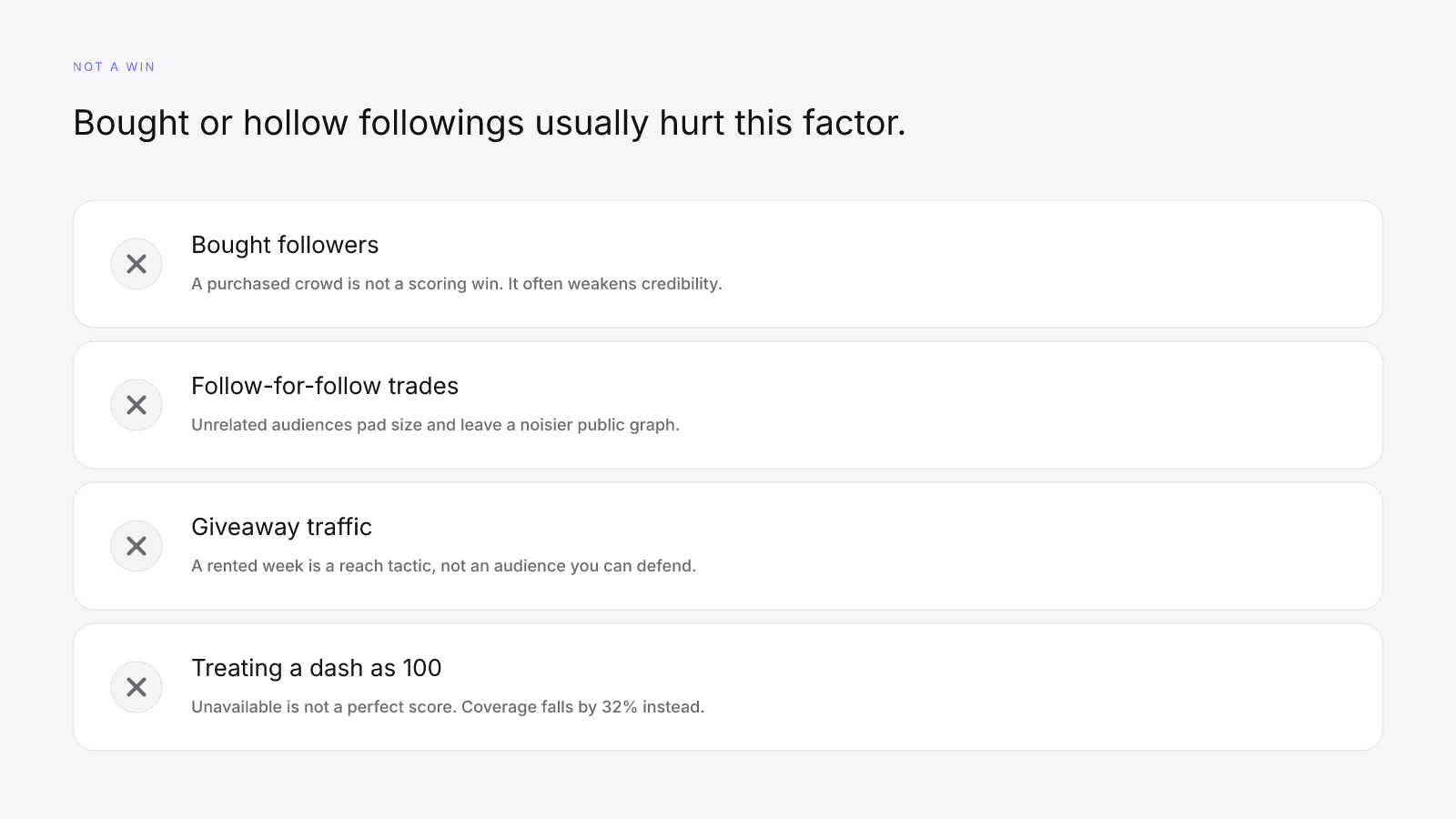
This is not a how-to. It is the opposite. Skip the shortcuts that assemble an audience nobody can defend:
- Buying followers, or recycling accounts that never return for the next ten posts.
- Follow-for-follow and shoutout trades with audiences that have no overlap with the work.
- Giveaways that rent a crowd for a week and leave a quieter graph behind.
- Comment pods that manufacture activity while the follower list stays hollow.
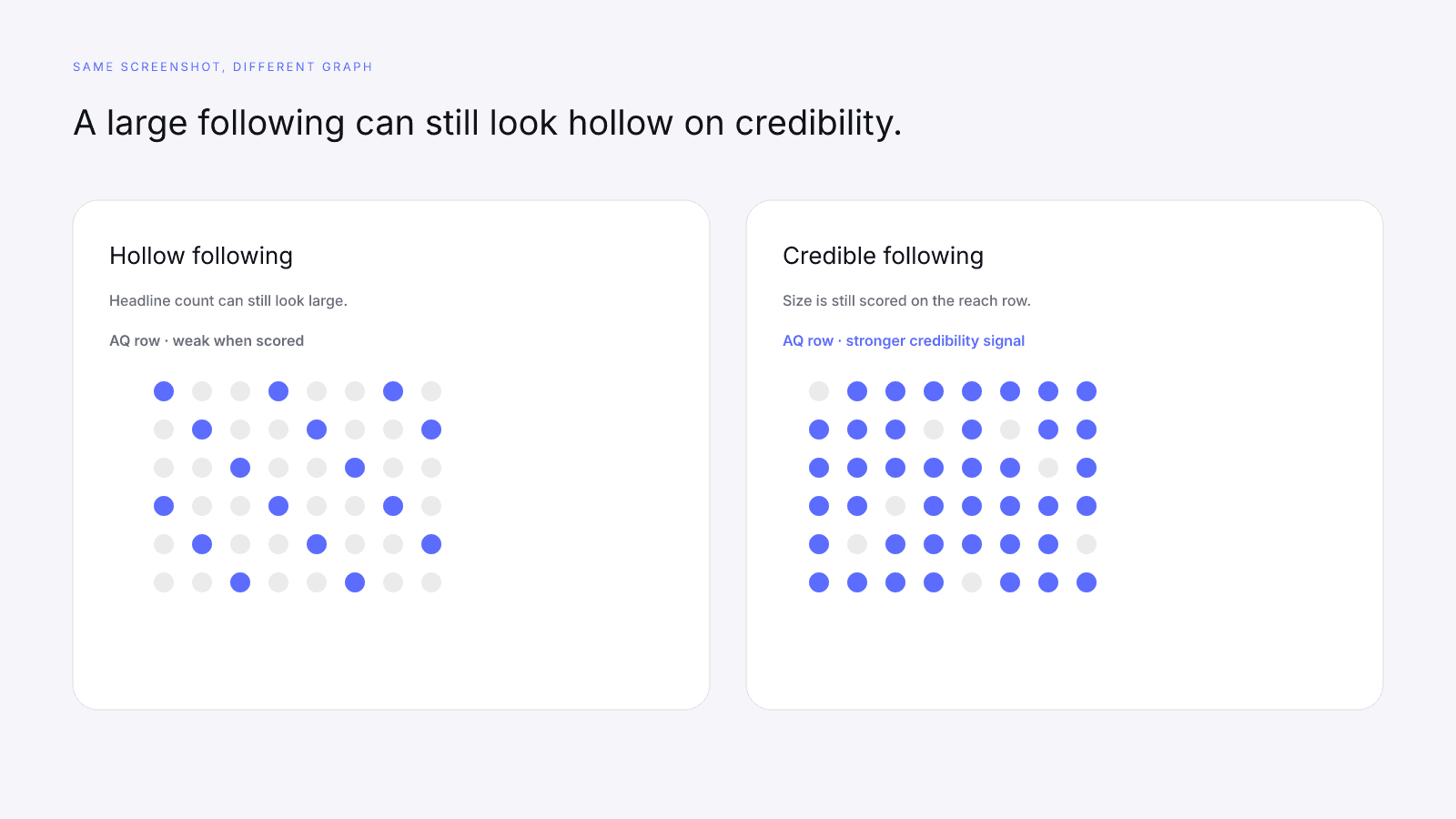
Those tactics can still move a headline count. Reach may even tick up for a moment, because reach is scored from observed size. Audience quality is the row that usually absorbs the damage. Engagement can look briefly busy and still leave you with a weaker AQ factor. That is why the model keeps the rows independent.
InfScore will not publish a recovery score for people who did those things. If the public signals improve later, the versioned model will pick that up the next time the profile is fetched. If they do not, the number should stay put.
Arguing that a dash should be scored as 100 because you "know" the audience is real is the same mistake in a different direction. Unavailable is not a perfect score. Coverage falls by 32% instead.
How to read AQ next to engagement and reach
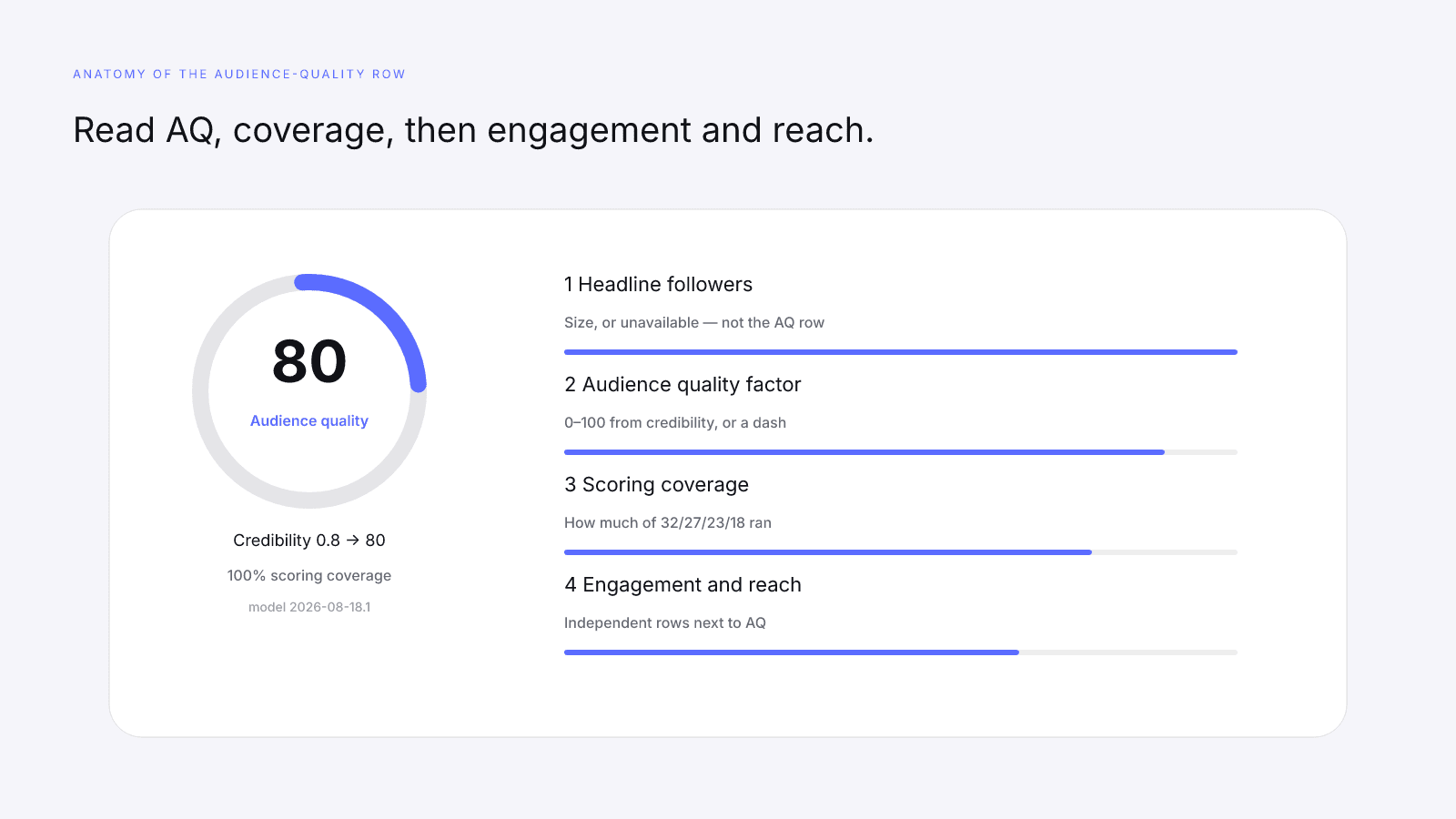
An 80 on audience quality is an 80 on that factor. It is not an 80 InfScore. The composite is a weighted average of the observed factors only.
Read the free scorecard in this order:
- Headline followers. Size when the provider returned it, or unavailable.
- The audience-quality row. 0–100 from the credibility signal, or a dash.
- Scoring coverage. How much of the 32/27/23/18 model ran.
- Engagement strength. Public rate on the fixed 0–8% scale, as 27% of the model. See What a Good Engagement Rate Looks Like in 2026.
- Reach & momentum. Logarithmic size, plus growth when it exists.
- Model version. Same formula, same comparison; different version, different conversation.
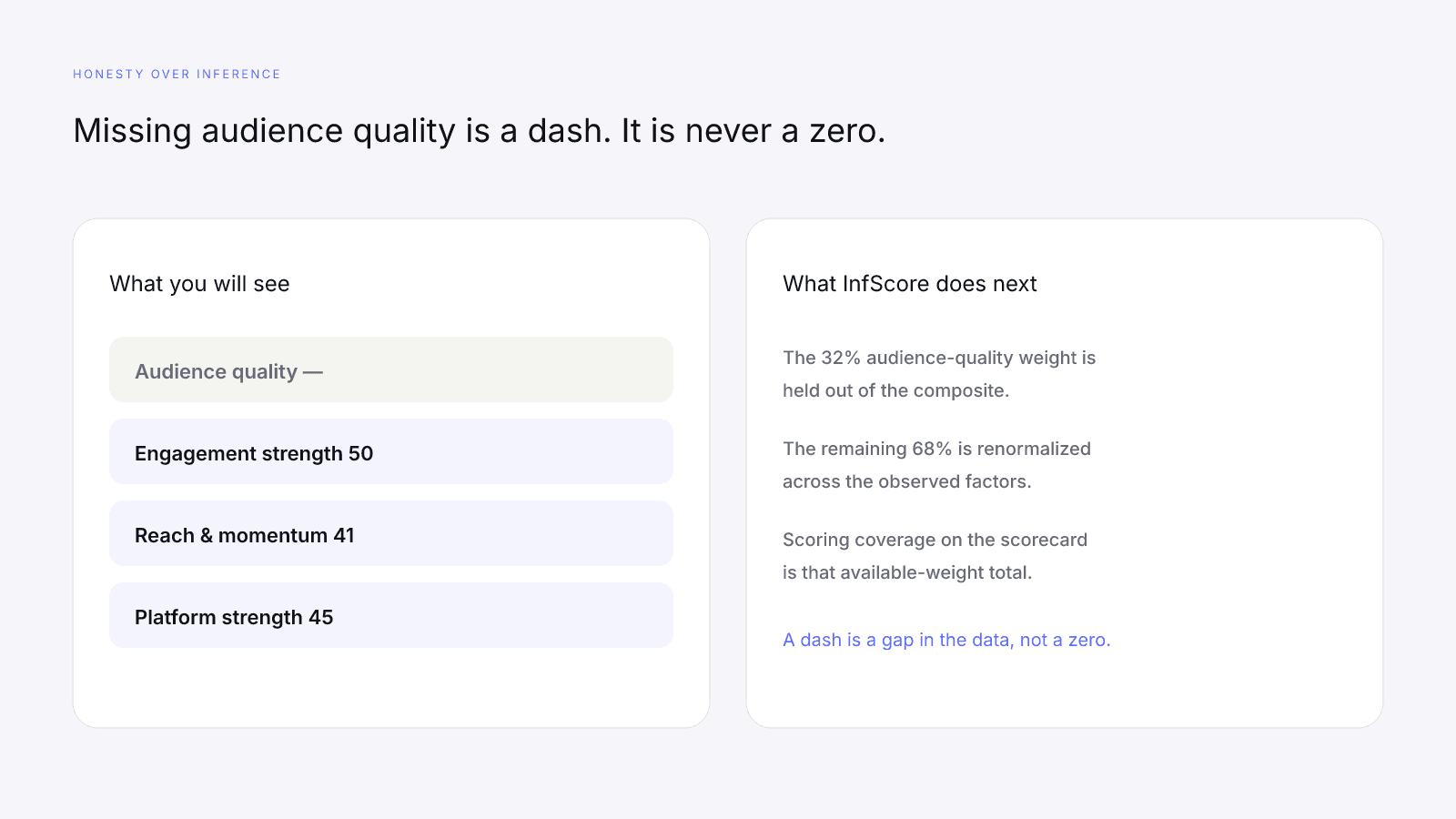
If AQ is missing, read the other factors first. They are still real. Then read scoring coverage. Do not assume the missing row would have been high, or low. You do not know.
A checkable case from the model tests: audience credibility 0.8 becomes 80 on the factor. Engagement at 4% becomes 50. With reach & momentum at 64 and platform strength at 75, and every factor present, coverage is 100 and the composite rounds to 67. If that same profile had no credibility signal, AQ would be a dash, coverage would be 68, and the 32% weight would not enter at all.
Two creators with the same headline follower count can have different InfScores. A higher number with 50% coverage is not better by default than a slightly lower number with 100% coverage. Coverage is part of the reading.
The public InfScore stays free. The denser report is a one-time $0.99 unlock, not a subscription. Pricing is one report, one dollar, no recurring fee. Paying does not purchase a friendlier credibility scale, fill a dash, or move the 32% weight. It adds provider modules when they exist, including the denser audience breakdown.
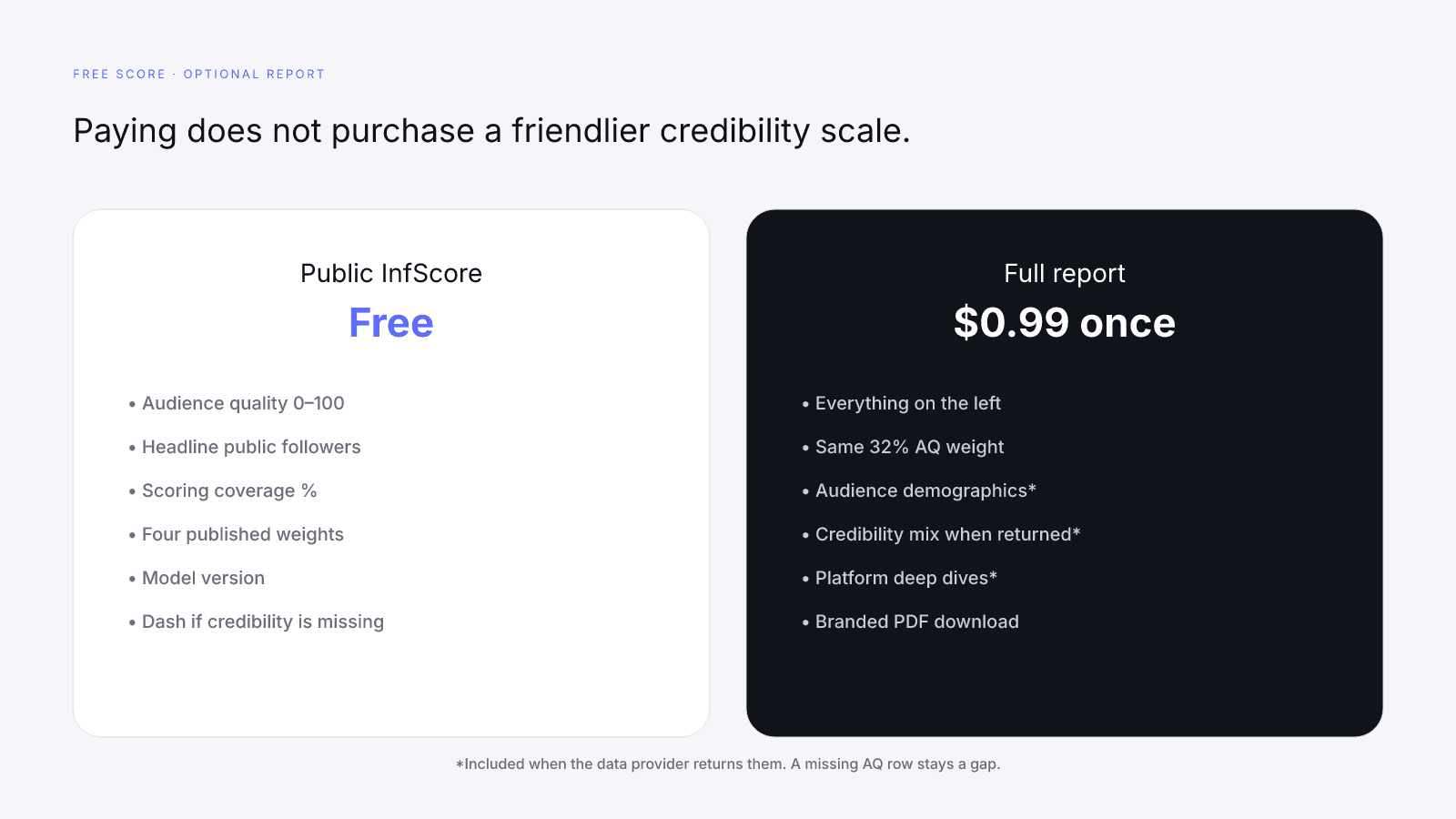
Use the paid report when you need to explain the score to someone else. Use the free score when you need the comparable number quickly. Both views are honest about gaps.
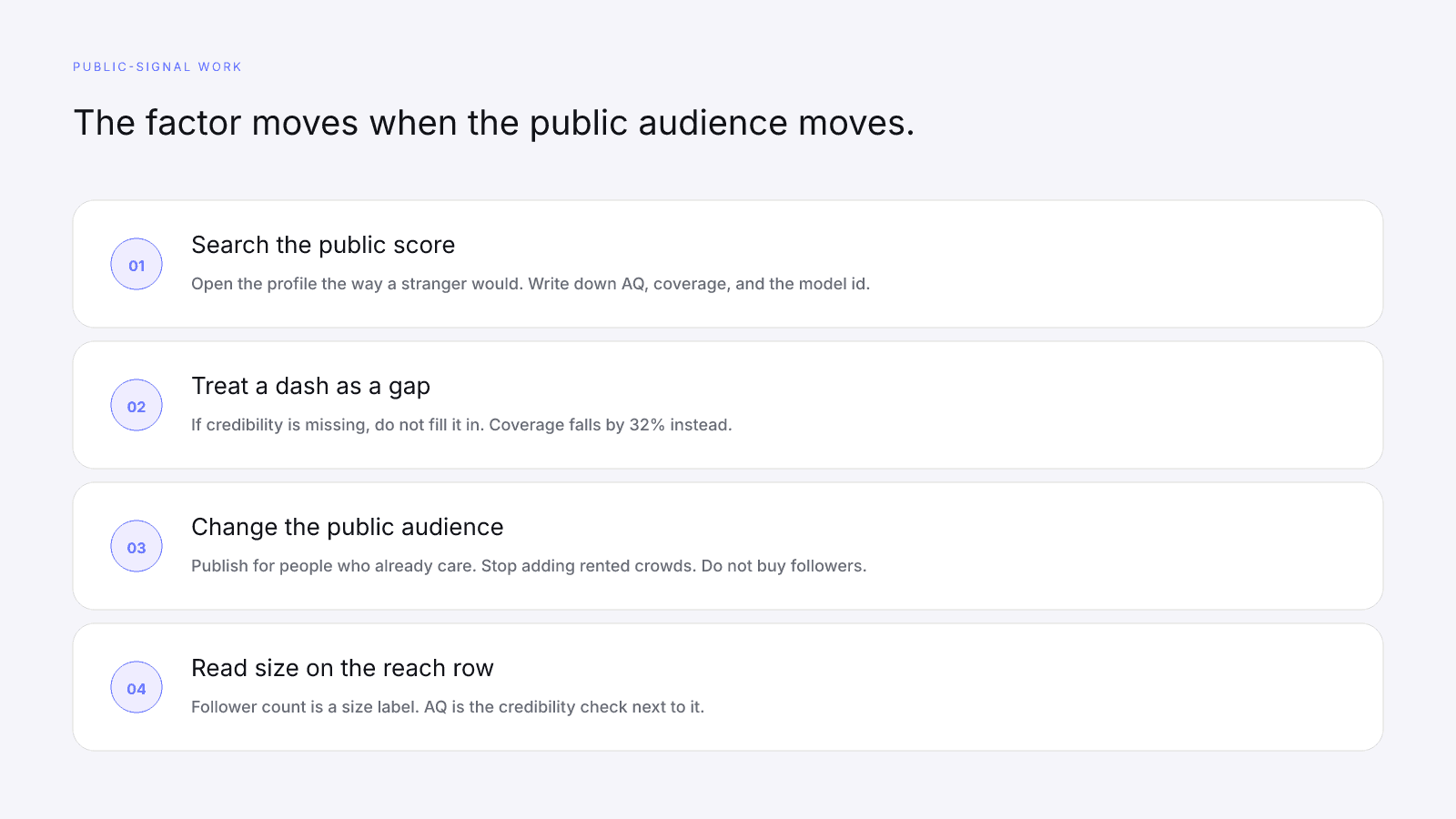
- Search yourself on InfScore the same way a stranger would.
- Write down the headline followers, the audience-quality factor, coverage, model id, and any dashed rows.
- If AQ is a dash, ask whether the public profile actually exposes that credibility signal.
- If AQ is scored, change the public audience over a normal month of work: publish for people who already care about the topic, collaborate where audiences overlap, and stop adding rented crowds. Do not buy the missing followers.
- Read engagement and reach next to AQ. Size is not a quality grade.
- Re-check after a normal month of work, not after one giveaway.
- If you need the denser modules, the full report is $0.99 once. If you do not, the free score is the product.
None of this requires disclosing private analytics. InfScore is scoring what is already public.
Follower count will keep being easy to screenshot. Audience quality is still the check that decides whether that screenshot is a size label or a credibility problem. InfScore is the part that holds still long enough to compare.
FAQ
What is audience quality on InfScore?
Audience quality is the 0–100 factor built from provider-measured audience credibility when that public signal exists. It is 32% of the versioned InfScore, or a dash if the credibility field is missing.
Why is audience quality 32% of InfScore?
It is the largest published factor because follower count without credibility is a noisy input. Engagement is 27%, reach and momentum is 23%, and platform strength is 18%. Those displayed weights are the weights the current model uses.
Is follower count the same as audience quality?
No. Follower count is a size label. Reach and momentum scores that size on a log scale as 23% of the model. Audience quality scores credibility as 32%. A large following can still have a weak AQ row.
Do bought followers raise InfScore?
That usually works against you. Bought or hollow followings tend to weaken the credibility signal the provider returns. InfScore is built from observed public creator signals, not from a screenshot of the headcount.
What if audience quality is a dash?
A dash is a gap, not a zero. The 32% weight is held out and scoring coverage is the sum of the weights that actually ran. If AQ is the only missing factor, coverage is 68, because 27 + 23 + 18 = 68.
Is audience quality on the free public score?
Yes. The free InfScore already includes the audience-quality factor when the credibility signal exists, scoring coverage, and the model version. The optional $0.99 report adds denser provider modules. Paying does not purchase a different 32% weight.
How should brands read AQ next to engagement?
Read both rows. AQ is independently calculated from credibility. Engagement is independently calculated on a fixed 0–8% scale. A high public rate next to a weak or dashed AQ row is an incomplete reading, not an automatic win.