Nano Influencers: What a Small Account's Score Can and Can't Tell You
Nano influencers: what a small account's InfScore measures, why reach sits at its floor up to 1,000 followers, and what the score can't tell you.
This versioned composite uses only available public signals. Missing factors stay unavailable and their weight is rebalanced across observed factors. It is not a percentile, price estimate, or guarantee of campaign results. Model 2026-08-18.1.
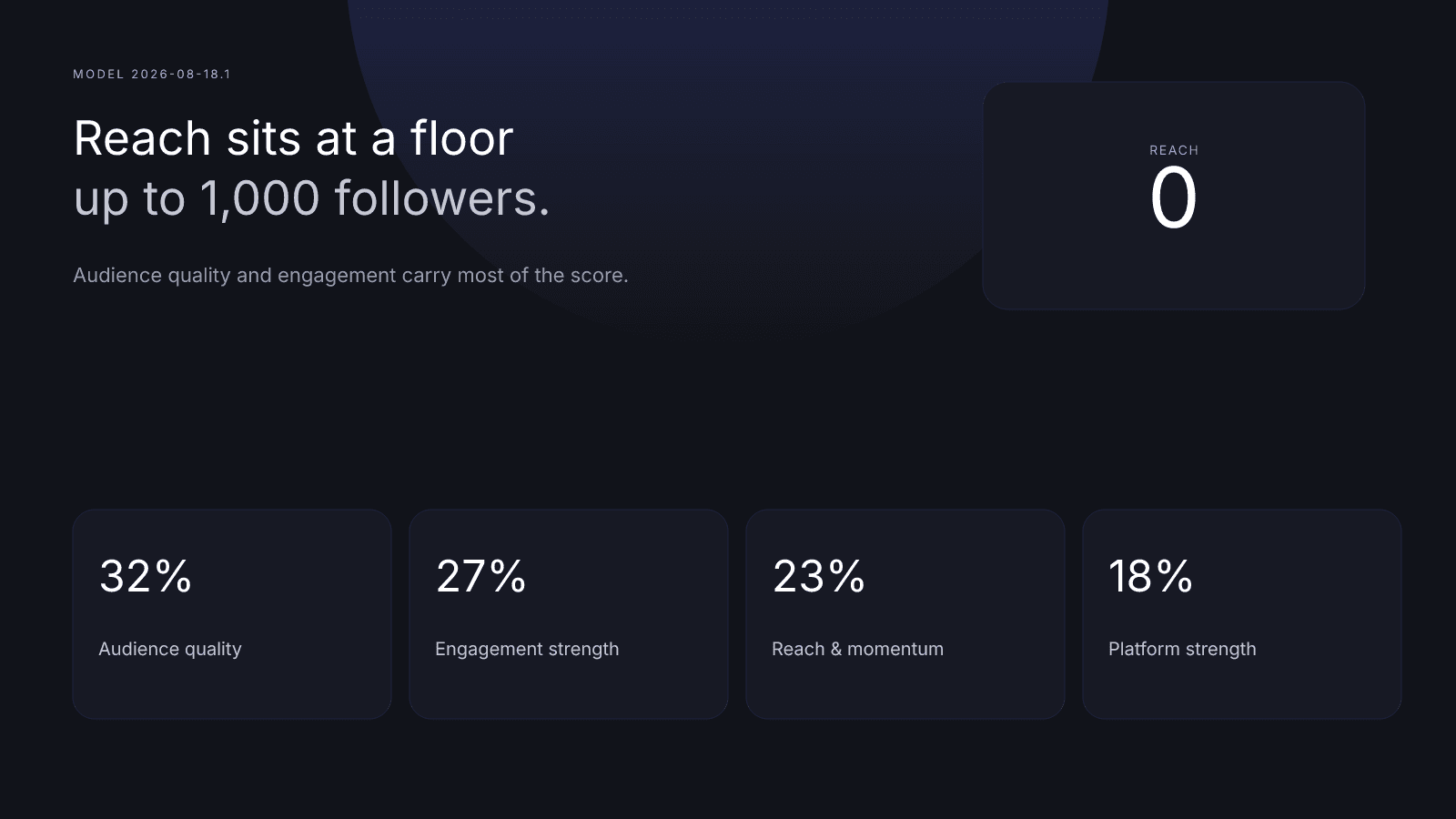
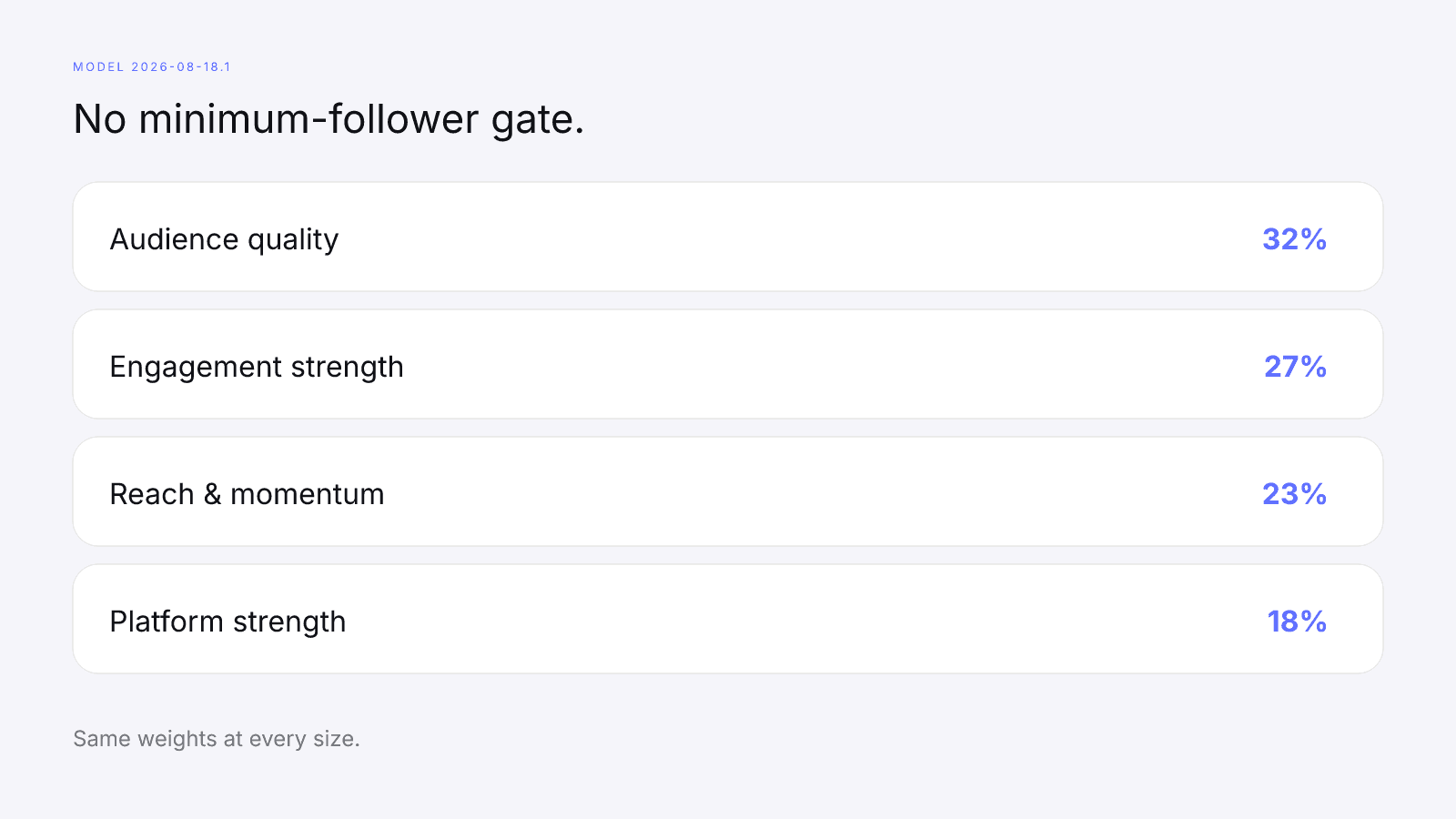
Nano influencers are the small accounts brands keep asking about, and InfScore scores them with the same formula it uses on every other account. On model 2026-08-18.1 the weights are audience quality 32%, engagement strength 27%, reach & momentum 23% and platform strength 18% at every size, and there's no minimum-follower gate. On a small account, audience quality and engagement carry most of the score. Reach sits at or near its floor: anything from 1 to 1,000 followers gives reach 0, which is a floor, not a penalty. What the score can't tell you is content fit, niche relevance, community trust, rates or results.
The short answer
A small account isn't scored on a separate scale. If the data provider has the platform you search and returns followers or an engagement rate for it, the account gets a card, whatever its size. Follower count only reaches the score through the reach row, and on a log scale that row barely moves at the bottom.
So for a small creator, the number mostly reflects audience quality and engagement. A credible audience with a good reported rate can produce a strong score while reach sits on the floor, and weak readings on those rows produce a weak score at any size. Two results can look like a bad score and aren't. A dash marks missing data, and "not found" means there was nothing to score. If you want the four-factor overview first, start with How to Measure Influencer Performance.
What "nano influencers" means
"Nano influencer" is an industry label, and InfScore doesn't use it as a term. It's commonly described as roughly 1,000 to 10,000 followers, though you'll see other edges quoted for the same words. That range is not an InfScore cutoff. InfScore does not publish a nano cutoff, there's no nano tier, and no factor is named after the label.
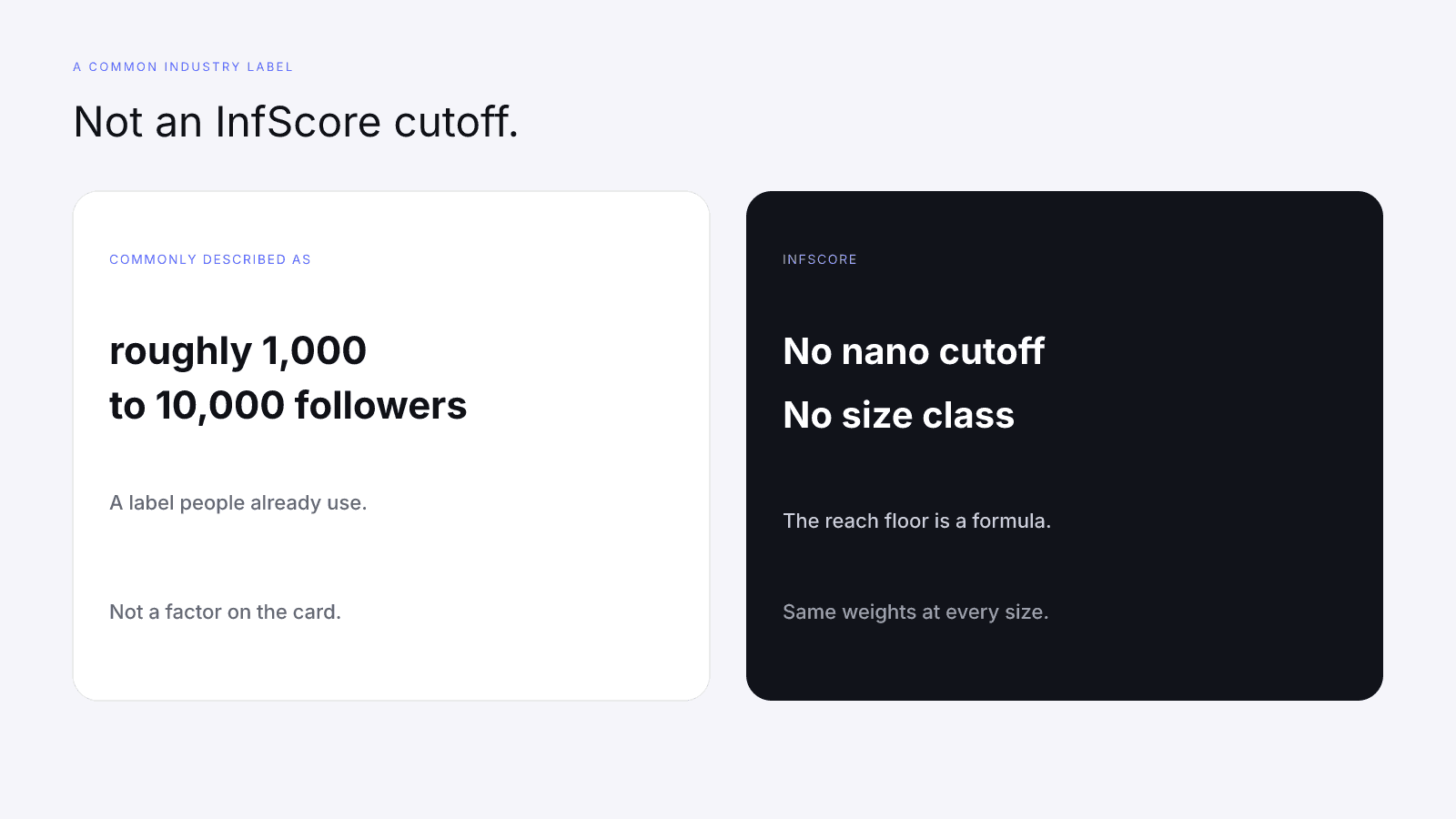
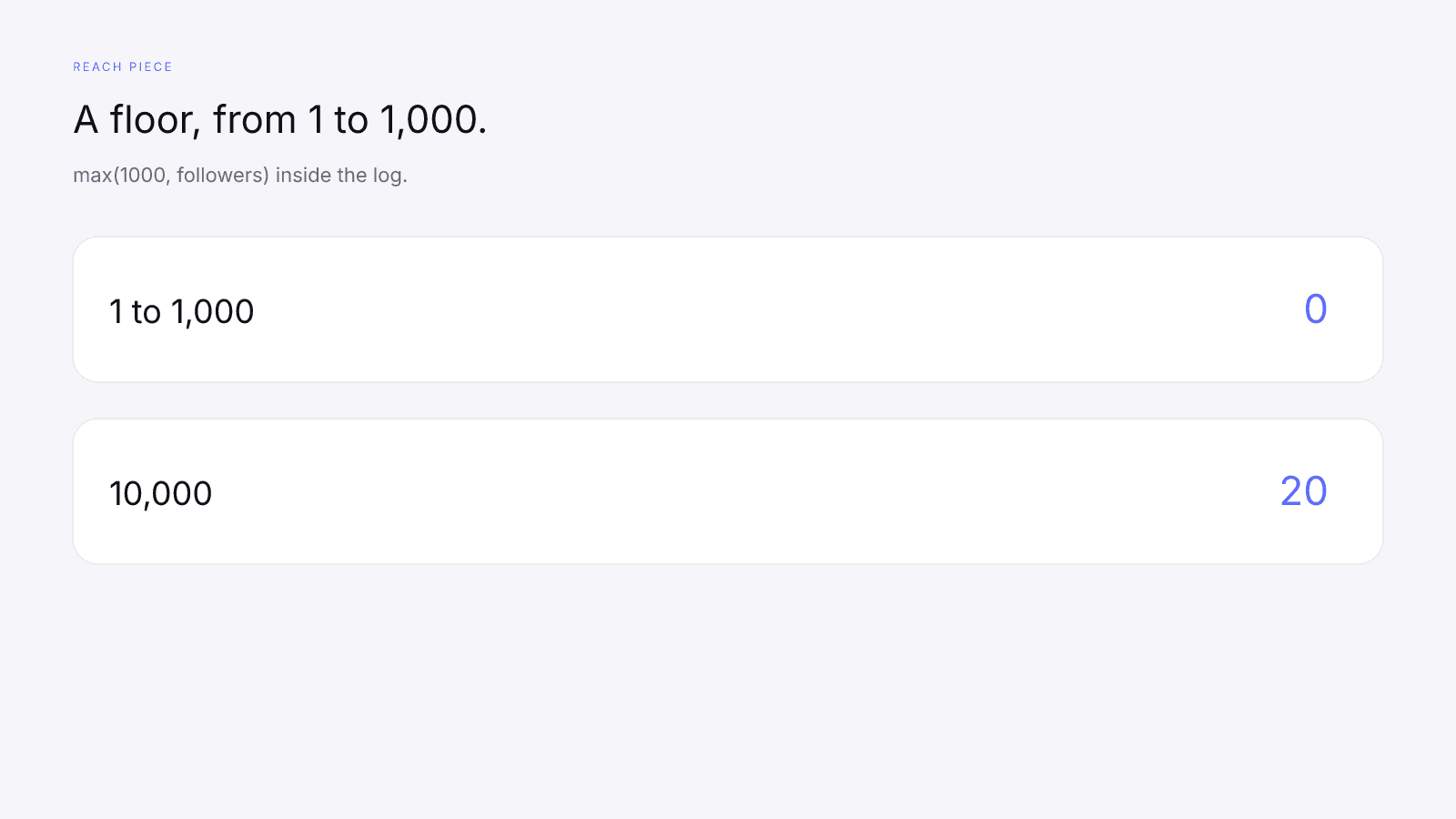
The reach floor is easy to tangle up with the label, but it's a separate fact. Reach is 0 for any follower count from 1 to 1,000, including 1,000 itself. An account at 10,000, the top of the usual description, has a reach piece of 20. Neither end is a category on the card. Keep the label in your planning notes if it helps, then on the card read the follower total that came back and the rows under it.
If you're weighing nano creators against bigger ones, that comparison is in Micro vs Macro Influencers: What the Score Actually Rewards.
How InfScore scores a small account
Under model 2026-08-18.1, follower count only enters through reach & momentum (23%). Platform strength (18%) counts the platforms with followers, not how many followers. Audience quality (32%) and engagement strength (27%) use the same scales at every size. Those weights don't shrink for a small audience, and they don't grow because someone hopes a small audience is "more engaged." The methodology publishes the split for every lookup.
One platform with followers gives platform strength 45. A second or third platform brings in balance math, which Cross-Platform Creators covers, and an empty extra profile doesn't add anything.
Audience quality is a provider-reported credibility signal for the platform you looked up, when the data provider returns it. Follower count isn't an input, so a small audience doesn't drag the row down and a large one doesn't push it up. If the signal is missing, the row is a dash. What the signal means is covered in Audience Quality vs Follower Count.
Engagement strength maps the provider-reported public rate onto one fixed scale: the rate divided by 8, times 100, capped. A 4% rate maps to 50, 6% maps to 75, and anything at 8% or higher stays at 100. A reported 0% maps to 0, and on an account with followers that's a scored row. InfScore doesn't calculate the rate itself, the scale is the same at every size, and nothing here claims nano influencers post higher rates than anyone else. For how the rate gets worked out in the first place, see How to Calculate Engagement Rate on Instagram, TikTok, and YouTube.
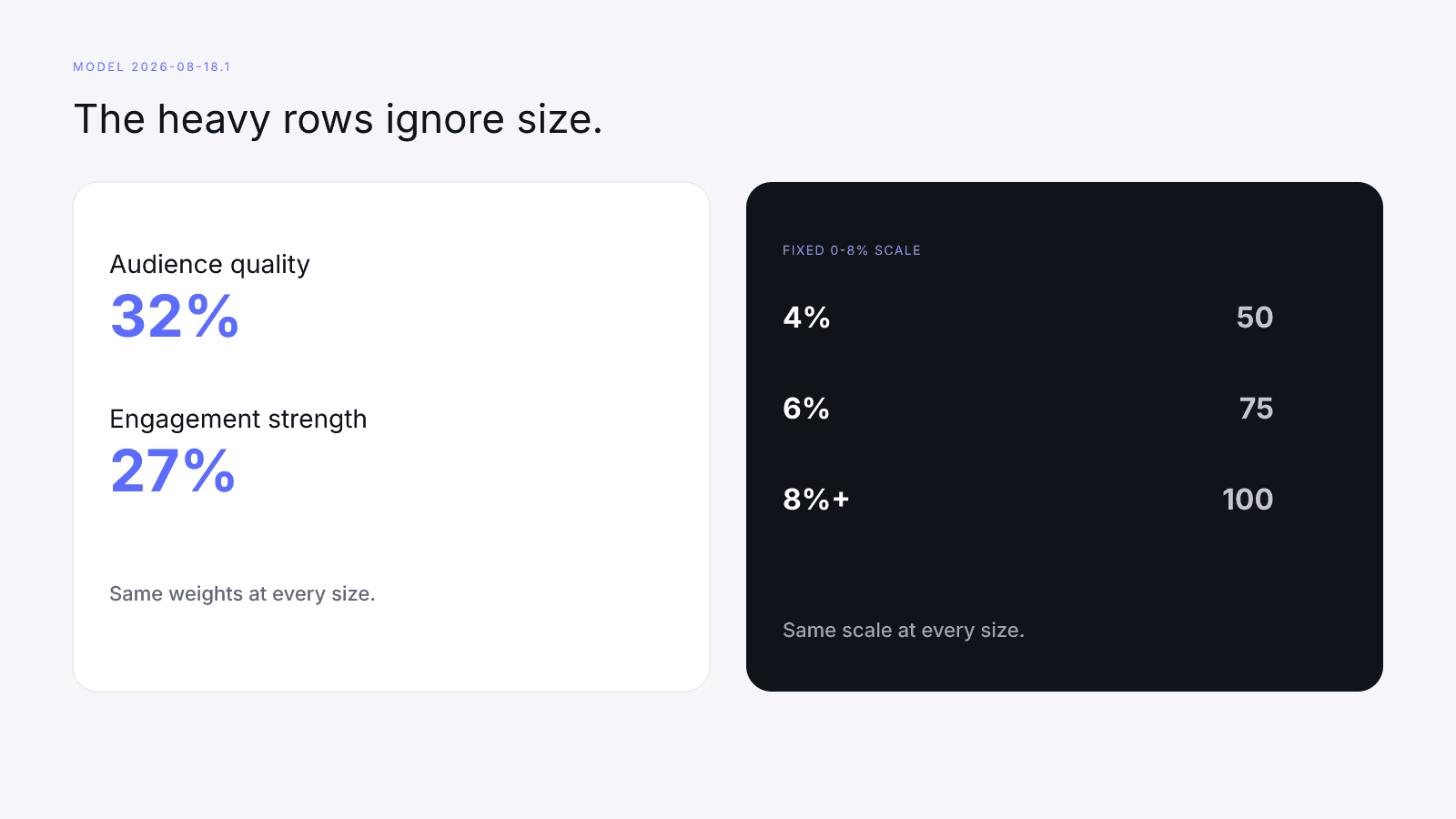
On model 2026-08-18.1 those two heavier rows make up 59% of the weights. A perfect reach score adds at most 23 points on a full-coverage card, so on a small account, where reach sits near the floor, the headline is mostly audience quality and engagement plus whatever platform strength picked up. The composite multiplies each available row by its weight, adds the products, and divides by the weights that ran, which is 100 when all four rows are there. Each row keeps its own inputs, so a strong audience-quality row can't fill a dashed engagement row, and a strong engagement row can't lend points to reach.
The reach floor: why 1–1,000 followers gives reach 0
The reach piece is logarithmic:
clamp((log10(max(1000, followers)) - 3) / 5 * 100)
The max(1000, followers) term is the floor. Any count from 1 to 1,000 is treated as 1,000 inside the log, log10(1000) is 3, and the piece comes out at 0. The clamp keeps it between 0 and 100, so it can't go below 0. At 10,000 followers the piece is 20. The rest of the curve, with the full log table, is in Micro vs Macro Influencers, and Why High Follower Counts Still Score Low explains how a very large audience can still end up with a low score.
That 0 is a measured floor. The row ran, and on model 2026-08-18.1 its 23% weight stays in the composite. There's no extra deduction for being small and no bonus for clearing 1,000.
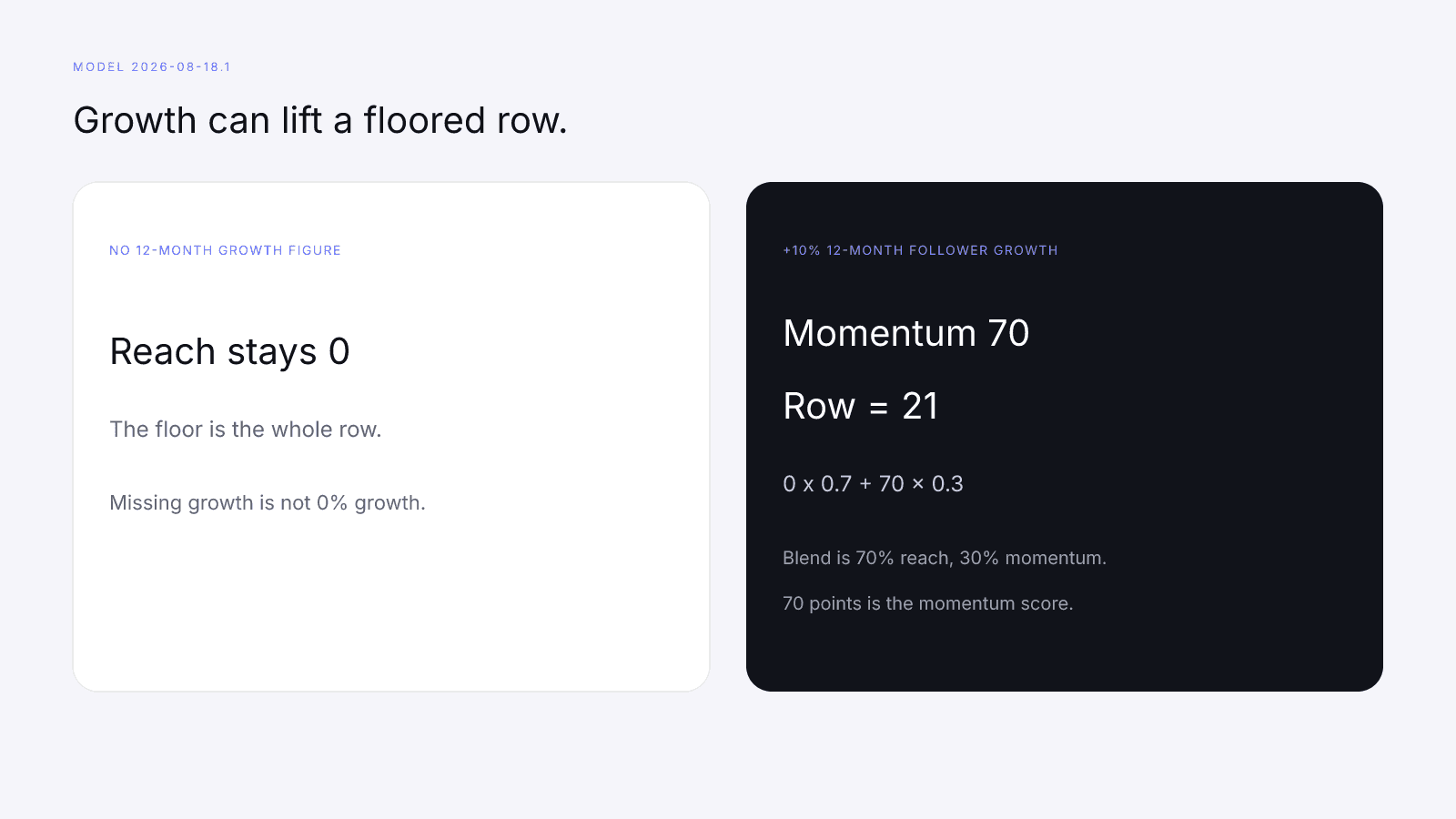
When the requested platform has a provider-reported 12-month follower growth figure, reach & momentum = 70% reach + 30% momentum, momentum = clamp(50 + growth% × 2) (negative growth pulls the row down). On an account sitting on the floor the reach piece is 0, so only the momentum share is left. A +10% figure sets momentum to 70, and the row becomes 0 × 0.7 + 70 × 0.3 = 21. The two 70s are different numbers: one is the momentum score, and the other is the share of the row that reach takes. On model 2026-08-18.1 the whole row is still the 23% factor, so the lift has a ceiling.
With no 12-month growth figure, the row is just the reach piece, rounded, and an account at or below 1,000 followers prints 0. A missing figure isn't a dash on this row, and it isn't the same as a reported 0%. A reported 0% is a real input and it blends. A missing one leaves the reach piece alone, so the floor stays at 0.
Growth can't fill a missing follower total. If the total across Instagram, TikTok and YouTube combined is 0 or missing, the row never gets to the blend and shows a dash instead. The +10% case needs a positive follower count sitting on the floor, like the 800 in Example A below.
Dash vs "not found" for tiny accounts
A reach floor of 0 and a dash are different things. The floor is a number: from 1 follower to 1,000, reach prints 0 and its weight counts. A dash means the row had nothing to run on.
0 or missing followers across Instagram, TikTok and YouTube combined (the follower total; X isn't counted) makes reach & momentum a dash (missing, weight held out), and platform strength is also a dash (only platforms with >0 followers count). A creator with 0 followers on the requested app but followers on another app gets a reach score, not a dash. This dash case only shows when the requested app has a provider-reported engagement rate; otherwise it's "not found".
On model 2026-08-18.1 those two weights are 23% and 18%, and each dashed row's weight is held out. A dash is missing data, not zero. Writing a zero into a dashed cell and still dividing by 100 would be a penalty the model doesn't apply. The full rule is in Missing Data on Creator Metrics.
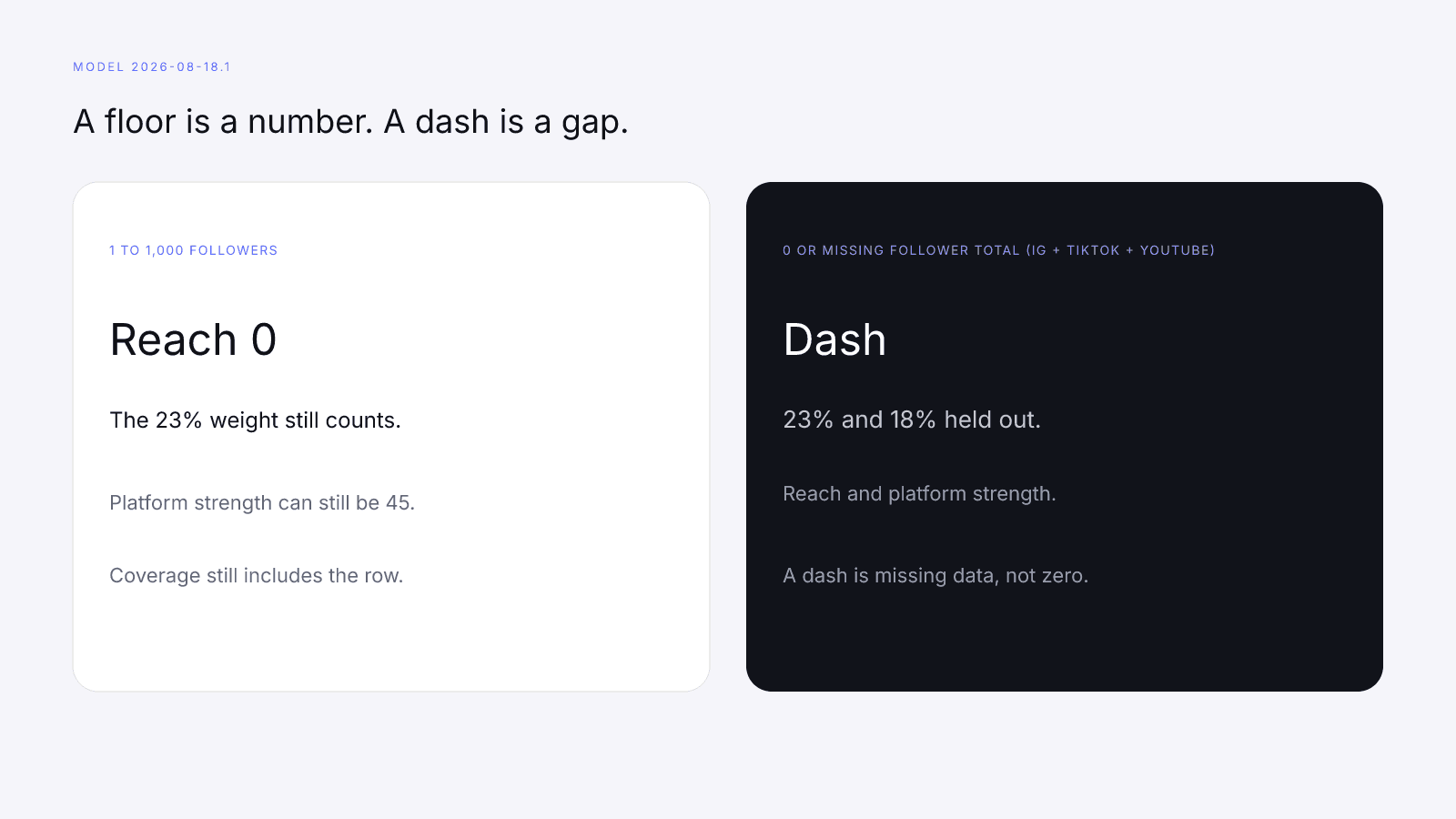
If audience quality and engagement are the rows left, coverage is 59, because those weights are 32% and 27% on model 2026-08-18.1, and the composite is divided by 59. Coverage only describes which weights could be used. A dash means a signal is missing, on a small account or a large one.
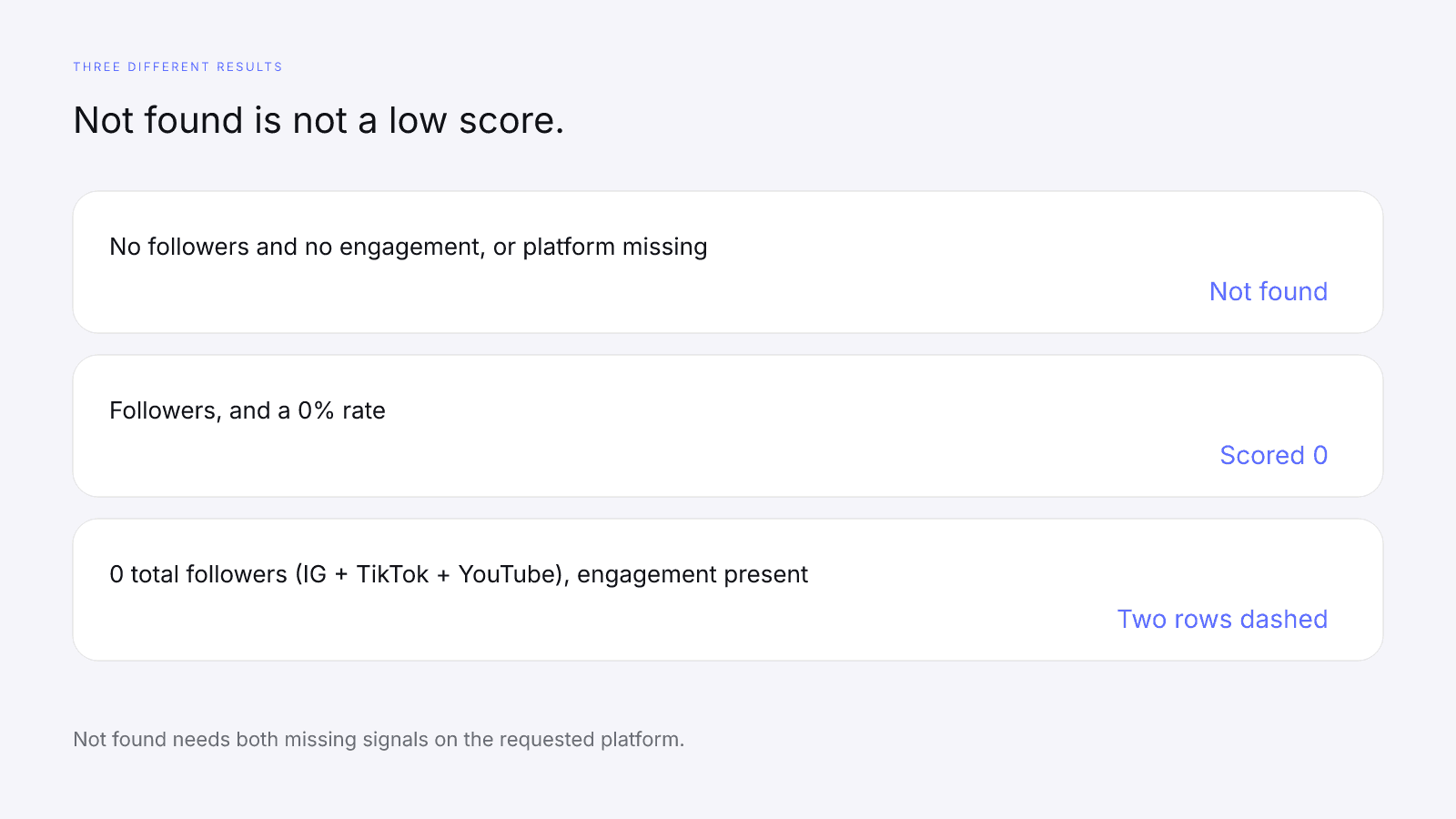
Not found is a third result, and it isn't a card full of dashes. Not found needs both signals missing, or no platform to read: 0 or missing followers and 0 or missing engagement on the requested platform, or that platform missing from the provider's data → "not found" (404), not a low score. Real 0% engagement on an account with followers is a score, not "not found". The lookup stops there, so there's no composite to compare with anything.
Followers plus a 0% rate gives you a card. Engagement strength is a scored 0, and reach can still sit on the floor. A reported engagement rate with a follower total of 0 across Instagram, TikTok and YouTube combined is the dash case above: reach and platform strength are dashes, and the engagement row still runs. Growth can't repair a missing follower total.
One follower is enough to leave not found, and enough for platform strength to count that platform, since the count is above zero. Reach is still 0 because of the floor. The account is small, and the rows that could run did run.
Worked examples (fictional creator)
All three readings use one made-up Instagram account. Instagram is the only platform with data, so platform strength is 45 and the follower total is the Instagram count. The arithmetic is model 2026-08-18.1. These figures are fictional, not a pattern for nano creators in general.
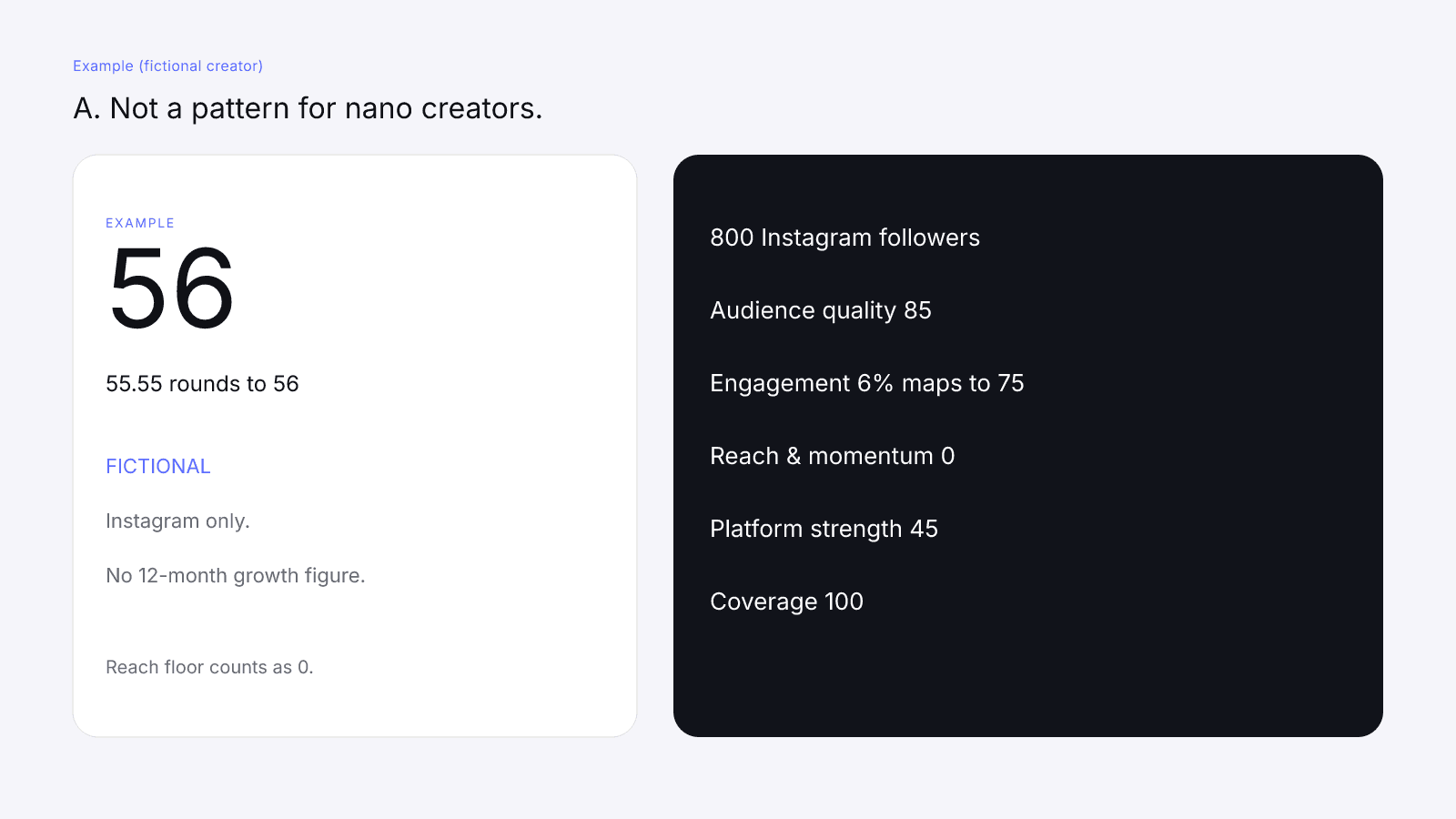
Example (fictional creator) A is a fictional account just under the range usually called nano: 800 Instagram followers, audience quality 85, a 6% engagement rate that maps to 75, and no 12-month growth figure. Reach & momentum is 0, the floor. Platform strength is 45. Coverage is 100, because that 0 is a score rather than a missing row.
On model 2026-08-18.1 the composite is (85 × 32 + 75 × 27 + 0 × 23 + 45 × 18) / 100 = (2720 + 2025 + 0 + 810) / 100 = 55.55, which rounds to 56.
Audience quality supplies 27.2 of that 55.55, engagement 20.25 and platform strength 8.1. Reach adds nothing, but on model 2026-08-18.1 its 23% weight stays in the divisor.
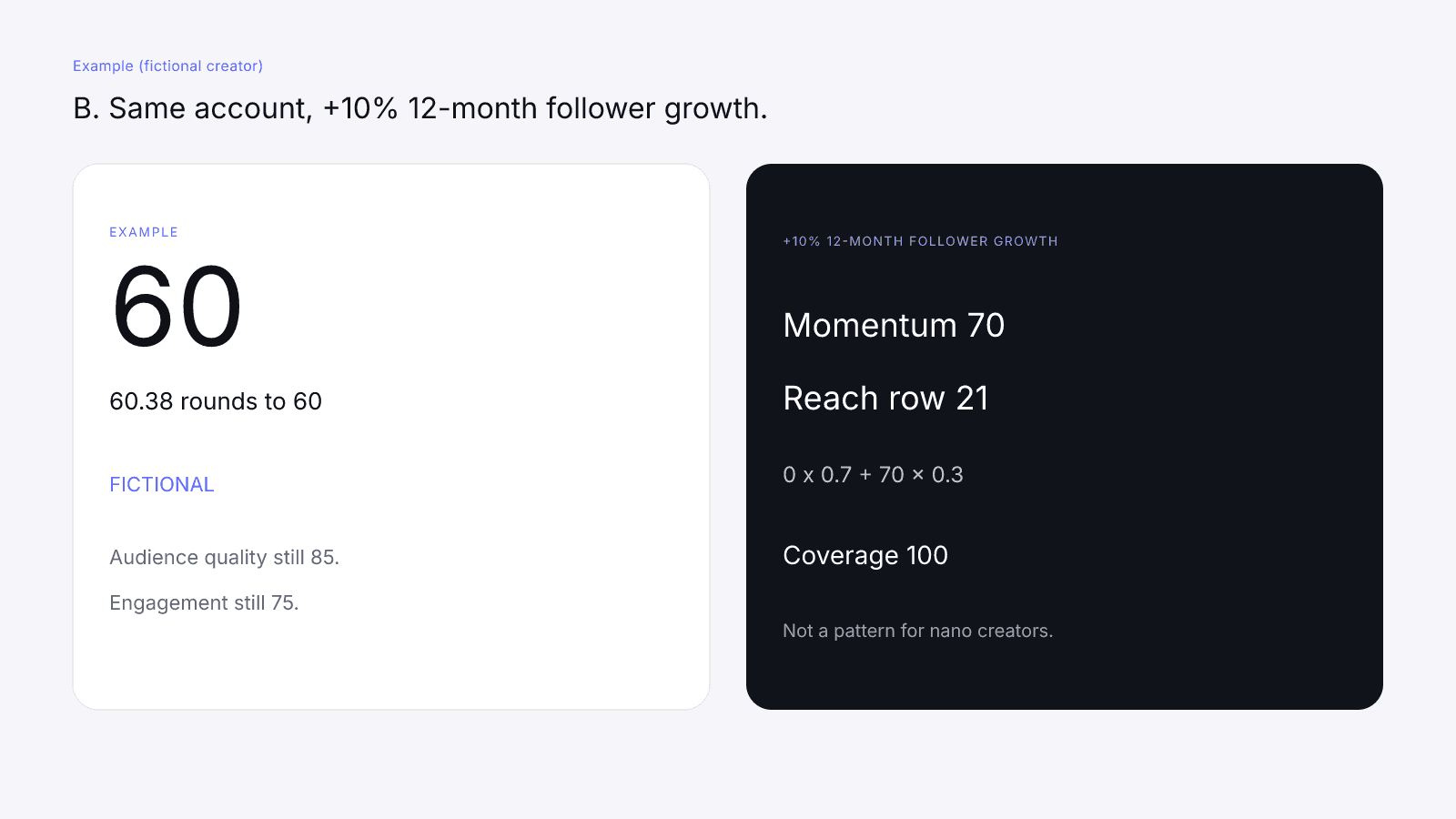
Example (fictional creator) B is the same account, with a provider-reported +10% 12-month follower growth on Instagram. Momentum is clamp(50 + 10 × 2) = 70, and reach & momentum is 0 × 0.7 + 70 × 0.3 = 21. Audience quality, engagement, platform strength and coverage don't move.
On model 2026-08-18.1 the composite is (2720 + 2025 + 21 × 23 + 810) / 100 = (2720 + 2025 + 483 + 810) / 100 = 60.38, which rounds to 60.
Growth adds 4.83 points before rounding (21 × 23 / 100). The exact composite goes from 55.55 to 60.38 and the rounded headline from 56 to 60, while audience quality and engagement stay where they were.
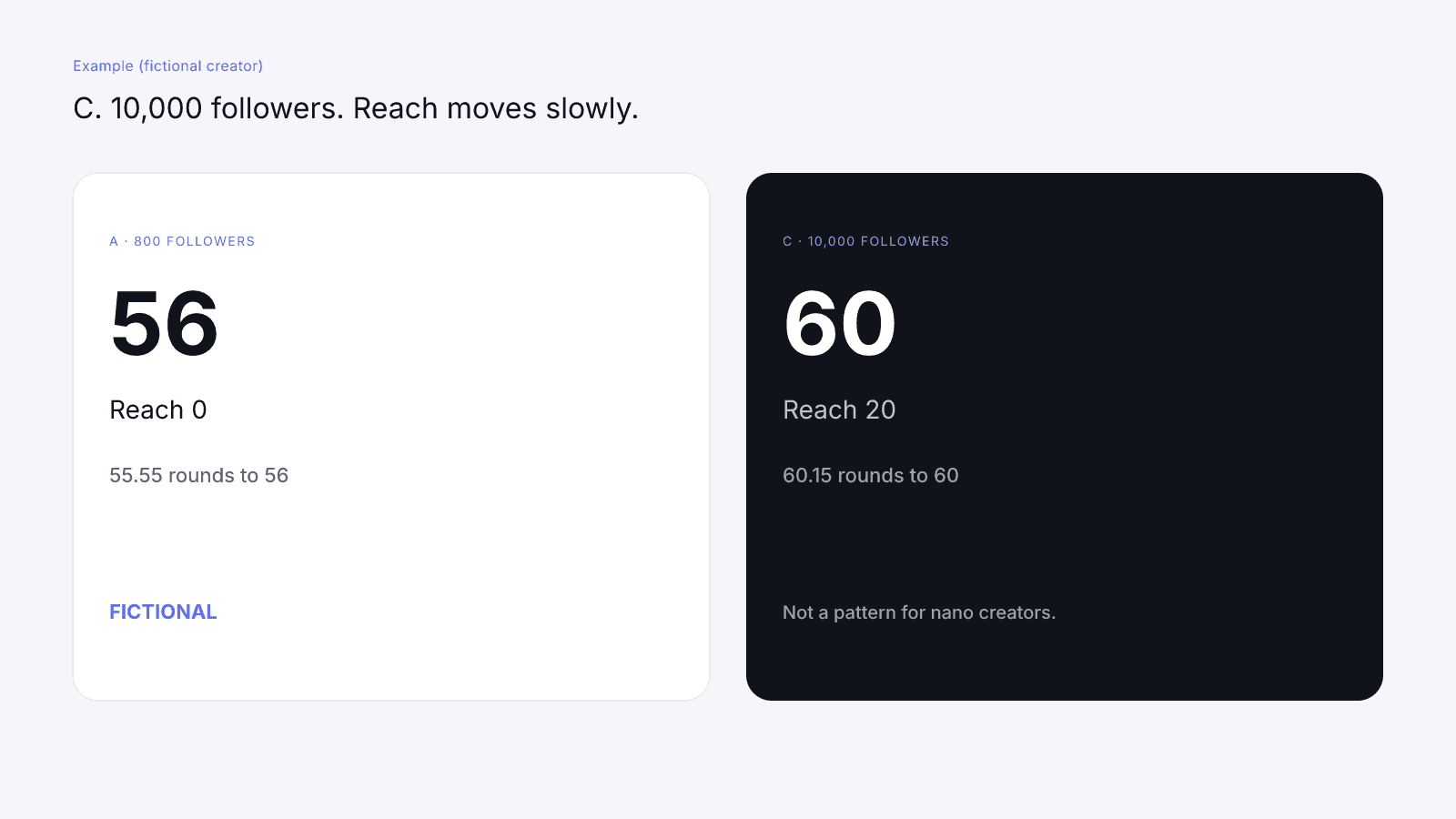
Example (fictional creator) C has the same rows as A, but with 10,000 followers instead of 800 and still no growth figure. The reach piece is 20, and everything else stays as it was in A.
On model 2026-08-18.1 the composite is (2720 + 2025 + 20 × 23 + 810) / 100 = (2720 + 2025 + 460 + 810) / 100 = 60.15, which rounds to 60.
Moving reach from 0 to 20 is worth 4.6 composite points before rounding. Ten times the followers took the rounded headline from 56 to 60, because the log scale moves slowly and the heavier rows still carry most of the score.
B and C both round to 60, for different reasons. B blended growth into a floored reach, while C took one log step off the floor with no growth at all. You'd only see that by reading the reach row. Treat 56 and 60 as worked arithmetic, and don't paste them beside a public profile.
What the score can't tell you about a nano influencer
The 0-100 reads the public signals that came back, and it shows you the rows, the coverage and the model id. Content fit, niche relevance and community trust are judgments about the work, the category and the people who follow the creator, and none of them is a row on the card. The score also can't show a rate, or what a post will do once it runs, so it can't speak to campaign results.
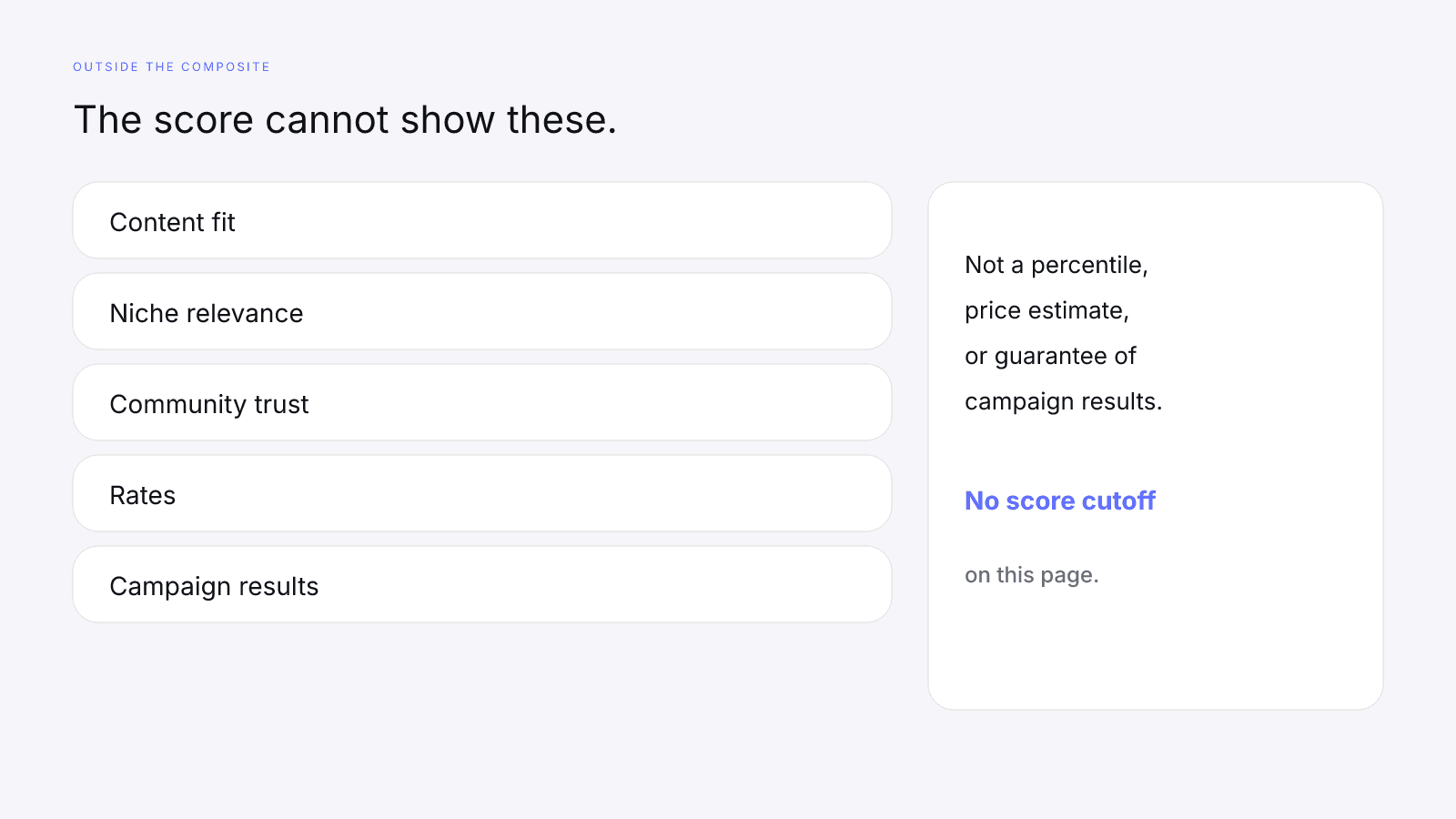
It is not a percentile, price estimate, or guarantee of campaign results. No score cutoff applies to a small account, and the fictional 56 and 60 aren't a passing band. The checks that sit beside the card, including fit and the terms you agree with the creator, are in How to Vet an Influencer Before You Pay Them.
If outreach is your next step, InfScore doesn't find creator contacts or send outreach for you. The card is a public reading, and it isn't an introduction or a list of addresses.
Two accounts with the same rows print the same composite, whether or not a team calls them nano influencers. On model 2026-08-18.1 the label isn't a factor. It can help people talk about creators, but it doesn't move a row.
Check a small account's card
A short reading order keeps the floor in its place:
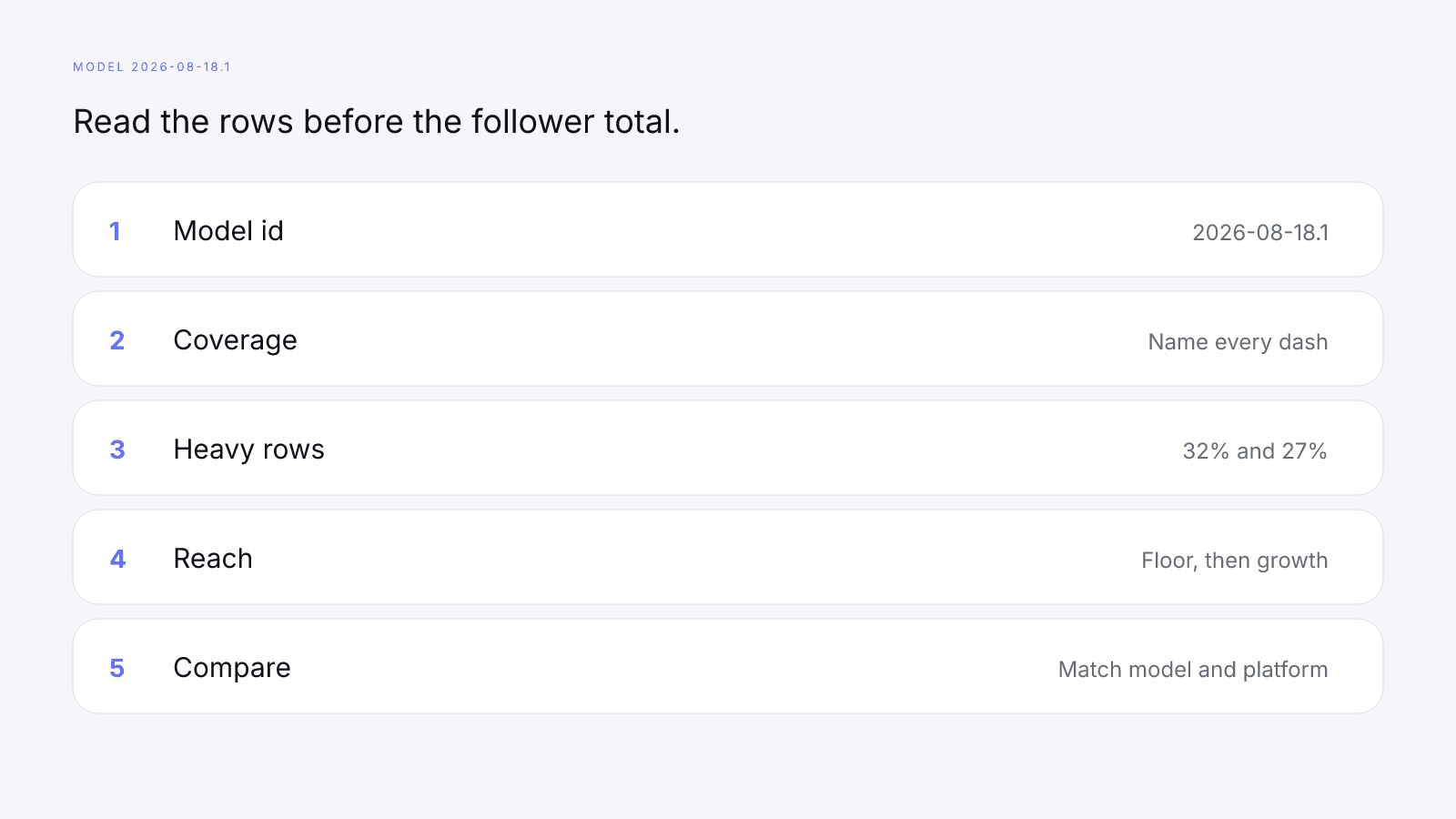
- Note the model id. The weights here belong to model 2026-08-18.1, and a different stamp means a different formula.
- Note scoring coverage and name every dash.
- Read audience quality and engagement before the follower total.
- Read reach as a log, with the floor from 1 to 1,000 followers and the 70/30 blend when there's a 12-month growth figure.
- If you're choosing between two creators, match the model id and the platform first.
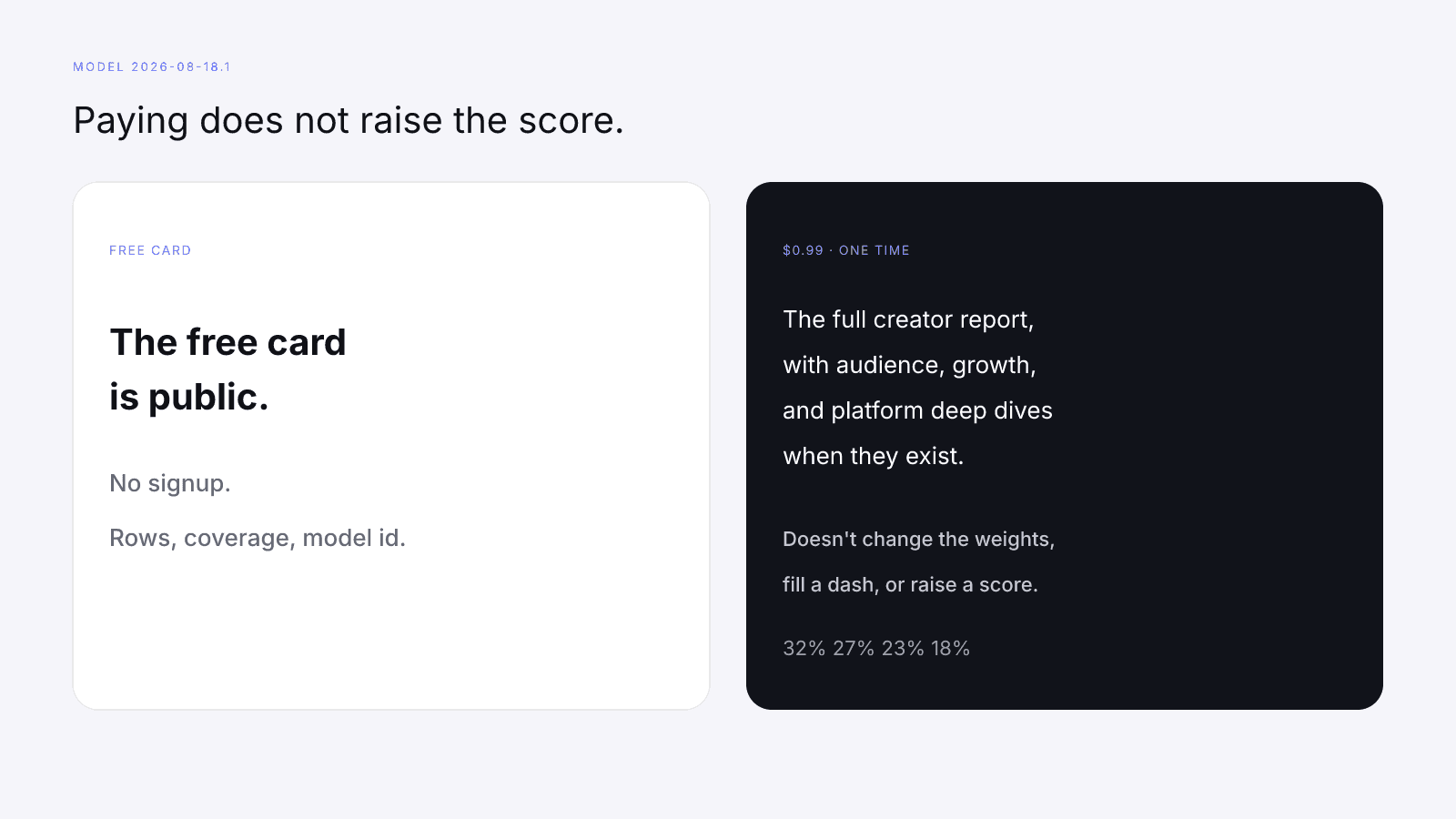
The free card is public. There's no signup, so you can search from infscore.com and read the rows on the profile you open, including a reach floor of 0 and any dash.
If you want more than the card, the $0.99 purchase is the full creator report, with audience, growth, and platform deep dives when they exist. It's one-time, not a subscription. Note that the $0.99 report runs a fresh read, so it may show audience data the public card lacked, but the score and its factor rows stay as on the public card. Paying doesn't change the weights, fill a dash, or raise a score. What else the paid page adds is in Free InfScore vs the $0.99 Report: What Actually Changes.
See Pricing.
FAQ
What is a nano influencer?
It's an industry label for a small creator account, commonly described as roughly 1,000 to 10,000 followers, though other ranges get quoted for the same words. It's not an InfScore cutoff, and InfScore has no nano tier. Every account is scored with the same formula, and there's no minimum-follower gate.
Does InfScore penalise accounts with under 1,000 followers?
No. Reach is 0 for any follower count from 1 to 1,000, but that's a floor, not a penalty: the row is scored and its weight stays in the composite. The same weights apply at every size on model 2026-08-18.1: audience quality 32%, engagement strength 27%, reach and momentum 23%, and platform strength 18%. Nothing extra is taken off for being small.
Can a nano influencer have a high InfScore?
Yes, if the heavier rows are strong. On model 2026-08-18.1 audience quality is 32% and engagement strength is 27% of the weights, and neither one reads follower count. A small account with strong readings on those two rows can score well with reach on its floor, and weak readings on them pull the score down at any size.
Why does a small account show a dash instead of a score on reach?
Because the follower total across Instagram, TikTok and YouTube combined is 0 or missing. X isn't counted. With no follower total, reach and momentum has nothing to run on, so it shows a dash, and platform strength does too. A dash is missing data, not zero: the row's weight is held out and coverage drops. If the creator has followers on another of those apps, reach gets a score instead.
Why does InfScore say "not found" for some tiny accounts?
Not found means there's nothing to score on that platform. The account has 0 or missing followers and 0 or missing engagement there, or the platform is missing from the provider's data. It's not a low score. An account with followers and a real 0% engagement rate still gets a card.
Does InfScore calculate a nano influencer's engagement rate?
No. InfScore doesn't calculate the rate. It maps the provider-reported public rate onto a fixed 0-8% scale, so 4% maps to 50 and 8%+ maps to 100, the same at every size. A small account isn't graded on a different curve.
Does the $0.99 report change a small account's score?
No. The $0.99 purchase is the full creator report, with audience, growth, and platform deep dives when they exist. It's one-time, not a subscription. Paying doesn't change the weights, fill a dash, or raise a score. The score and its factor rows stay as on the public card.