Influencer Marketing Glossary: Terms Behind a Creator Scorecard
Influencer marketing glossary: the terms on a creator scorecard, like reach, momentum, coverage, and dash, plus industry terms InfScore doesn't calculate.
This versioned composite uses only available public signals. Missing factors stay unavailable and their weight is rebalanced across observed factors. It is not a percentile, price estimate, or guarantee of campaign results. Model 2026-08-18.1.
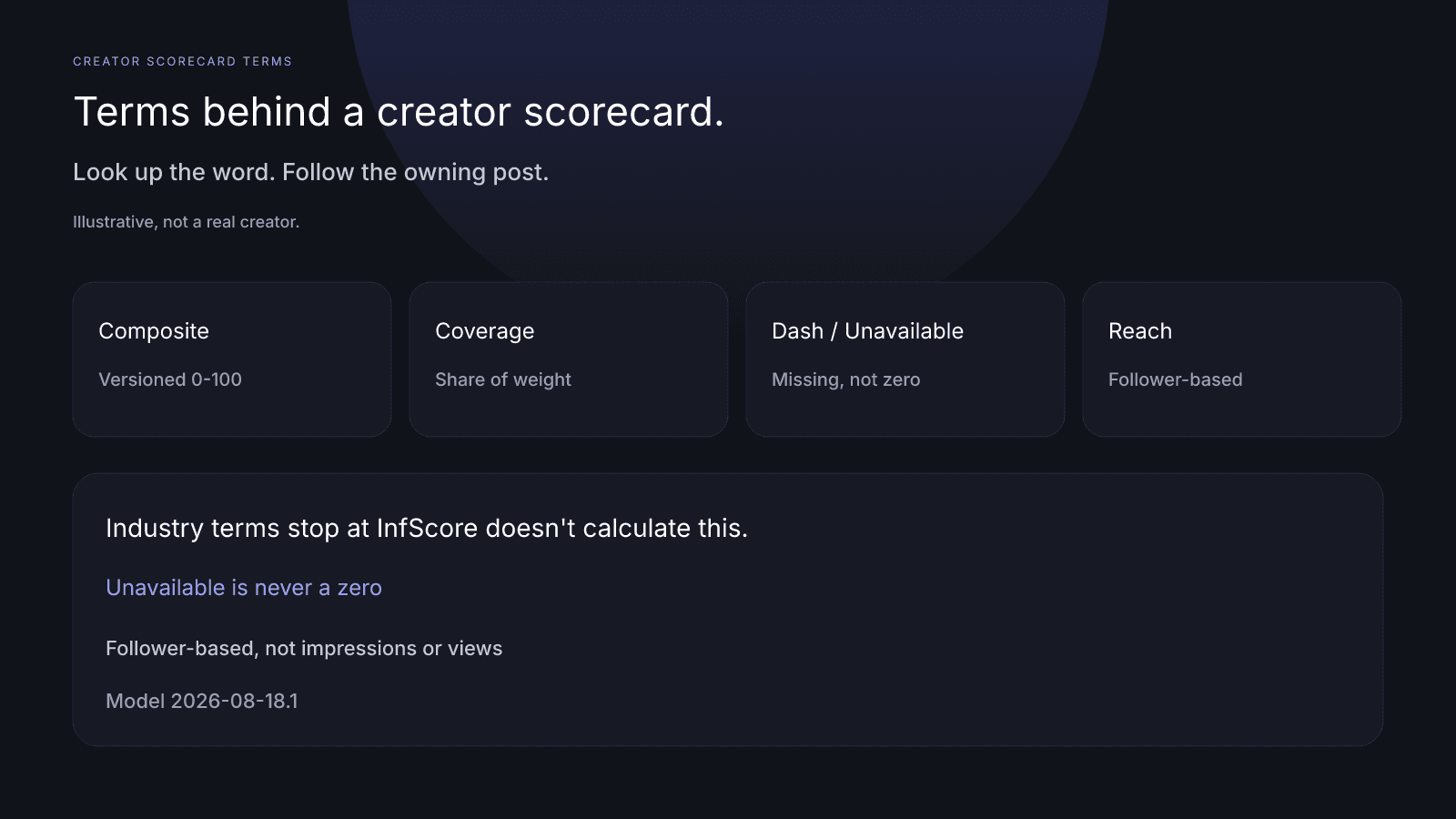
This influencer marketing glossary defines the terms on an InfScore creator card, plus a few industry terms InfScore doesn't calculate. Each entry is short and points to the post that owns the topic. Several terms mean something narrower here than elsewhere: reach is follower-based, momentum is follower growth only, and coverage is not accuracy.
How to use this glossary
Terms here are defined for model 2026-08-18.1, and the model is versioned, so a later model id is a different composite. Each heading is one of the creator scorecard terms printed on the card, or an industry word you'll meet next to the card in a brief. You can open a free public card on infscore.com without an account, and it prints the composite, the four factor rows and the model id. Where an entry has a link, that post holds the arithmetic, the exceptions and the reading order.
Scorecard terms: the score and what feeds it
These influencer metrics definitions cover the composite and the four factor rows on the card: "Audience quality", "Engagement strength", "Reach & momentum" and "Platform strength". Each row prints its label, its weight as "{n}% weight", and a 0–100 value, or a dash when that factor had no data. The composite is the 0–100 InfScore built from those rows. It is not a percentile, price estimate, or guarantee of campaign results.
InfScore (composite)
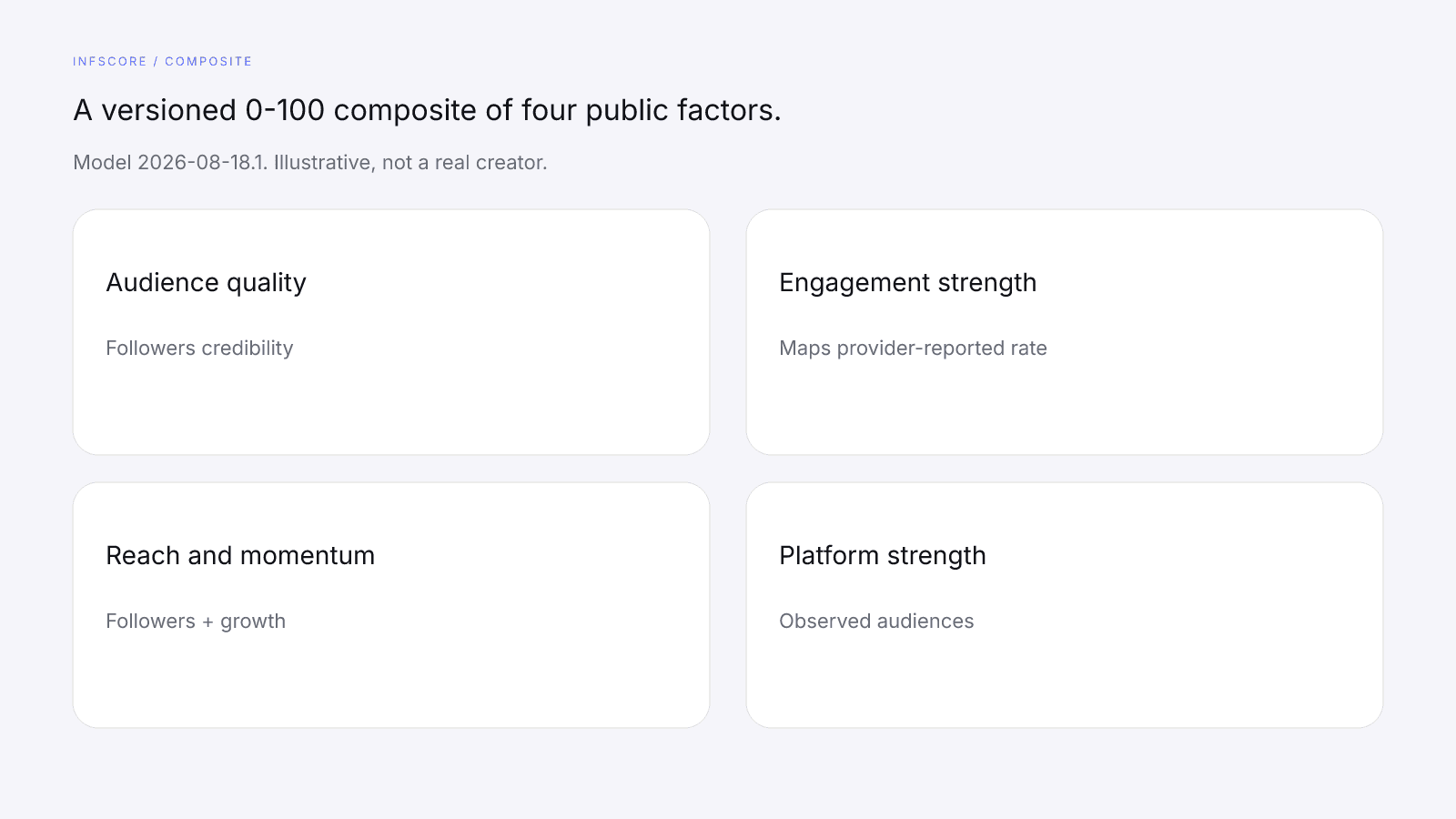
InfScore is a versioned 0–100 composite of four public factors: audience quality, engagement strength, reach and momentum, and platform strength. On the card it's the number for the profile you looked up, printed with its coverage line and model id. What Is an Influencer Score? How InfScore Builds One covers it in full.
Audience quality
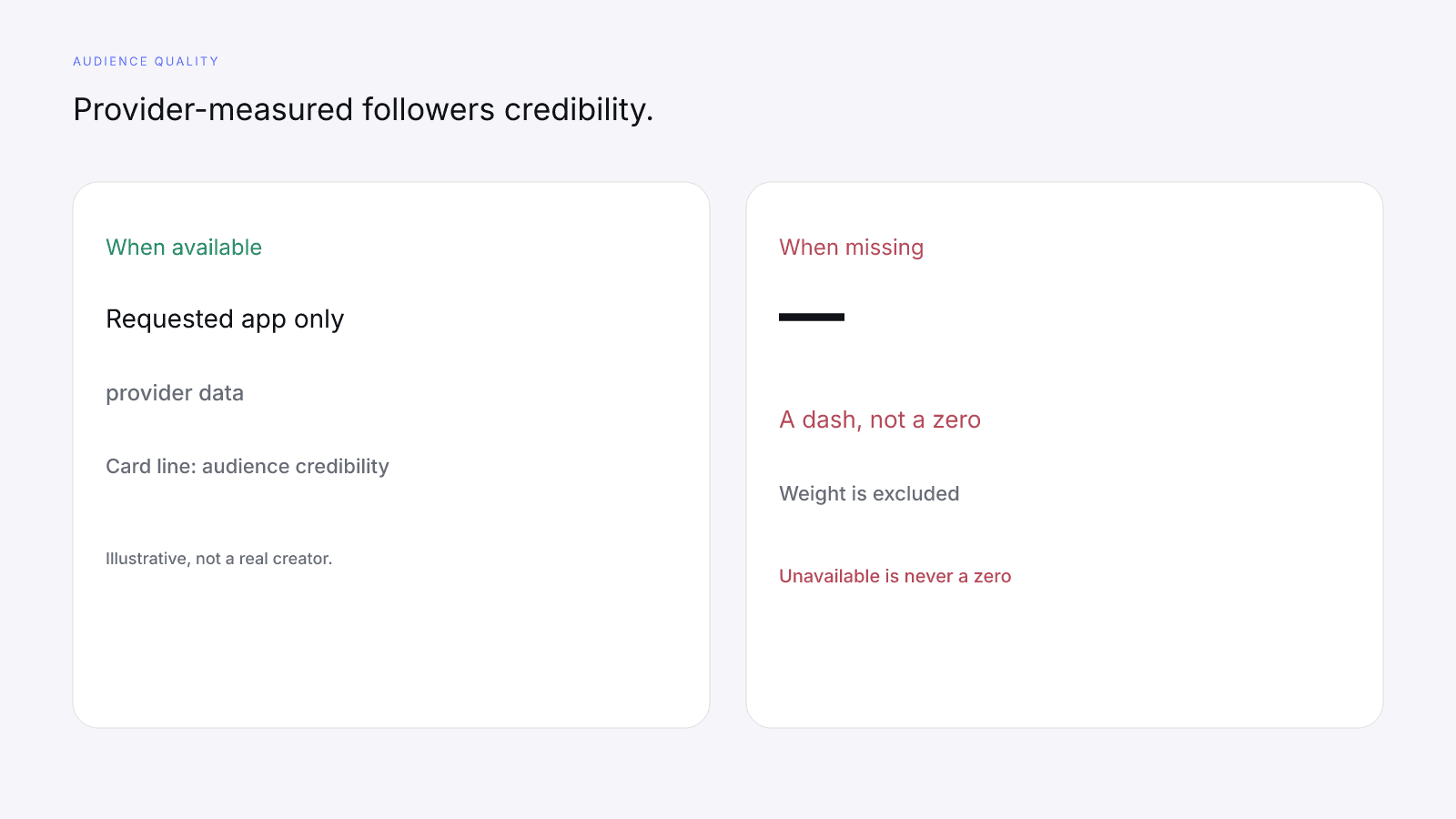
Audience quality is the provider-measured followers credibility for the requested app, when available. The card's row copy reads "Provider-measured audience credibility when available," and the row shows a dash when that figure didn't come back. Audience Quality vs Follower Count sets it against a raw follower count.
Engagement strength
Engagement strength maps the provider-reported engagement rate for the requested app onto a fixed 0–8% scale, capped at 100. InfScore doesn't calculate the rate, and 0–8% is the scale's limit, not a typical or good rate. The rate itself is printed separately on the card as provider-reported "Avg. engagement".
Reach
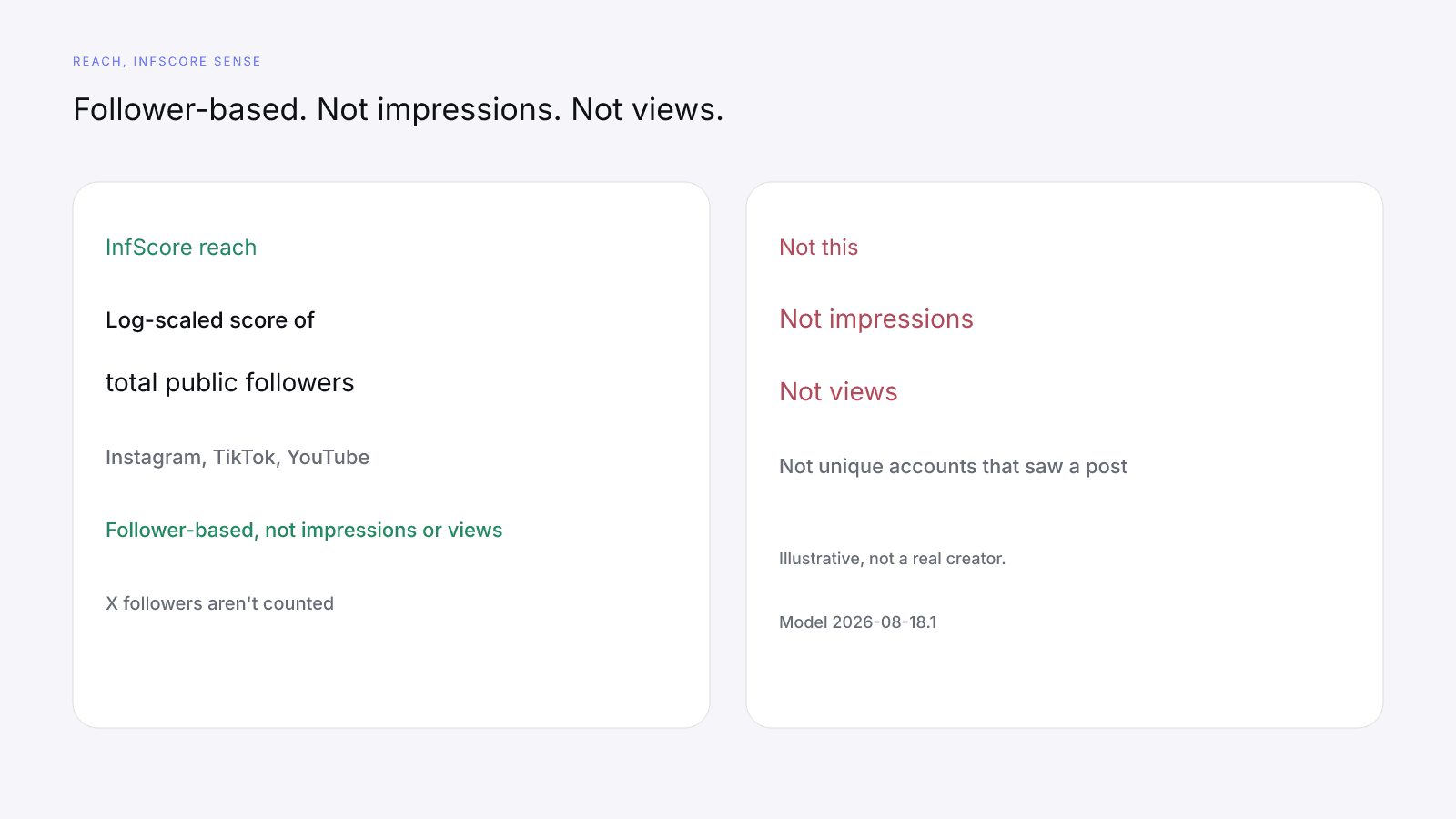
On InfScore, reach is a log-scaled score of total public followers across Instagram, TikTok and YouTube. It's follower-based: not impressions, not views, and not unique accounts that saw a post. X followers aren't counted.
Momentum
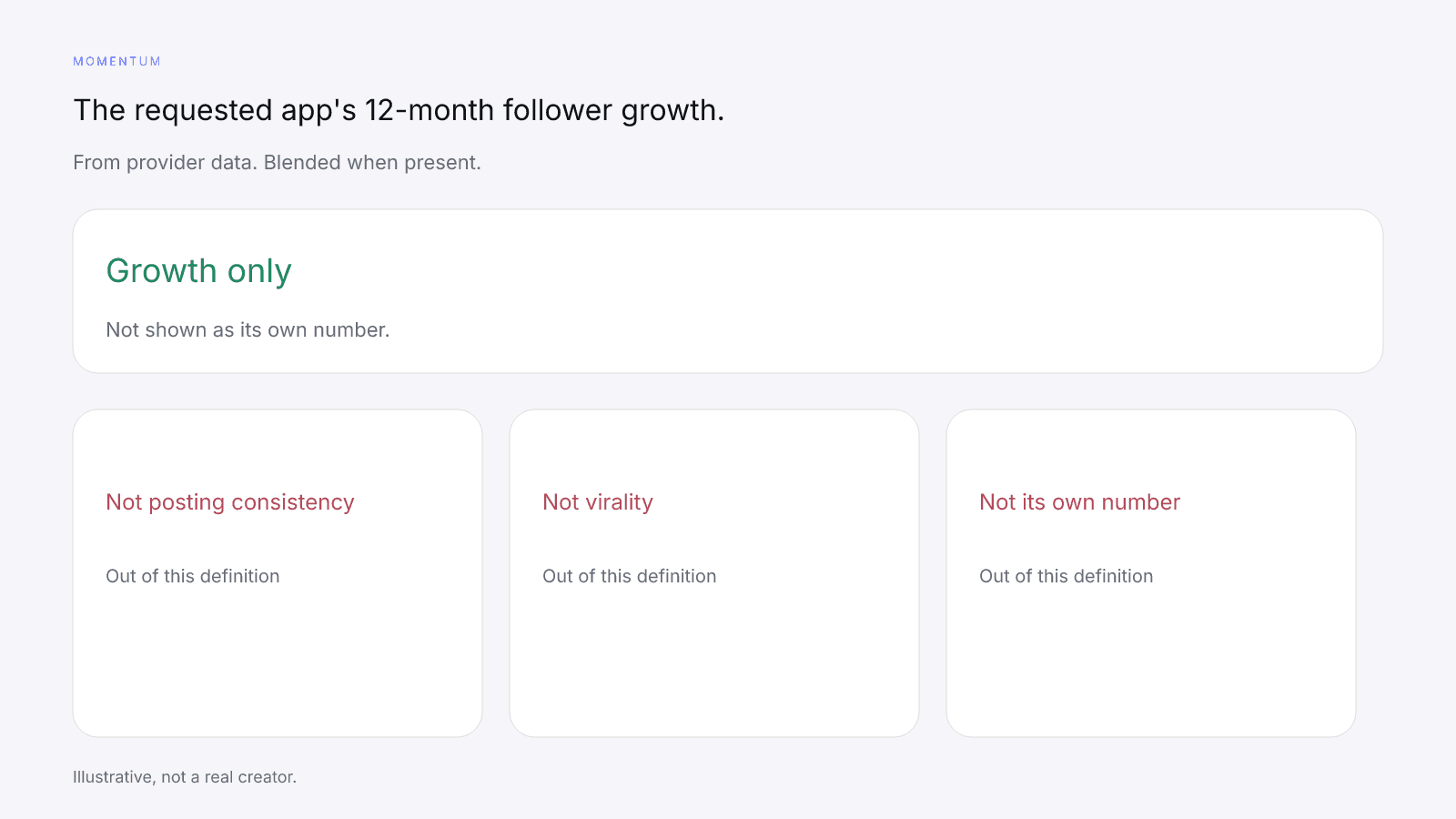
Momentum is the requested app's 12-month follower growth, from the provider's data, blended 30% into reach and momentum when present. It's growth only, not posting consistency or virality, and it isn't shown as its own number on the card. It sits inside the "Reach & momentum" row. Influencer Follower Growth: What 12-Month Growth Does to a Score covers it in full.
Platform strength
Platform strength reflects observed audiences across Instagram, TikTok and YouTube and their balance. It doesn't pick a best platform.
Scorecard terms: missing data and coverage
Missing data on the card has two printed forms, a dash on a factor row and the word Unavailable, and scoring coverage is the share of model weight that had data. Neither form is a quality grade, so don't type either one as 0 in a sheet you keep yourself. The card's own note reads: "Missing factors stay unavailable and their weight is rebalanced across observed factors—never inferred from the final score." When the lookup completes and no usable profile exists, you'll see a 404 page. It reads "This signal went quiet." It isn't a score of 0, and it says nothing about the creator.
Coverage
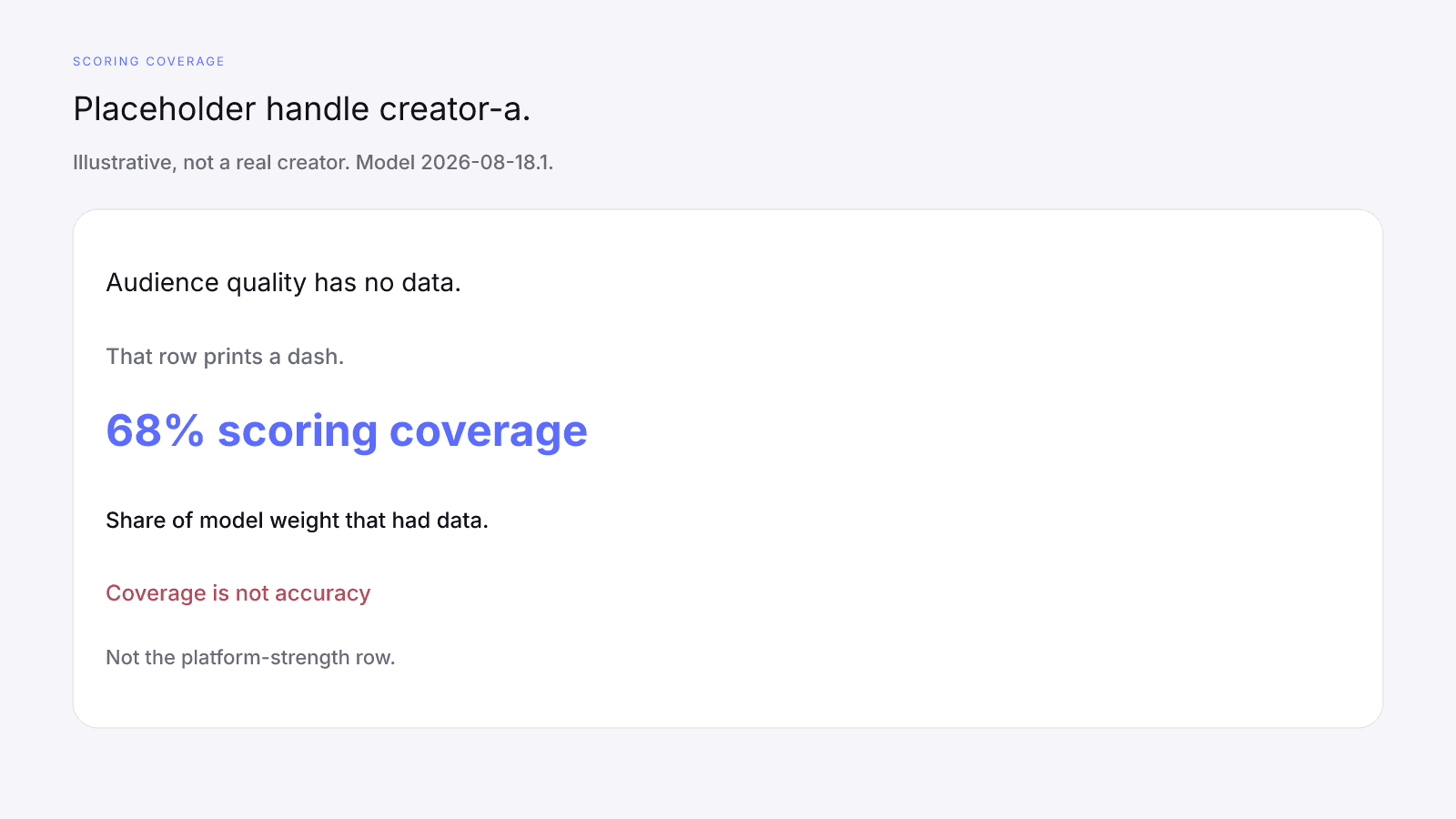
Scoring coverage is the share of model weight that had data, shown on the card as "{n}% scoring coverage". It isn't accuracy, confidence or data quality. Illustrative, not a real creator (placeholder handle creator-a): On model 2026-08-18.1 the weights are 32% audience quality, 27% engagement strength, 23% reach and momentum and 18% platform strength; if audience quality is the only dash, the observed weights add up to 68%, so the card reads "68% scoring coverage".
Dash
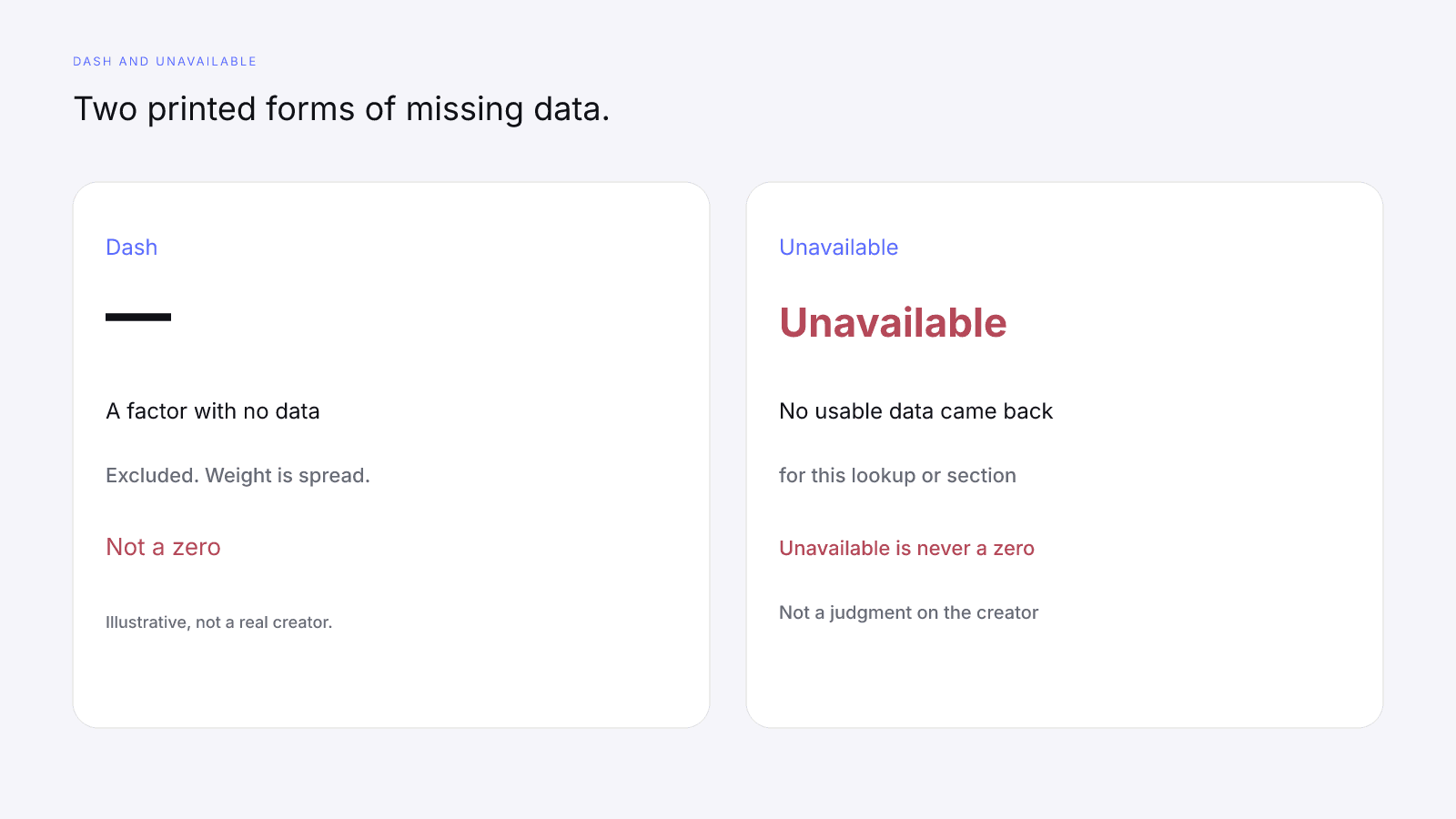
A dash (—) means a factor had no data. It's excluded, and its weight is spread over the observed factors. It isn't a zero. Missing Data on Creator Metrics: Why Dashes Beat Fake Zeros covers it in full.
Unavailable
Unavailable means no usable data came back for this lookup or section. It isn't a zero, and it isn't a judgment on the creator. When a whole card is unscored, it shows no score, just a dash, and the coverage line reads "Unavailable", with no tier and no unlock button.
Scorecard terms: what the card is based on
The lookup you ran, and the page you can open without paying, set which numbers exist on the card in front of you. Three things shape them: the model id behind the composite, the requested app the lookup used, and which provider-reported figures came back. The paid report doesn't change the composite, the coverage line or the model id on that card, and it doesn't fill a dash.
Model id
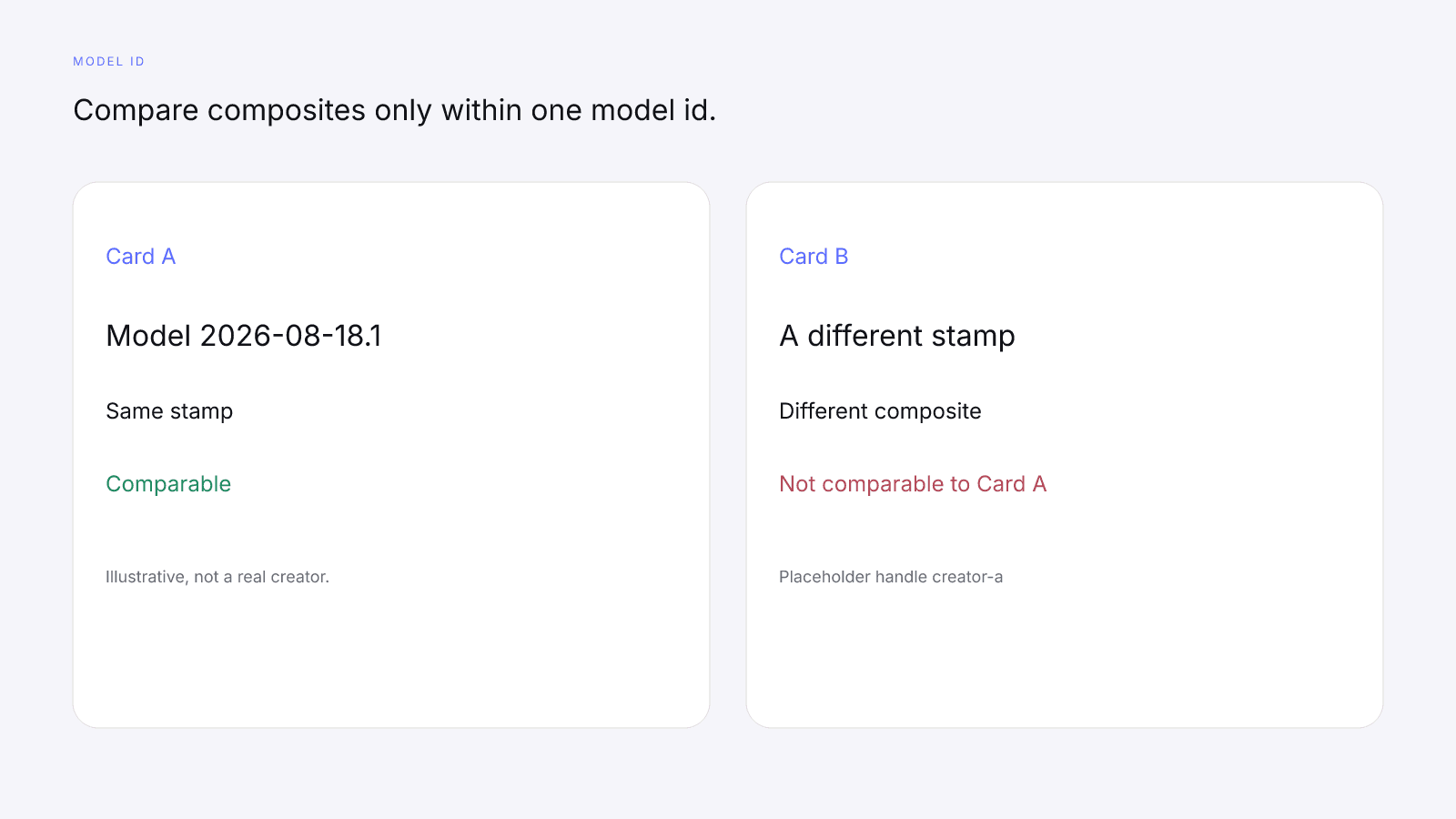
The model id is the version string on the card, e.g. Model 2026-08-18.1. Compare composites only within one model id. Comparing InfScore Across Model Versions Without Fooling Yourself explains why a new id means a new composite.
Requested app
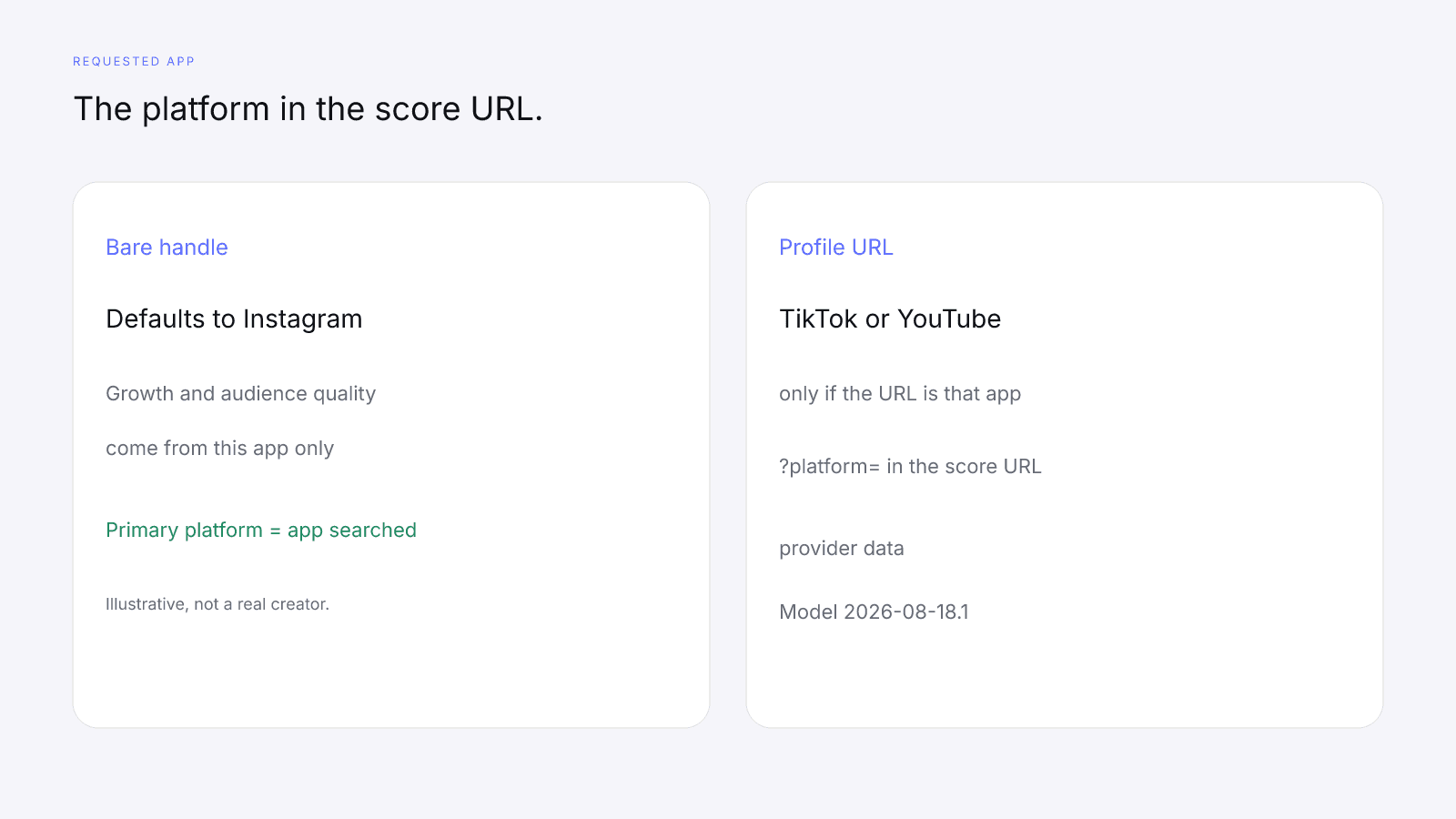
The requested app is the platform in the score URL (?platform=). A bare handle defaults to Instagram. Growth and audience quality come from this app only, and the card's Primary platform row shows this app, not the creator's biggest platform.
Provider-reported
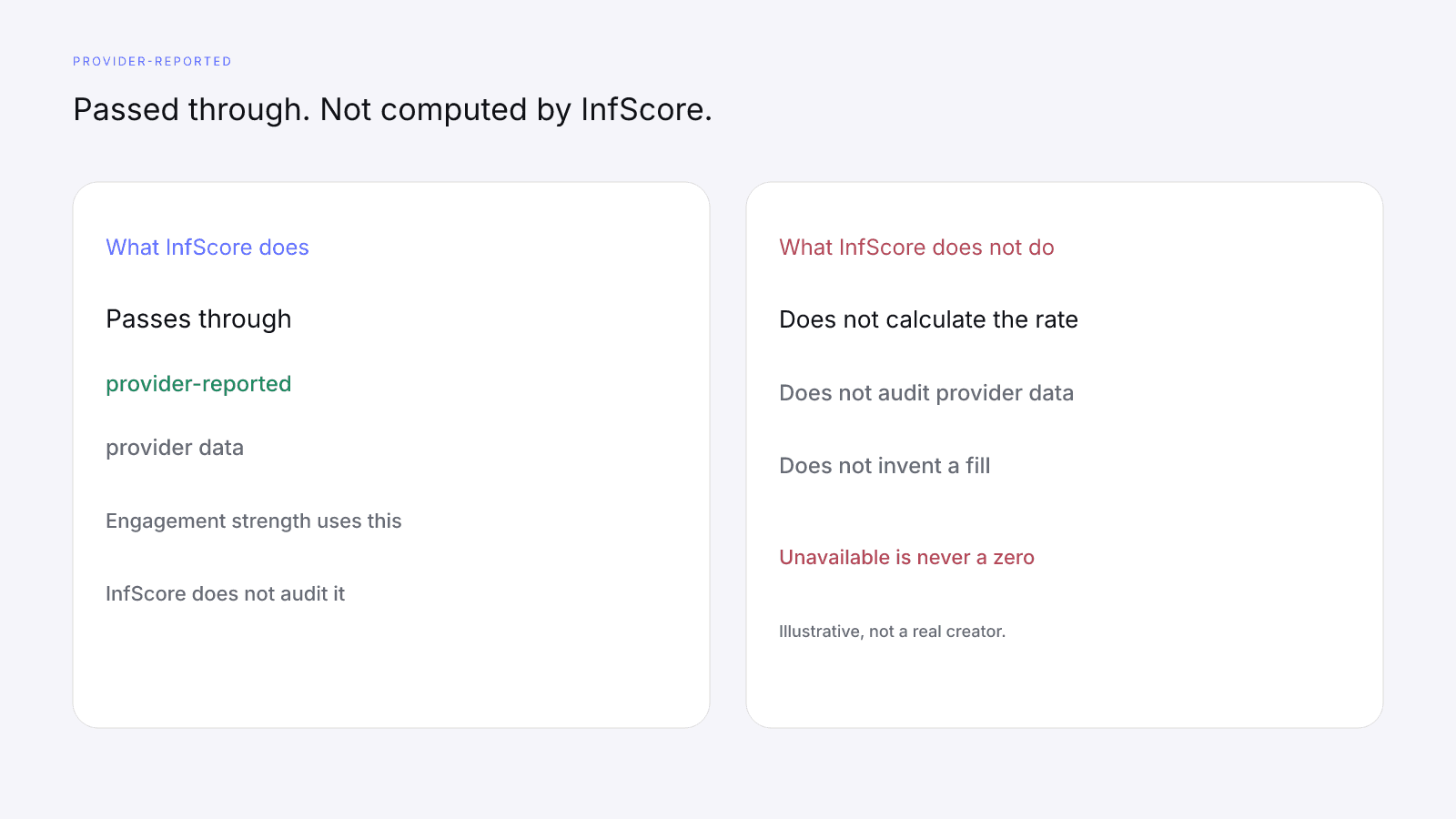
Provider-reported figures are ones InfScore passes through from its public-data provider, not computed or audited by InfScore. The provider-reported engagement rate on the card (Avg. engagement) is one of those figures, and Engagement strength is InfScore's 0–100 mapping of that rate. On the card, the coverage line ends with "Public provider data".
Public card
The free card is the public /score/{handle} page: the 0–100 InfScore, the tier, scoring coverage, the four factor rows with their weights, the model id, Total public followers, provider-reported Avg. engagement and Primary platform, with no date and no demographics. The one-time $0.99 report is the full creator report, with audience, growth, and platform deep dives when they exist; no field is guaranteed after paying, and it doesn't fill dashes or change the score. Free InfScore vs the $0.99 Report: What Actually Changes goes through the two side by side.
Total public followers
Total public followers is the follower count summed across Instagram, TikTok and YouTube on the card. It's a size figure, not a quality figure. InfScore reach is a log-scaled score of that total, so the two numbers differ.
Industry terms InfScore doesn't calculate
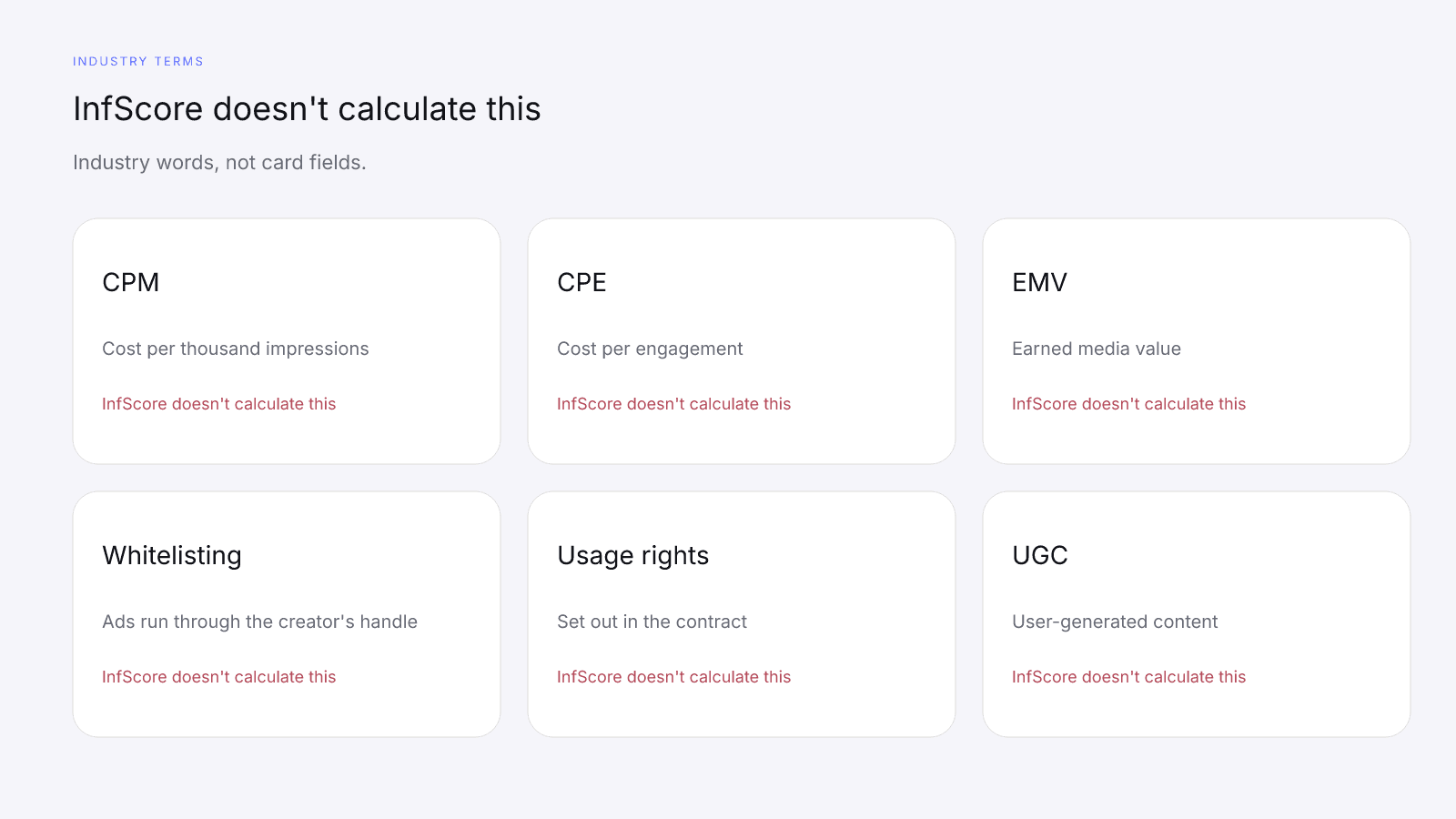
These influencer marketing terms show up in briefs, contracts and invoices, where a brand or agency works them out with its own tools. Each one gets a plain definition and the same closing line.
CPM
Cost per mille: what a campaign pays per thousand impressions. InfScore doesn't calculate this.
CPE
Cost per engagement: what a campaign pays per interaction, such as a like, comment or share. InfScore doesn't calculate this.
EMV (earned media value)
An estimate some tools assign to earned coverage. Methods differ from tool to tool. InfScore doesn't calculate this.
ROI
Return on investment: the return a brand measures against what it spent, using its own goals. InfScore doesn't calculate this.
Usage rights
What the brand may do with the creator's content, and for how long, as set out in the contract. InfScore doesn't calculate this.
Whitelisting
An arrangement where the creator lets the brand run ads through the creator's handle, on terms the contract defines. InfScore doesn't calculate this.
UGC
User-generated content: content made by creators or customers rather than the brand. InfScore doesn't calculate this. For the buying decision, UGC vs influencer marketing separates a license for clips you run yourself from a creator who posts to their own audience.
Terms that sound alike but aren't
Three pairs of words mean one thing on the InfScore card and something else in a media plan or a brief.
| Term | On the InfScore card | Elsewhere |
|---|---|---|
| Reach | A follower-based, log-scaled score of total public followers across Instagram, TikTok and YouTube. X followers aren't counted | Impressions, views, or unique accounts that saw a post |
| Momentum | The requested app's 12-month follower growth, from provider data, blended when present. Not shown as its own number | Posting consistency or virality |
| Scoring coverage | The share of model weight that had data, shown as "{n}% scoring coverage". Not the "platform coverage" wording on the Platform strength row | Accuracy |
FAQ and next steps
Look up a creator's free InfScore at infscore.com. The public card needs no sign-up and prints no date, so write the date you viewed it in your own notes, next to the number, the coverage line and the model id. With the model id beside the number in a brief, the composite stays tied to the version that produced it.
See what the $0.99 report includes on Pricing. It's an optional one-time purchase, it doesn't fill a dash or change the score, and the free card itself has no demographics.
What does reach mean on an InfScore card?
On InfScore, reach is a log-scaled score of total public followers across Instagram, TikTok and YouTube. It's follower-based: not impressions, not views, and not unique accounts that saw a post. X followers aren't counted.
Does momentum measure posting consistency?
No. Momentum is the requested app's 12-month follower growth, from the provider's data, blended 30% into reach and momentum when present. It's growth only, not posting consistency or virality, and it isn't shown as its own number.
What is scoring coverage?
Scoring coverage is the share of model weight that had data, shown on the card as "{n}% scoring coverage". It isn't accuracy, confidence or data quality, and it isn't the platform coverage wording on the Platform strength row.
What is the difference between a dash and Unavailable?
A dash means a factor had no data, so it's excluded and its weight is spread over the observed factors. Unavailable means no usable data came back for that lookup or section. Neither is a zero, and neither is a judgment on the creator.
Why compare InfScores only within one model id?
The model is versioned, and the model id on the card, for example Model 2026-08-18.1, names the version that produced the composite. Composites from different ids aren't comparable, so compare composites only within one model id.
Does InfScore calculate CPM, EMV or ROI?
No. Those are industry terms InfScore doesn't calculate. The engagement figure shown on the card is provider-reported, and InfScore doesn't calculate that rate either.