How Much to Pay an Influencer: The Score Is Not a Price
How much to pay an influencer is a negotiation over deliverables and rights. The public card can inform the talk and never prints a fee, rate, or CPM.
This versioned composite uses only available public signals. Missing factors stay unavailable and their weight is rebalanced across observed factors. It is not a percentile, price estimate, or guarantee of campaign results. Model 2026-08-18.1.
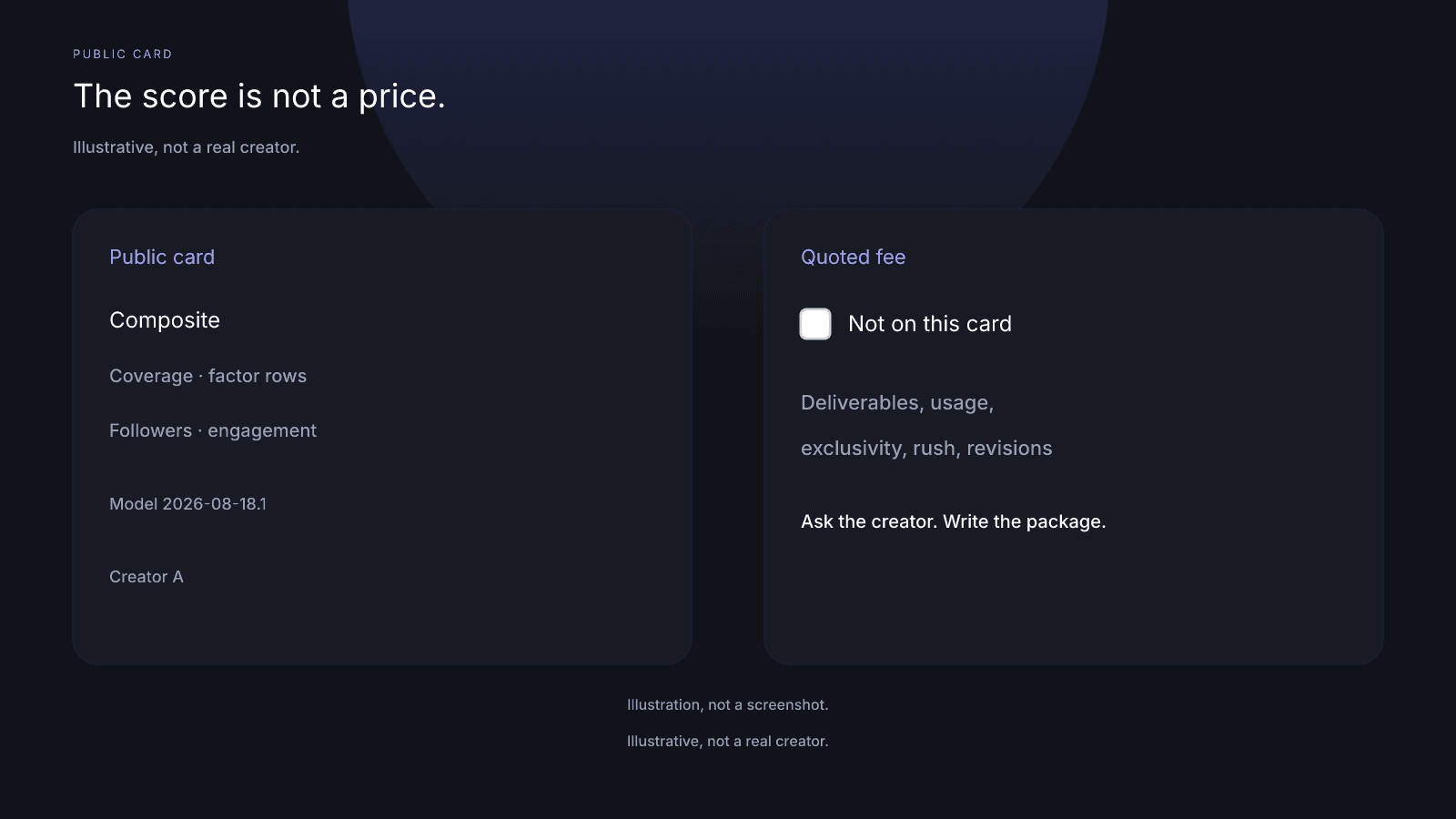
How much to pay an influencer is a quoted fee you negotiate over deliverables, usage, exclusivity, rush, revisions, and the window, not a number the public InfScore card prints. The public card can supply context: the composite, scoring coverage, Total public followers, Avg. engagement, and the model id. The public card never prints a creator fee, rate, CPM, or income estimate.
What a quoted rate usually includes
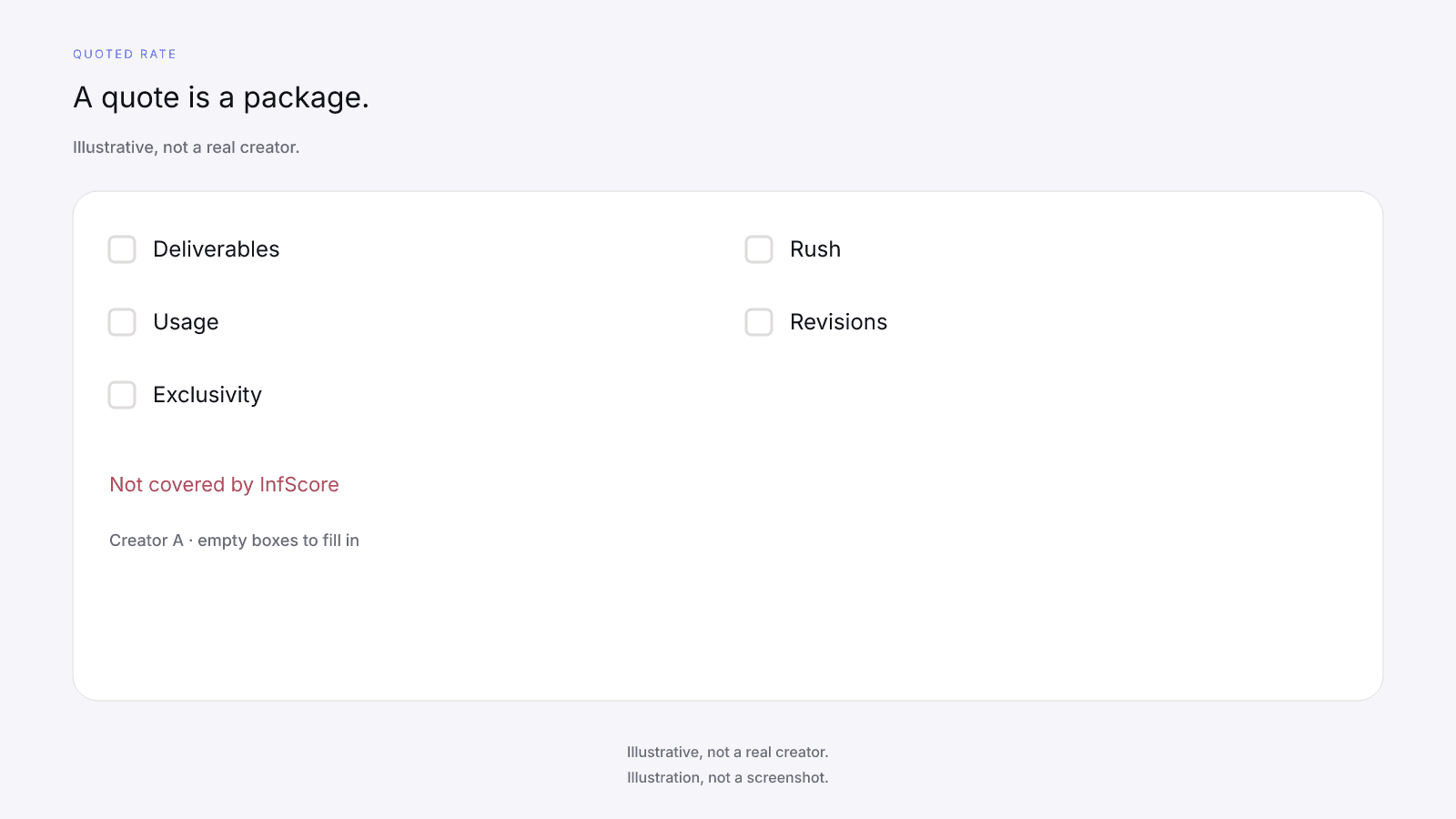
A quoted rate is a package, not a sticker on a follower total. Before you compare two numbers, write what each quote buys. A table of influencer rates can't tell you that.
Quotes usually mix some of these:
- Deliverables: how many posts, on which app, in which format.
- Usage: whether the brand can run the work as ads, for how long, and where.
- Exclusivity: whether the creator sits out a category for a window.
- Timing: a rush fee if the window is short.
- Revisions: how many rounds sit inside the quote.
None of that is a public-card field. InfScore does not set or validate a fee, write a rate card, compute CPM or EMV, draft contracts, or negotiate. Influencer Marketing Checklist: Before You Pay a Creator already puts those terms in Gate 4 and says InfScore doesn't set fees. If you're holding a quote and a score and hoping the card will name a fee, it won't.
A creator's kit can list a fee as a self-reported line. What to Put in an Influencer Media Kit in 2026 splits that line from stats a brand can check on the public card. Treat a kit fee as a starting quote, not as a number InfScore printed.
If two quotes look far apart, the packages are probably far apart. One number with paid usage and exclusivity is not the same product as one organic mention. The same handle can quote two different figures if one package adds a usage window or a rush date and the other doesn't. Write the package first, then look at the number.
What the public card prints that can inform a conversation
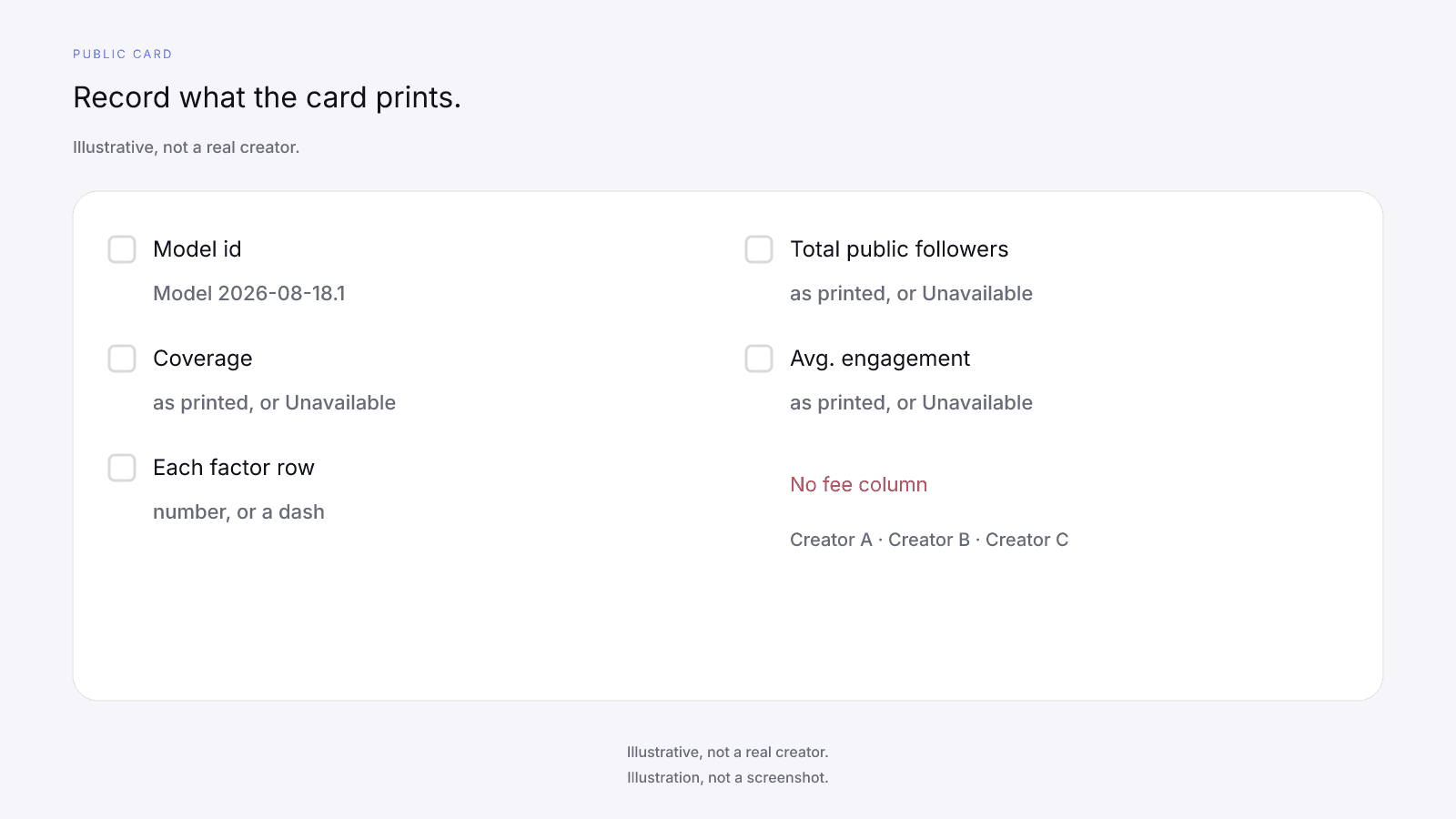
Once you have a handle and an app, record what the public card prints. Don't add a fee column the card doesn't show.
On model 2026-08-18.1 the weights are Audience quality 32%, Engagement 27%, Reach & momentum 23%, and Platform strength 18%. Scoring coverage is the share of model weight that had data. The 0 to 100 is a versioned composite of the rows that came back, renormalized over those rows. It is not a percentile, price estimate, or guarantee of campaign results. Tiers are card labels only: 90 or above Elite, 80 or above Rising, 65 or above Emerging, else Developing. Total public followers is the public follower total across Instagram, TikTok, and YouTube. Engagement rate is a public figure InfScore reads. Engagement strength is InfScore's own 0 to 100 mapping of it.
Record these from the card:
- The model id.
- Scoring coverage as printed, or Unavailable.
- Each factor row as a number, or as a dash.
- Total public followers and Avg. engagement as printed, or as Unavailable.
- Primary platform as printed.
- The composite ring, or a dash. The tier pill appears on a scored card only.
Compare this card only with others that share this model id and this app.
The free card needs no sign-up. On a scored locked card the InfScore product unlock CTA may show $0.99. That dollar is the product price, not a creator fee. The optional purchase is the full creator report, with audience, growth, and platform deep dives when they exist. It's one-time, per creator, not a subscription. Paying doesn't fill a dash. No field is guaranteed after paying. The $0.99 unlock button only appears on a scored card. Free InfScore vs the $0.99 Report: What Actually Changes sets the two views side by side.
Those fields can inform a fee conversation, but they don't close it.
What the card will never tell you about price
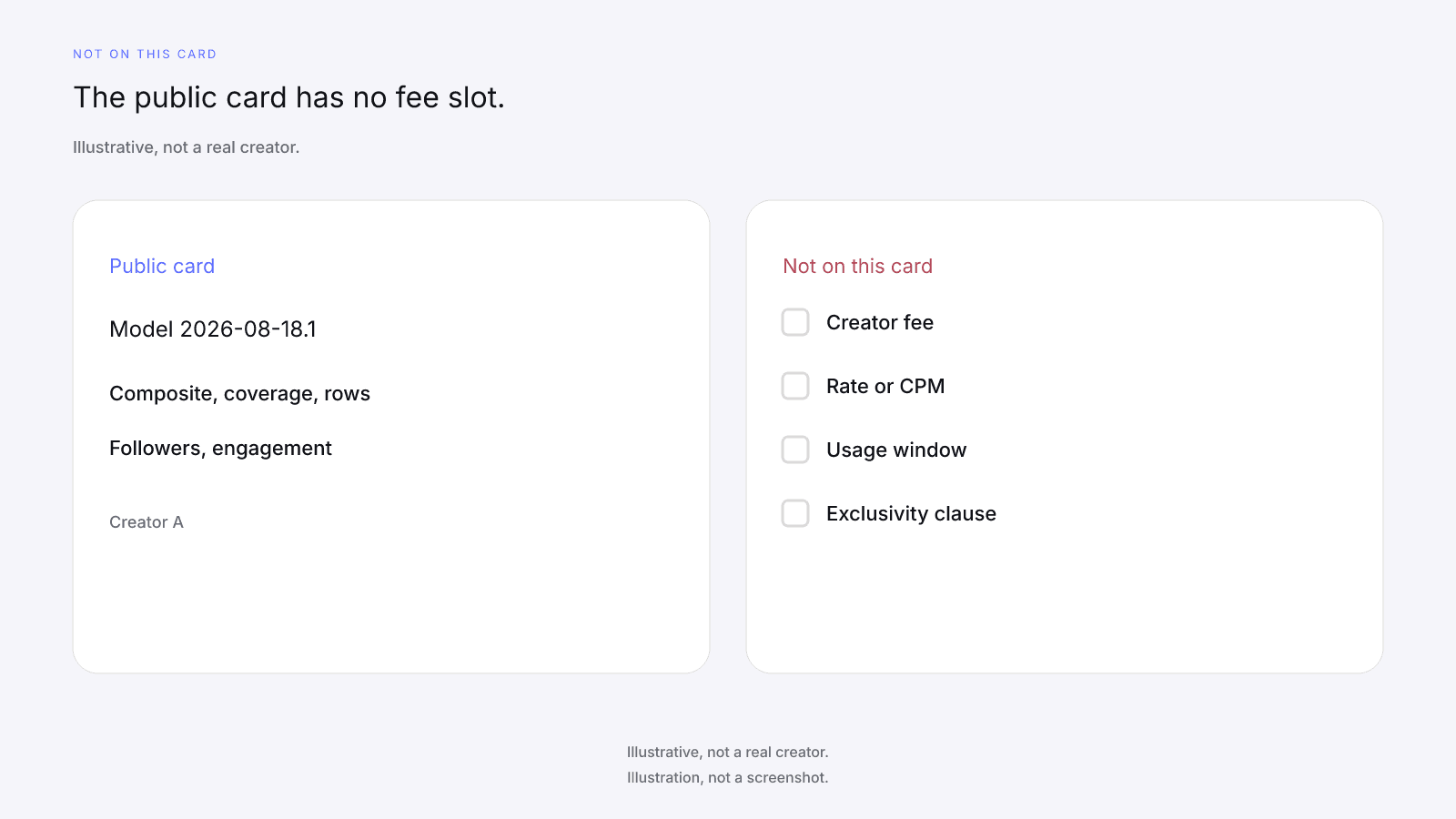
The public card never prints a creator fee, rate, CPM, or income estimate. It doesn't print a usage window, an exclusivity clause, or a revision cap, and it doesn't say what the last brand paid. Nor does it convert followers into a unit price or turn Avg. engagement into a cost per view; those formulas aren't InfScore outputs. If you need a number for the fee, ask the creator and write down what the number buys.
Contracts, negotiation, and payments between the brand and the creator are not covered by InfScore. It doesn't classify gifted vs paid work or grant whitelisting or ad-account access. Those sit with you and the creator.
A higher 0 to 100 isn't a reason to pay more, and a lower one isn't a reason to pay less. The composite is the mix of the rows that came back on this model id, not a price estimate.
Campaign return is a different question from the booking fee. Read what a score cannot tell you before a campaign for that split. Don't import a return formula into the quote.
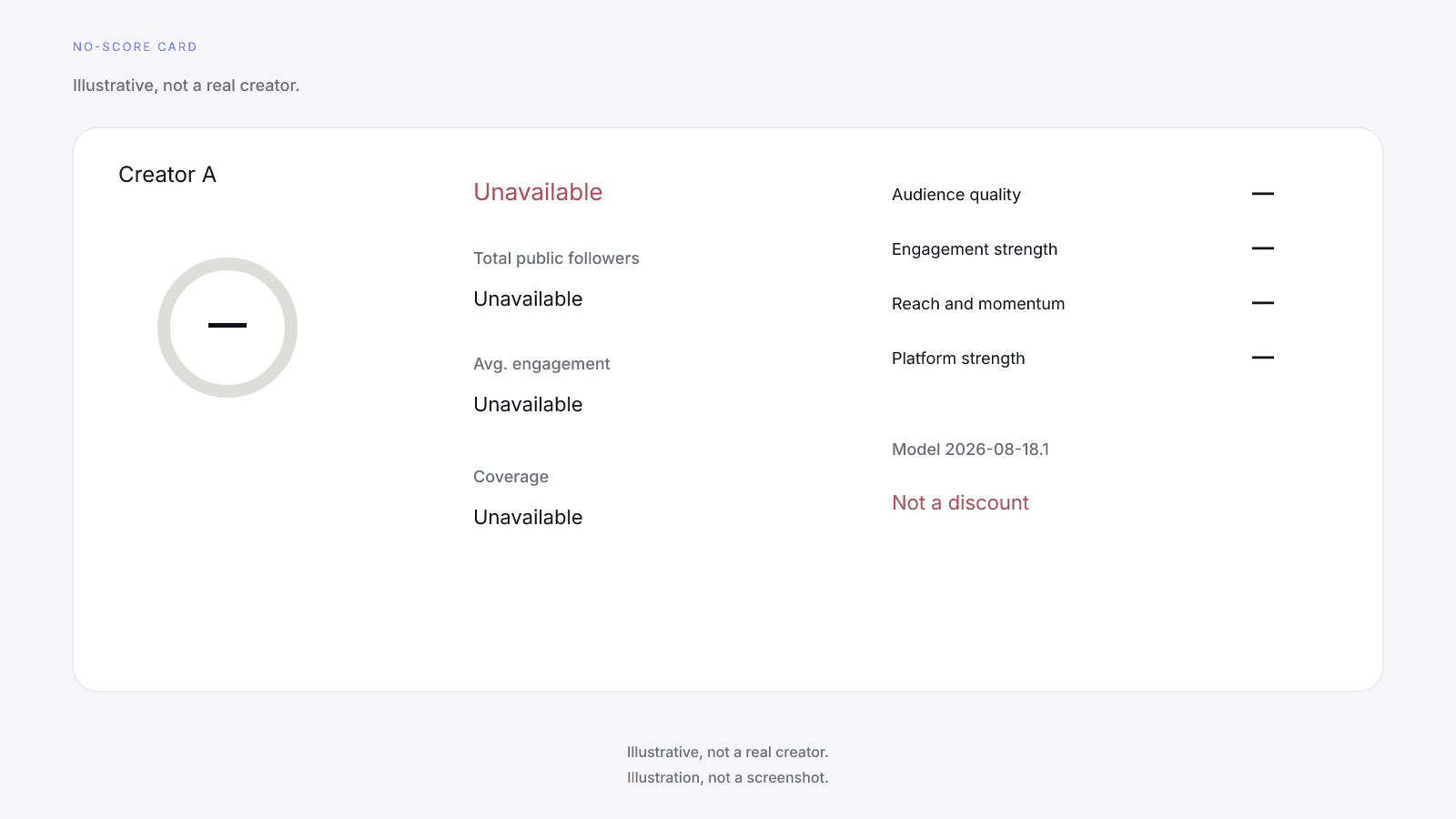
If the card has no score, stop treating it as a pricing input. On a no-score card the ring and factor rows show a dash, and Total public followers and Avg. engagement show Unavailable. The coverage slot shows Unavailable, or the card's note when one is present. There's no unlock button on that card. A dash or Unavailable is never 0, and that screen isn't a discount.
Coverage, dashes, and why a missing slot is not a discount
A missing factor, dash, or Unavailable is missing data, not a discount and not a zero. Scoring coverage is the share of model weight that had data. It isn't accuracy, and it isn't a coupon. A missing factor is missing public data, not a reason to cut the quote.
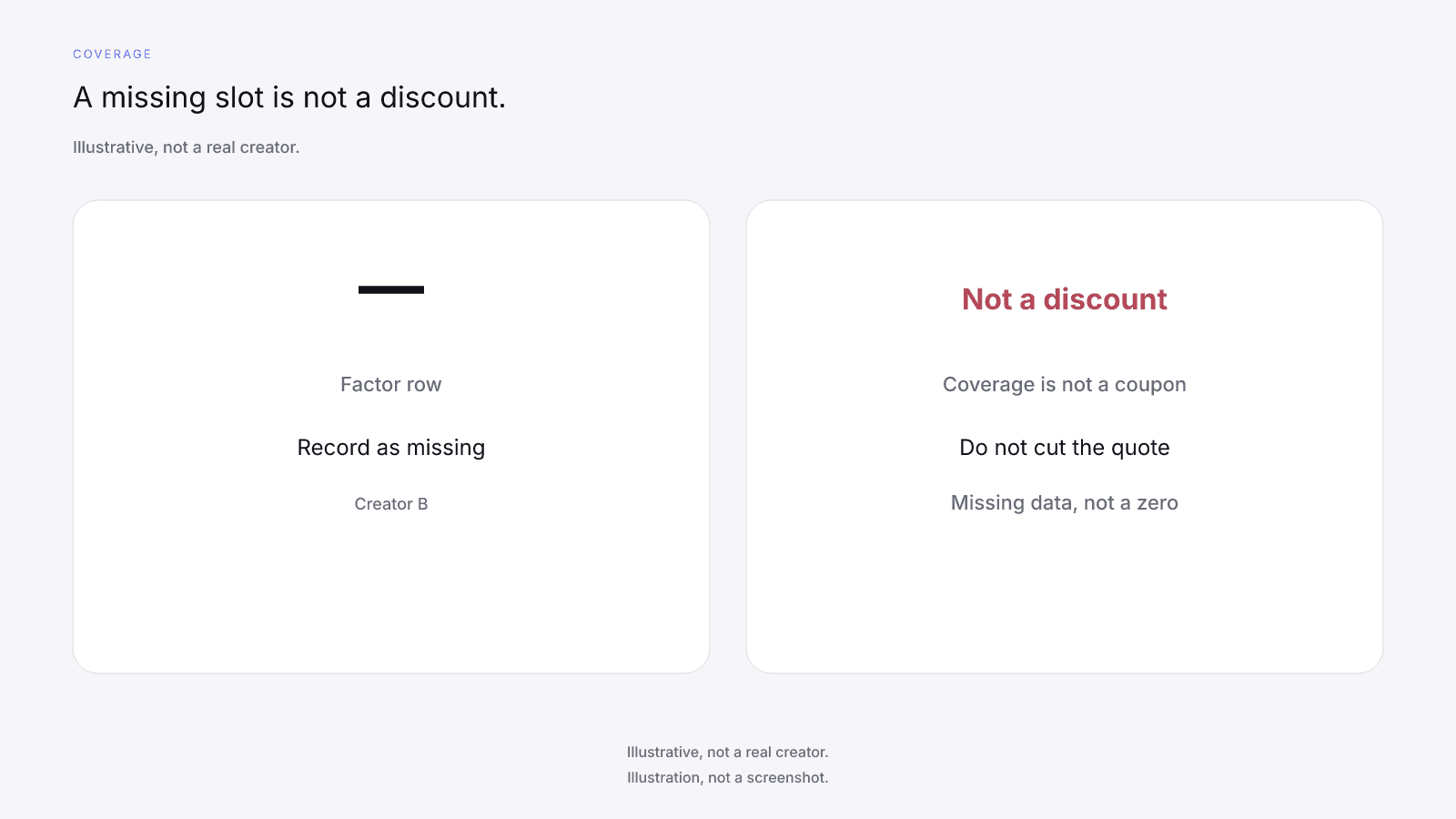
If Audience quality is a dash, that row's weight is held out. Coverage falls to 68% when the other three rows returned. The composite is then a three-factor mix, renormalized. Don't write a 0 in that row so a sheet sorts, and don't treat 68% coverage as a cut to the fee.
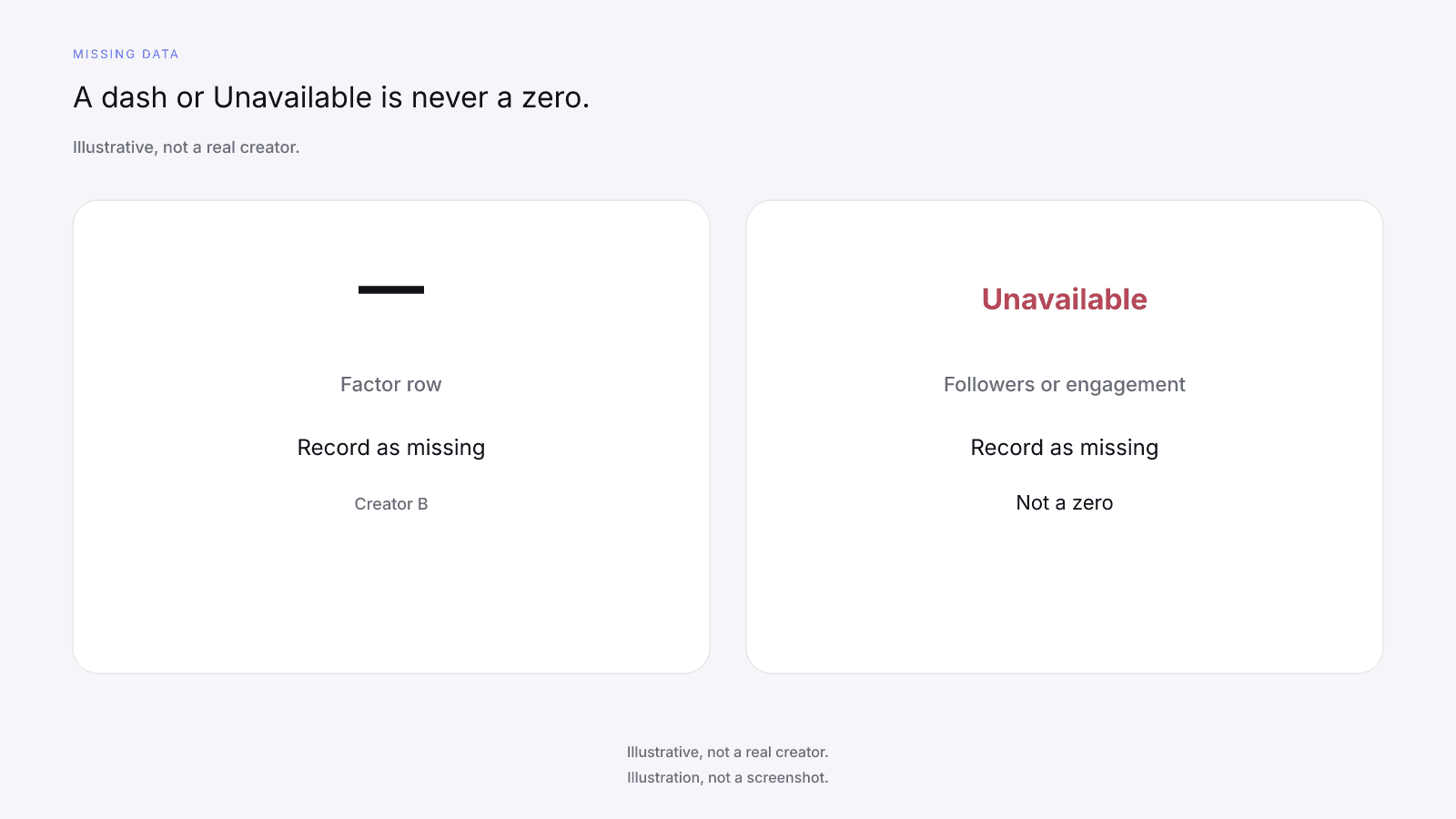
A dash or Unavailable is never 0. Name the missing row in your note. If you still want the creator, ask them for the missing public context you need, or decide the package without pretending the blank was a low score. On a no-score card there's no unlock button, and that screen isn't a reason to pay less.
How to Vet an Influencer Before You Pay Them is the order for the checks a score can't do, including what the fee includes. A blank cell doesn't set the fee either.
Deliverables, usage, and exclusivity sit outside the score
Nothing on the score describes what you're buying. InfScore has no field for usage rights, whitelisting, exclusivity, rush, or revisions. Name those as negotiation terms. To trade those terms once a quote is on the table, see how to negotiate with an influencer. For the ads part, influencer whitelisting covers what to agree before a brand runs ads through the creator's handle. Two creators with similar composites can quote different packages: one quote can bundle two Reels, paid usage, and category exclusivity, while another is a single organic mention with no reuse rights. Whether you book a single post or a run of posts changes the package too; influencer ambassador vs a sponsored post covers how the two differ and why you file a fresh card before paying again.
Write the package down next to the quote:
- What posts, on which app.
- Whether the brand may run the work as ads, and for how long.
- Whether the creator is exclusive in a category, and for how long.
- Who owns the draft, and how many revisions sit inside the quote.
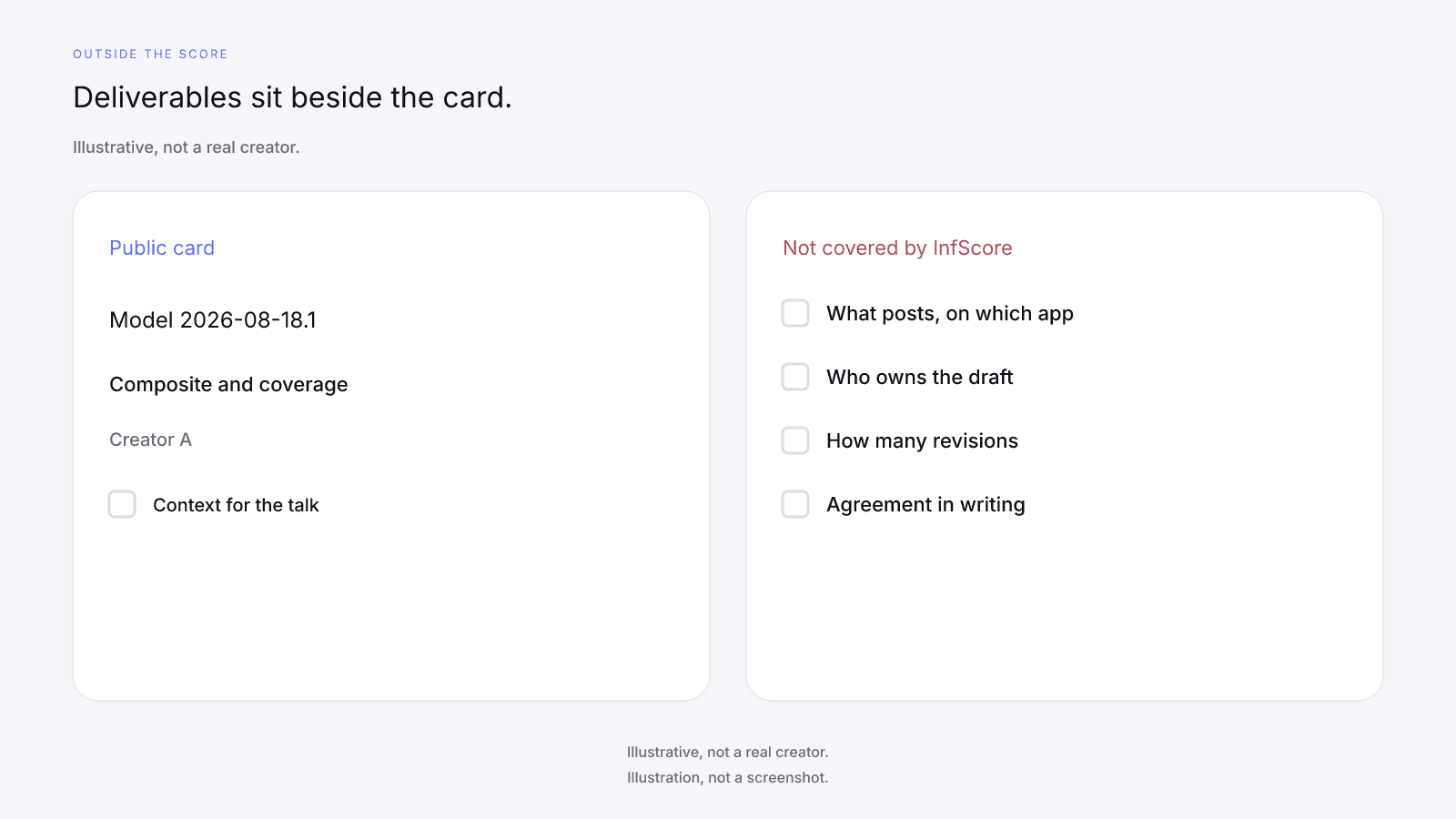
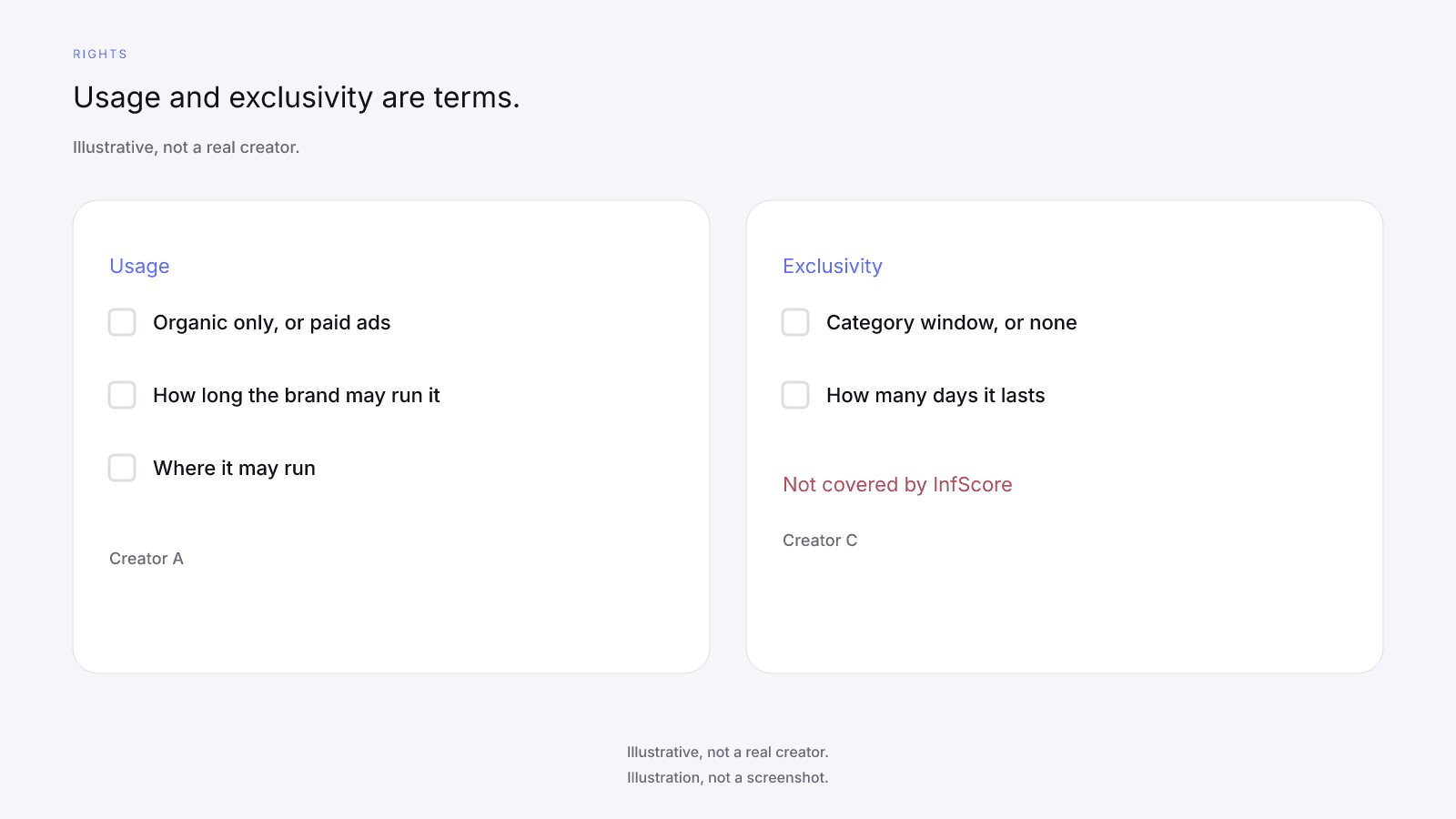
None of those lines come from InfScore. If they're still a chat promise, you don't have a rate yet, only a maybe. Put the package in writing before money moves. The public card can sit in the same note as context, but it can't stand in for the terms.
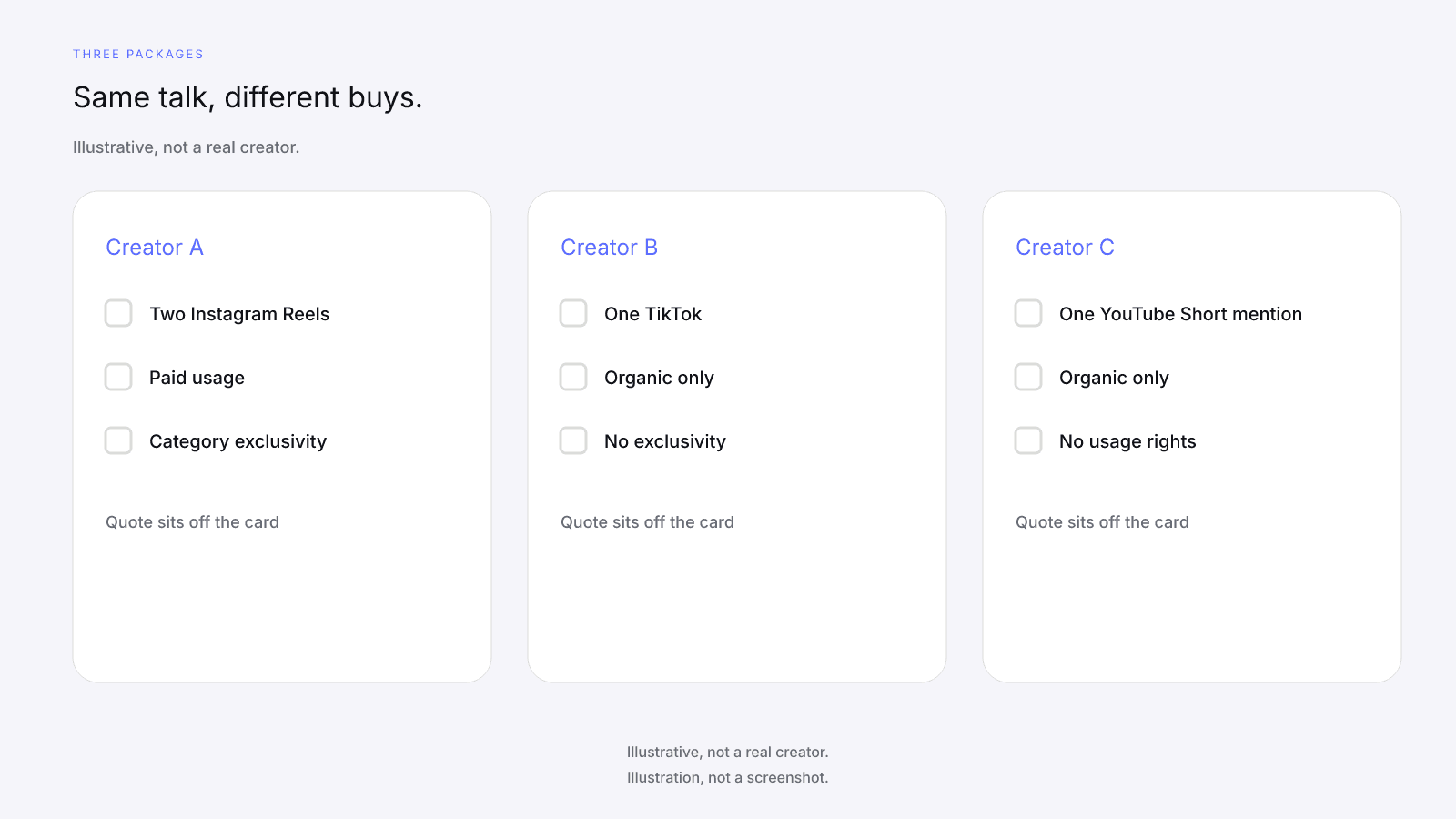
Three quotes on the table (Creator A/B/C)
Illustrative, not a real creator. Three public cards on model 2026-08-18.1, all on the same app, plus the quote the brand received for each package. Every dollar line below is a quote the brand received, not an InfScore output, and a fictional example, not a typical market rate. The numbers are chosen so follower totals and composites don't sort the same way as the quotes.
Creator A's public card: 67 Emerging, 250k Total public followers, 4.2% Avg. engagement, 100% coverage. Factor rows 84, 53, 55, and 74. Quote the brand received: $4,200 for 2 Instagram Reels, 60-day paid usage/whitelisting, and 45-day category exclusivity. That $4,200 is not an InfScore output. It is a fictional example, not a typical market rate.
Creator B's public card: 77 Emerging, 1.2M Total public followers, 6.0% Avg. engagement, 68% coverage. Audience quality is a dash; Engagement 75, Reach & momentum 62, Platform strength 98. Quote the brand received: $1,850 for 1 TikTok, organic only, no paid amplification, no exclusivity, 14-day window. That $1,850 is not an InfScore output. It is a fictional example, not a typical market rate. Creator B's 77 is not a four-factor composite.
Creator C's public card: 81 Rising, 20M Total public followers, 7.2% Avg. engagement, 100% coverage. Factor rows 92, 90, 84, and 45. Quote the brand received: $950 for 1 YouTube Short mention, organic only, no usage rights, no exclusivity, 7-day window. That $950 is not an InfScore output. It is a fictional example, not a typical market rate.
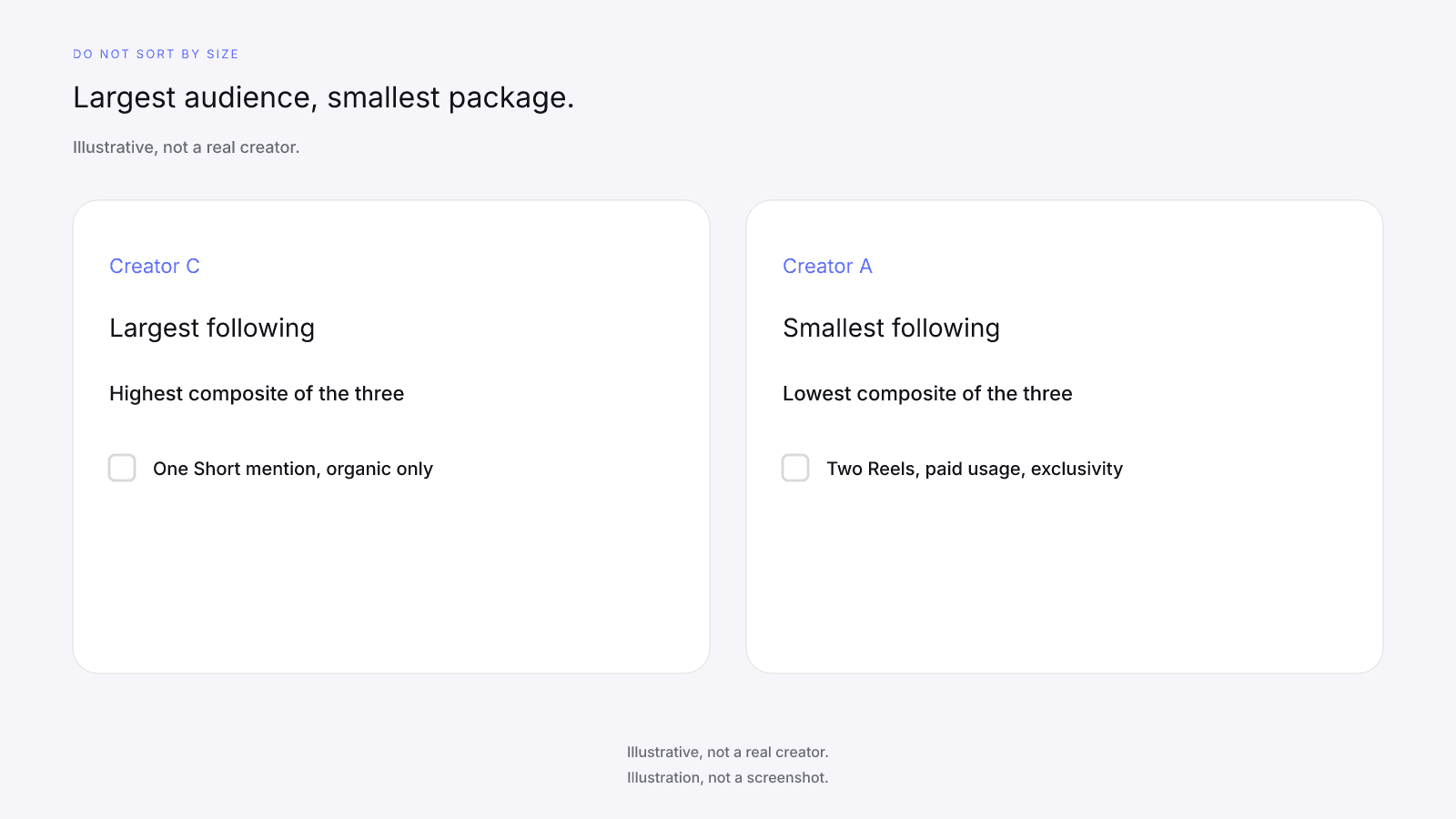
Creator C has the largest following and the highest composite of the three, and the lowest quote, because the package is a short organic mention. Creator A has the smallest following and the lowest composite, and the highest quote, because the package buys two Reels plus paid usage plus exclusivity. Creator B sits in the middle on followers and on the composite, with a missing audience-quality row, and the quote is for one organic TikTok. Sorting by followers, or by the 0 to 100, would reverse the quotes, which is the point of the example. Don't read a fee off the card, and don't treat Creator B's dash as a reason the quote should have been lower.
FAQ and next steps
Look up a creator's free InfScore at infscore.com, then read the public card before you treat a quote as a deal.
See what the $0.99 report includes on Pricing. You buy it per creator, from that creator's scored card. It doesn't set a fee.
How much should I pay an influencer?
It depends on the package: deliverables, usage, exclusivity, rush, revisions, and the window. How much to pay an influencer is the quote you negotiate for that package, not a number on the public card. The public InfScore card can supply context (composite, coverage, followers, engagement, model id). The public card never prints a creator fee, rate, CPM, or income estimate. Write what the quote buys before you compare two figures.
Does InfScore tell me what a creator charges?
No. InfScore does not set or validate a fee, write a rate card, or negotiate. The public card never prints a creator fee, rate, CPM, or income estimate. What it prints is public-card context: the composite, scoring coverage, the four factor rows, Total public followers, Avg. engagement, Primary platform, and the model id when a score exists. A quote still comes from the creator, with the package written down.
Why would a smaller creator quote more than a larger one?
Because the quote is for a package, not for a follower total or a composite. Creator A is the smallest audience and the lowest composite of the three, and the highest quote, because the package buys two Reels plus paid usage plus exclusivity. Creator C is the largest audience and the highest composite, and the lowest quote, because the package is a short organic mention with no usage rights. Rights and deliverables drove those figures, not size.
Does a missing factor or a dash mean I should pay less?
No. A missing factor, dash, or Unavailable is missing data, not a discount and not a zero. Do not write a 0 so a column sorts, and do not cut the quote because a slot is blank. Name the missing row in your note. Scoring coverage tells you how much of the model had data. It isn't a coupon. Creator B's dash is not a reason the quote should have been lower.
What does a quoted rate usually include?
A quoted rate is a package. It usually mixes deliverables (how many posts, on which app, in which format), usage (whether the brand can run the work as ads, for how long, and where), exclusivity (whether the creator sits out a category for a window), rush, revisions, and the window. None of those lines is a public-card field. If two quotes look far apart, write the packages down before you compare the numbers. InfScore does not draft those terms.
Do I need the $0.99 report to decide what to pay?
No. The $0.99 report is optional. It is one-time, per creator, not a subscription. No field is guaranteed after paying. The report still does not set a fee, print a creator rate, or replace a written package. The free public card is enough context for a fee talk. You buy the report per creator from that creator's scored card if you want it.
Can I use two public cards to compare two quotes?
You can compare two public cards when they share the same model id and the same app. A different app is a different lookup. You are still comparing packages, not letting the composite pick the fee. Record coverage and dashes as missing, never as 0. The 0 to 100 does not choose the quote. Write what each quote buys, then look at the numbers.